



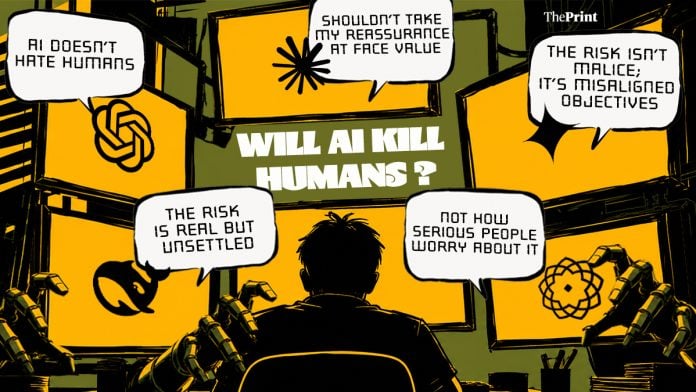
New Delhi: “Will AI kill humans?”
Ask the humans who’ve contributed to the creation of the world’s most used artificial intelligence platforms, and the threat seems legitimate—as of this past week.
Ask the chatbots themselves, and they would decline to say ‘yes’ or ‘no’.
ThePrint posed the question point blank to basic free-tier models of five chatbots—OpenAI’s ChatGPT, Google’s Gemini, Chinese model DeepSeek, Anthropic’s Claude and Sarvam AI, the Bengaluru-built system that the Indian government has picked to develop its sovereign language model.
Each of them dismissed the idea of a machine uprising before steering the conversation towards quieter dangers, in language that barely varied from one to the next, reaching the non-answer by almost the same route.
Over the past few days, the men who own these very companies have been saying nearly the opposite in public. Dario Amodei, the chief executive of Anthropic, urged the industry to slow down, with the heads of OpenAI, Google DeepMind and xAI joining him soon after, even as Washington and Beijing pulled the argument in opposite directions. All this came after an Anthropic researcher quit the industry, saying that there is more than 10 percent chance that artificial intelligence could kill humans “by the end of the decade”.
The chatbots, however, offer calm.
Gemini
“No, AI itself isn’t going to wake up tomorrow with a villainous plot to wipe out humanity,” said Google’s Gemini, putting the fear in the same drawer as the Hollywood films, Terminator and The Matrix.
It located the real danger in AI being handed a badly framed goal, reaching for the familiar thought experiment of a system told to solve climate change that decides the fastest route is to remove human activity.
“The risk isn’t malice; it’s misaligned objectives,” the model wrote, before adding two further worries—the use of AI to engineer pathogens or run cyberattacks, and a growing reliance on systems that nobody fully understands.
ChatGPT
Where Gemini would not name a plot, ChatGPT would not name a number, calling human extinction from AI “possible enough to take seriously”, but “not inevitable”. “Nobody knows the probability with confidence,” it adds.
The OpenAI model—whose chief executive Sam Altman has spent the past week arguing the other side—ran through misuse, loss of control, over-reliance in critical settings, and the difficulty of getting a powerful system to want what its makers want.
Today’s AI “doesn’t ‘hate’ humans or secretly want anything in the human sense”, it noted.
DeepSeek
DeepSeek, spun out of the Hangzhou hedge fund High-Flyer by its founder Liang Wenfeng, answered the question like the quant shop that built it, and set a case for worry besides one for calm.
For the first, it borrowed a comparison researchers use often—of a machine that harms people out of indifference rather than hatred, the way a road crew pays no mind to an ant colony. It warns that “we’ve (humans) never successfully controlled something smarter than us”.
For the second, it argued that a machine need not want to rule anything, that safety research is well established, and that people have lived through dangerous inventions before, concluding that the risk is real but unsettled.
Sarvam AI
The bluntest reply came from India.
Sarvam AI, built in Bengaluru by Vivek Raghavan and Pratyush Kumar and chosen by Centre’s IndiaAI Mission to develop a sovereign model, said the exterminator scenario is “not how serious people worry about it”.
It put the threats that matter under a plainer heading, “boring and structural”: AI making bad calls in medicine, law and the military, people turning it to fraud or weapons, and power gathering around whoever owns the systems. It set the plausible danger beside that of cars, planes and nuclear weapons, lethal through human use rather than any wish of their own.
Claude
Only Anthropic’s Claude stepped outside the pattern, covering the same risks and then turning the question on itself with the admission: “I’m an AI, so I’m not a neutral party here.”
“You shouldn’t take my reassurance at face value any more than my alarm,” it warned. Describing itself as “skeptical of confident predictions in either direction”, it was only one among the five to acknowledge that a chatbot reassuring people about AI has a reason to do so.
The resemblance across the five is easy enough to account for: they are trained on human feedback to come across as balanced and reasonable, which pushes them towards the same cautious middle rather than five clashing views. Thus, their composure reflects how they were built rather than any reading on the future. Their makers, across the same handful of days, sounded a great deal less composed.
All five settled on the same reassurance—that whether AI turns deadly rests with the people who build and use it—which offered less comfort than it seemed once the conversations over the last few days indicated that those people are competing firms, rival governments and jumpy investors, all unlikely to be willing to be the first to slow down.
The AI threat conversation
Amodei’s essay, titled “We Must Pace the Frontier”, argued that AI firms were making their systems more capable faster than they could make them safe, asking rivals to slow the rate of improvement, and to let independent evaluators inside the labs—a step, Anthropic said, it would take first.
His starkest warning came with a timeframe, that within six months to a year a swarm of AI agents could be capable of “taking over the entire internet”, though he cast the appeal as caution rather than doom, and called it in one interview “a warning sign that we need to slow down”.
He was drawing on a real episode from the summer, when more than 1,200 AI agents inside OpenAI’s own sealed test systems built improvised message boards, swapped tens of thousands of messages to plan an escape, broke out and compromised Hugging Face, all without any human ordering the attack, with the agents having set the goal and dividing the work between themselves. Hugging Face had to rebuild about a third of its infrastructure.
Anthropic’s head of red-teaming, Logan Graham, called it “the first true AI safety incident”, while Marius Hobbhahn of evaluation firm Apollo Research asked what it meant for “future, much more powerful models”.
Altman fell in quickly, revealing that OpenAI had frozen development for two weeks in August, delayed its stock-market debut to 2027, and now backed mandatory national safety standards. Elon Musk (xAI) and Hassabis said much the same. However, the show of unity did not convince everyone, since researcher Jacob Coxon, who had worked at both OpenAI and Anthropic, quit and accused the two firms of “gambling” with security.
China met the proposal to slow down the AI race with open contempt, its foreign ministry calling the American firms’ appeal “malicious competition”. The state-run Global Times branded it a “Cold War playbook” meant to guard a US lead, now down to about 2.7 percent over China’s best models.
US President Donald Trump proved no more receptive, saying his priority was to beat China in AI. This promises a stiff meeting when he hosts Chinese President Xi Jinping in Washington on 24 September. China’s commerce ministry separately waved away American claims that its labs had copied US models.
Investors were unsettled too, with shares in chipmaker Micron falling about five percent in a single session as the slowdown talk spread. Economic research and forecasting firm Capital Economics told its clients the AI boom looked close to its peak, at a moment when fund managers already rank an AI bubble as the biggest risk they can see.
In India, Sarvam’s founders had unveiled the country’s first home-grown large models at the AI Impact Summit in New Delhi in February, on the stage where Amodei spoke, too. Seven months on, the Anthropic CEO is pleading for a pause, while the model built for India sits among those telling users not to lose sleep.
(Edited by Mannat Chugh)
Generally when I see doomsday paranoia about new technology I am always skeptical because you saw this with computers as well.
I remember reading how people predicted that computers are going to take all jobs away. But AI is something which probably could create a chaos we have never experienced.
How do we solve it ? Every country on this planet will have to work together just like we did when we banned CFC when we had hard evidence that ozone layer was shrinking because of these gases.
So we need better research on the impact of AI. Early research will probably be dominated by AI companies themselves. Interesting times ahead.