


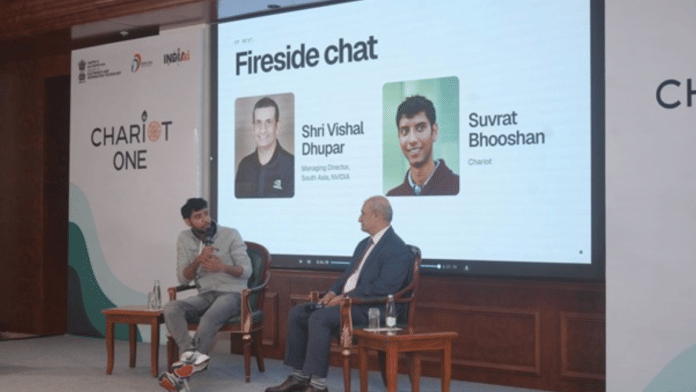
New Delhi: If India solves AI problems of language, diversity and scale at home, it can become the reference point for two-thirds of the world, Nvidia’s Managing Director for South Asia Vishal Dhupar said Wednesday.
“And when you do it in the age of intelligence, you’re called the capital of intelligence,” Dhupar said in a fireside chat with Suvrat Bhooshan, co-founder of IndiaAI Mission-backed speech lab Chariot, at the lab’s launch event.
He called for the next decade to be “fully India in the age of intelligence”.
Power, according to him, is the first constraint on how far that goes. India has about 1.6 gigawatts (GW) of data centre capacity powered up and is “inching pretty quickly towards 8 to 10 gigawatts in coming years,” he said. “Power is a determinant about how much compute you have… demand is really high.”
A government factsheet put India’s installed data centre capacity at 1.57 GW as of August 2026, up from about 375 MW in 2020, and projected it could reach 8 GW by 2030.
“Ultimately, nations compete with each other, just like how companies compete,” Dhupar said. “If you don’t have that advantage, you lose that advantage.”
He credited the government for the build-out. “It is the government of India’s policies; it is the people of India’s determination that we’re taking advantage of recent technology.”
The Nvidia leader thanked the IndiaAI Mission and described its compute programme as a public-private partnership, in which companies with infrastructure partnered with the government to give students and researchers access.
Under the Mission, approved in March 2024 with a five-year outlay of Rs 10,371.92 crore, more than 38,000 GPUs have been onboarded on a common compute portal and offered to startups and academia at subsidised rates.
Dhupar also chairs the Telangana AI Mission. At the AI Impact Summit in February, he said about 800,000 developers in India build on Nvidia’s platforms.
India’s place in technology was moving on from its IT services era, Dhupar said. Indians once served the world, and companies set up global capability centres in the country. Now people can talk to computers in their own languages. Using a computer had been limited to those who learned its language, he said, but now “even in my broken English, [the] computer understands me”.
Also Read: Token point: Sarvam’s Make in India AI push has a problem, and it’s Made in China
Power, racks, ‘factories’
“Power absolutely is the fundamental start block,” Dhupar said. Business houses had secured renewable energy and India had a national grid, he said.
Racks in the telecom era drew about 10 kilowatts, while AI racks now draw over 150 kilowatts, and the infrastructure to support them has to be built. Data centres also lose power. “Just because you have one gigawatt doesn’t mean you have one gigawatt.”
He described AI infrastructure as five layers: power, chips, the ‘AI factory’, models and applications. Data centres that once stored and retrieved data now produce tokens, the units of AI output. “If the production of a token is the output, and it brings you revenue, then you do it in a factory.”
Nvidia’s role, he said, is to share “recipes” with countries and companies so they can build their own stacks.
Dhupar recalled that Bhooshan’s first request to him was “Give me computers”.
Bhooshan responded saying computers had shaped his career. As a graduate student at Stanford in 2017-18, he worked with 64 to 128 GPUs. He then joined Facebook’s AI research team in New York, where he had access to thousands of GPUs.
The IndiaAI Mission, he said, gave Chariot’s founders the chance to build foundation models from India. He invited researchers abroad to return and said his quality of life in India was better than in the US.
Founded by Bhooshan and Parth Sarthi, Delhi-headquartered frontier AI research lab Chariot (formerly known as Gan AI) is one of the first four teams selected under the IndiaAI Mission to build foundation models. The other three teams are Sarvam AI, Soket AI, and Gnani AI.
(Edited by Tony Rai)
Also Read: No misuse of IndiaAI Mission support by Sarvam—MeitY Secretary. ‘AI labs also need revenue model’