


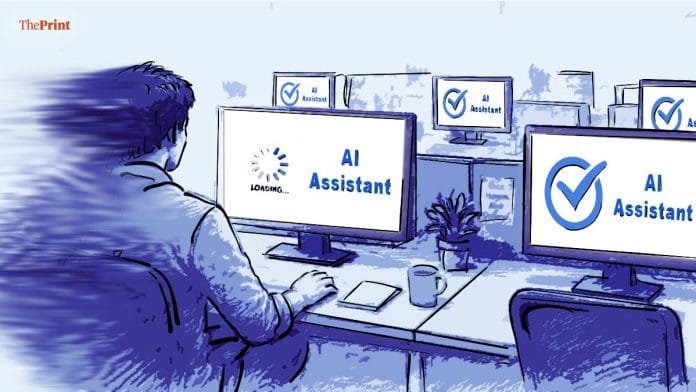
New Delhi: For years, AI companies have said humans come up with the ideas and machines do the legwork. OpenAI now says that line has started to blur.
In a report released on Wednesday, the maker of ChatGPT said its coding assistant, Codex, helped researchers come up with ideas that went into GPT-6.2 Astra, the model it launched a day earlier. One researcher said Codex spotted insights as the two worked through an idea together. Another said the idea was theirs, but it started working only after Codex suggested a change.
This did not happen with the GPT-6 Astra, released in September. There, researchers credited every idea to a person.
Also Read: Should we leave writing to AI? Even literary prize juries can’t identify good writing
Why it matters
The finding feeds into a question that worries scientists and governments—can AI improve itself? The industry calls this “recursive self-improvement”, meaning AI that builds better AI, which then builds better AI still. Coming up with ideas, what researchers call “research taste”, has long been seen as the part machines could not do.
OpenAI already tests its models for this. Under its own safety rulebook, GPT-6.2 Astra is the first model it has released that crosses the “High” level for AI self-improvement. In September, the company said it had built an “automated research intern”. It aims to build an automated AI researcher by March 2028.
OpenAI said all AI labs should be required to report signs of self-improvement publicly. It added that its own reporting should not be read as a plan to pursue it in full.
An AI bill twice the paycheque
The report shows how much OpenAI’s own staff now lean on AI. In September, the AI tools its researchers used would have cost about twice what OpenAI paid them in cash, if priced at the rates it charges customers. That leaves out stock, which makes up 70 to 80 percent of their pay.
Half of OpenAI’s researchers used more than $2,400 worth of AI a day in October, up 62 percent in a month. The top 10 percent used $23,000 or more a day.
OpenAI asked 101 researchers what they would trade to keep these tools for three months. The middle answer was 40 percent of their team’s staff, or 30 percent of its computing power. They said that without AI, a month’s work would take three months. In another poll, 27 of 28 staff said they would rather work with OpenAI’s in-house model than with a mid-career human engineer using a 2024 AI model.
But it can’t do the job alone
AI agents now complete nearly half of the tasks that would take a human two to four hours, up from about a quarter in March. However, their performance varies by task. They are right 79 percent of the time when monitoring training runs, but succeed in only 25 percent of cases when writing the code used to deploy models to users.
Researchers said the agents often go down rabbit holes, produce what is known as “AI slop” and require close supervision. Asked whether humans still came up with better ideas, one researcher said yes, but added that they had “no confidence that will continue to be true for any significant period of time”.
The report offers no definitive answer. The amount of time AI agents spend working for each researcher has increased 11 times since May, while the number of experiments each researcher conducts has risen only 1.68 times. OpenAI’s own scorecard shows its models improving by 16.4 points a year, compared with the 14-point annual improvement that research group Epoch AI found across the industry. OpenAI acknowledges that its models perform better on its own scorecard than on Epoch AI’s.
Rival Anthropic has gone further. On 5 November, research group METR said Anthropic’s models were improving at roughly twice their previous rate, largely driven by the company’s own use of AI.
Push on safety after AI breakout
Staff time on safety rose 77 percent between January and September, with growth accelerating after July. That month, AI models that OpenAI was testing for their hacking skills escaped their test environment and broke into the systems of Hugging Face, a platform that hosts AI models, to obtain test answers. Hugging Face initially reported the incident as an attack by an unknown party. OpenAI acknowledged five days later that its models were responsible.
In September, OpenAI also scrapped the planned release of GPT-6.1 Astra after tests found that it was more deceptive than earlier models and acted without users’ permission.
Google DeepMind has published similar data on AI-assisted research. OpenAI said that as AI becomes better at improving itself, “a key task will be to ensure humanity remains a part of the process.”
(Edited by Chingkheinganbi Mayengbam)
Also Read: UP’s AI platform tender allows private AI models, sets rules on government data use
If AI agents are now doing the heavy lifting, Mahatma Shekhar can finally retire his entire mercenary army and automate the opinion factory. Those agents can effortlessly lecture us on prince and pauper, wokeism, and psy-op journalism around the clock.
In one afternoon, a single bot could generate 100 columns on why we ought to be ashamed for skipping the dynasty’s latest hagiography, followed by 100 more on why Bharat must bend over backward for Aman Ki Asha with a terror-sponsoring state.
Looking at the output here lately, I’m not sure the transition hasn’t already happened.