


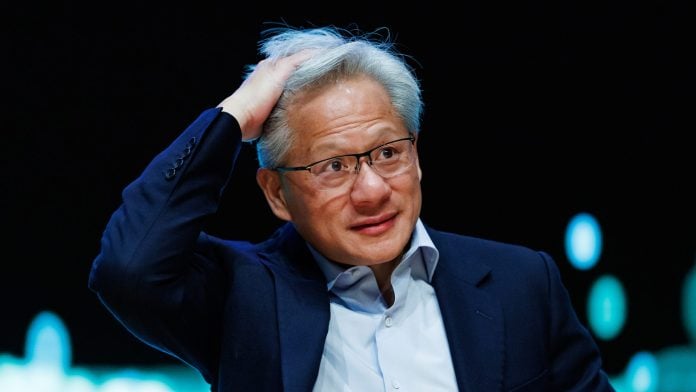
Jensen Huang’s return to Nvidia after a controversial exit has brought relief to Wall Street and renewed optimism in the global AI industry. But the extraordinary market reaction to his reinstatement has also raised questions about America’s technological dominance, the growing influence of Silicon Valley’s billionaires and the AI industry’s dependence on a handful of companies.
ThePrint asks: Jensen Huang’s return as Nvidia CEO – How it affects Brand America & AI industry?
The Jensen saga is a learning in two things for me

Shakthi Vadakkepat
Enterprise AI architect
The Jensen saga is a learning in two things for me.
First: Vendor lock-in is a huge mistake and one of the biggest risks for enterprises today. Irrespective of whether Jensen is right or wrong, Nvidia and the American AI ecosystem is completely unreliable and totally unstructured. In any other industries, he would be either behind bars or banned by now. So, enterprises should start routing every dependency smartly and efficiently based on domain and level of regulation. Sovereign should be the ideal goal. If you look at it, the AI tools are the most used but also most unreliable now.
Second: Accountability and audit trails should be a part of every vendor, model, agent, skill and infrastructure platform that you use from the inception of the project to day-to-day running with clear ownership and responsibility defined.
Nvidia’s crisis exposes the vulnerability of Brand America

Raunaq Lekhi
Senior Sub Editor, ThePrint
Jensen Huang’s return to Nvidia is good news for Wall Street and the AI industry. But should the fortunes of an industry worth trillions of dollars depend so heavily on one man?
Nvidia is, in many ways, a great advertisement for Brand America. A Taiwanese immigrant building a gaming chip company that would eventually power the global AI revolution is a classic American success story. It speaks volumes about the country’s ability to attract talent, encourage innovation and reward ambition.
But there is another side to this story. America’s dominance in AI increasingly rests on a handful of companies and their founders. Trump’s intervention in Huang’s reinstatement also raises questions about where business ends and politics begins. Being indispensable to an industry should not mean being immune to scrutiny.
The AI industry, too, needs a reality check. The demand for AI is undeniable, but the dependence on Nvidia and the staggering sums of money riding on its success are cause for concern. More competition, even from China, might actually be good for the industry.
America has built its reputation on producing some of the world’s finest entrepreneurs and giving them the freedom to innovate. It must continue to do so without allowing its economic and technological ambitions to become hostage to a few individuals.
Allies or adversaries, Washington holds the tap

Prasanto K Roy
Tech public policy advisor
The Nvidia crisis highlights the shaky US-controlled foundation of the global AI ecosystem, supported on a fragile three-layer stack. Sub-3 nanometer chips are reliant on ASML’s EUV machines (and the Dutch monopoly complies with US directives). Those chips power GPUs dominated by Nvidia (and followed by AMD, Intel). Those GPUs run frontier models—Claude, GPT, Gemini, DeepSeek—mostly American, some Chinese. While China pushes aggressively across all three layers, India lacks deep indigenous capability in any of them.
Nor is vulnerability confined to chips.
On June 12, a US Commerce Department export-control directive forced Anthropic to suspend foreign-national access to its frontier Fable 5 and Mythos 5 models over cybersecurity fears, imposing a blanket ban for allies and adversaries alike. Although controls were lifted on June 30, the shockwave hit New Delhi. Claude’s second-largest market saw firsthand how commercial AI services can be switched off overnight by executive fiat.
Together, the Nvidia turmoil and the Fable-Mythos precedent signal a new era of strategic control. Allegations of chip diversion, political intervention in Jensen’s reinstatement, and Washington’s clampdown on overseas data centres and remote GPU access have rattled the global AI economy.
The EU has taken several ‘derisking’ steps, including a Parliamentary scrutiny and sovereignty push, and advancing the European technological sovereignty package.
For with Anthropic and Nvidia, Trump’s actions signal something worrying to US allies: America can’t really be trusted, even by allies, who need to watch out for their own backs and their own strategic autonomy, and not be forever dependent on US largesse in technology.
America’s AI dominance cannot rest on one man

Ramakant Yadav
Co-founder & CEO, Scalar Field
Jensen Huang’s return strengthens Brand America in the short term but exposes a deeper structural vulnerability. When the departure of a single individual destabilises global markets and the AI ecosystem, it raises fundamental questions about corporate governance and institutional resilience.
Nvidia centralised leadership model may have accelerated innovation, but organisational structures that make leaders indispensable can also create systemic risks.
America’s greatest competitive advantage has historically been its ability to build enduring institutions and innovation ecosystems. Its long-term technological supremacy will depend not merely on visionary leaders, but on building companies and ecosystems capable of thriving even in their absence.