





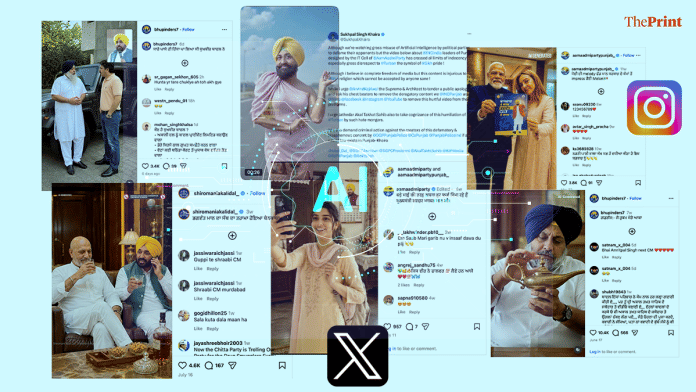


Chandigarh: Last week, senior Congress leader Sukhpal Singh Khaira accused the ruling Aam Aadmi Party (AAP) of “crossing all limits of indecency” after an AI-generated video depicted him and other Punjab Congress leaders walking the ramp before Congress leader Rahul Gandhi. Terming the video defamatory and disrespectful, Khaira demanded criminal action against those behind the video and urged social media platforms to remove it.
He also appealed to the Akal Takht jathedar to take cognisance of the video for disrespecting the Sikh turban. Khaira also moved the court demanding removal of the video and identification of the anonymous accounts involved. On Friday, the Chandigarh District Court issued notices to Meta Platforms Inc. (Facebook and Instagram) on his petition.
The episode is only the latest example of a rapidly evolving political campaign in Punjab, where AI is being used across party lines to generate satirical content targeting opponents.
Social media is flooded with AI-generated videos that ridicule rivals, revive old controversies and exaggerate political narratives. The infamous Congress vs Shiromani Akali Dal newspaper advertisement battles that had become the hallmark of almost every election campaign earlier has now been replaced by these AI-generated videos.
Although we’re watching gross misuse of Artificial Intelligence by political parties to defame their opponents but the video below about @INCIndia leaders of Punjab designed by the IT Cell of @AamAadmiParty has crossed all limits of indecency especially gross disrespect to… pic.twitter.com/YcLHlDD5D7
— Sukhpal Singh Khaira (@SukhpalKhaira) August 1, 2026
These videos combine AI-generated visuals, cloned voices and fictional conversations with authentic news footage in a bid to make them far more persuasive than traditional campaign material. While many leave little doubt that these are fake, the blending of reality with these fabricated visuals sometimes makes it difficult for viewers to immediately distinguish between actual events and digitally-created political fiction.
The only giveaway is a disclaimer that it is made using AI.
Though rare, AI generated videos are also being used by political parties to publicise their achievements. With Punjab set to vote early next year, political observers believe this digital contest is only likely to intensify.
The AAP and its supporters are generating two kinds of content. On the one hand, it is being used to present the Bhagwant Mann government’s welfare schemes and governance initiatives through polished, emotionally driven storytelling. On the other hand, they are posting videos with personalised attacks on political opponents.
One AI-generated promotional video presents an imagined day in the life of a young woman receiving the party’s monthly financial assistance of Rs 1,000. Through AI-created visuals and narration, the video follows her daily routine, showing how the money enables her to buy small gifts for herself and her family.
Another video shows a youngster who only recently returned from abroad and is impressed with the development that has taken place in the past few years in his village.
In yet another video, Prime Minister Narendra Modi is shown standing next to Italy’s Giorgia Meloni and they both are releasing a booklet listing AAP’s achievements in Punjab.
AAP’s political attacks are considerably sharper. Several videos target Shiromani Akali Dal (SAD) president Sukhbir Singh Badal, portraying him through fictional conversations and exaggerated scenarios. Some depict him discussing an ‘opium addiction’ with his wife Harsimrat Kaur Badal while others suggest he has a stake in every successful business in Punjab.
One such video shows Harsimrat sitting with women in a village who are appreciating Bhagwant Mann’s work. The video shows that she is so impressed with his achievements that she secretly goes and votes for AAP.
In another video, she is shown going into the bank and withdrawing the Rs 1,000 per month given to women for herself, admitting the Badals only ‘looted’ Punjab.
Other videos invoke former chief minister Parkash Singh Badal, suggesting he bears responsibility for many of Punjab’s present-day problems, while some revisit the sacrilege controversy through dramatised AI-generated narratives.
Even institutions traditionally kept outside the realm of political satire have found themselves becoming subjects of such content. For instance, one video circulated by accounts linked with AAP’s online campaign depicts Badal rubbing a ‘magical lamp’ and Akal Takht jathedar Kuldeep Singh Gargajj appears. The fictional dialogue portrays the Jathedar assuring Badal that he would act according to his wishes, suggesting that the highest Sikh temporal office functions at the behest of the Akali leadership.
The AAP has also produced AI-generated videos targeting senior Akali leader Bikram Singh Majithia. These videos revisit long-standing political allegations relating to the drug trade through fictionalised narratives and imagined conversations.
Others mock Majithia’s return to active politics after his release from jail, with one clip derisively referring to him as the ‘mouse of Majha’ instead of the ‘General of Majha’, using AI-generated caricature to undermine his political image.
SAD targets Mann
The SAD, too, has adopted AI just as aggressively to counter the ruling party’s narrative.
Chief Minister Bhagwant Mann is perhaps the single most frequent target of AI-generated satire produced by the Opposition. Numerous reels portray him in fictional conversations with family members or political colleagues. Several depict him as constantly consuming alcohol despite having sworn not to, while one imagines him waking up in panic after dreaming that Badal has returned to power and fearing he would have to flee Punjab.
Another AI-generated video presents a fictional version of Badal’s appearance before the Special Investigation Team (SIT) probing the 2015 sacrilege cases. In the fabricated sequence, SIT officials are shown treating Badal deferentially and repeatedly asking him what questions they should ask. The video then depicts a fictional telephone conversation with Mann, who tells investigators they have nothing to ask Badal and should simply send him home, portraying the investigation as political theatre rather than a genuine inquiry.
Other Akali-generated videos reconstruct contemporary political controversies through AI storytelling. One fictionalises a public meeting by depicting people intending to question the chief minister being placed under house arrest before his arrival.
The AI-generated sequences are then interspersed with television news footage from the event, giving the overall presentation an appearance of authenticity despite much of the narrative being entirely fictional.
In another video, school students target the Chief Minister during a public event, questioning him about the multiple exam leaks in the state.
Another video shows AAP supremo Arvind Kejriwal suggesting to Mann that the only way he can overcome the damage to his image is by giving Rs 1,000 per month to women. The video ends by Mann saying the he can buy the loyalty of Punjabis when a few thousand rupees are thrown at them.
The Punjab government’s delay in granting the enhanced dearness allowance to its employees has also become a subject of a satirical AI video.
BJP: Different strategy
The Bharatiya Janata Party (BJP) has adopted a somewhat different AI strategy, often repackaging governance issues and news events into cinematic political narratives.
One video presents an entirely synthetic retelling of police action against protesters in Barnala, depicting Mann ordering a crackdown. Rather than relying on actual footage, the video recreates the controversy using AI-generated narration, characters and scenes designed to evoke an emotional response.
Another BJP video uses symbolism rather than dialogue. It depicts Mann sitting inside his office while every object around him—including files, papers, a cup and even a glass—begins to leak. The visual metaphor is intended to highlight examination paper leak controversies while simultaneously responding to the opposition attacks on the BJP over paper leaks elsewhere in the country.
Yet another AI-generated video portrays Mann travelling in an elaborate cavalcade while remaining oblivious to events unfolding around him. As the fictional journey progresses, he is shown ignoring public protests, women allegedly being robbed and citizens in distress, reinforcing the BJP’s narrative that the AAP government is disconnected from the masses.
Several videos shared by the Opposition in the state also weave together real controversies with entirely fictional conversations. One depicts Mann allegedly receiving money from gangsters before engaging in an imagined conversation with his mother about where the cash should be hidden safely. The narrative then references the Enforcement Directorate’s searches at premises linked to a person close to him, combining a real political controversy with fabricated scenes and AI-generated dialogue to create a dramatic storyline.
Also Read: Punjab got anti-sacrilege law after three failed attempts in past decade. And this one has teeth
Congress: Trying to catch up
The Congress, meanwhile, has found itself at the receiving end of AI-generated political content. Much of it exaggerates the party’s internal divisions, particularly the perceived rivalry between former chief minister Charanjit Singh Channi and Punjab Congress chief Amarinder Singh Raja Warring. One video shows the Congress party on its deathbed.
The campaign, a political communication expert told ThePrint, has entered a new phase where AI is no longer being used merely to create posters or translate speeches. “AI is enabling political parties to manufacture persuasive narratives that combine humour, cinema, parody and selective references to real events in ways that are highly optimised for social media. Earlier these battles were fought in newspapers through advertisements,” said Kanwalpreet Kaur of the department of political science, DAV College, Chandigarh.
In 2006, she recalled, the Congress had launched a cartoon campaign against the Shiromani Akali Dal in the newspapers. “The content was shocking at that time because the attacks were personal and the language used was very harsh. But now these personal attacks seem to have normalised in social media.”
According to her, a notable feature across party lines “is the increasing use of authentic television footage or real videos from political events alongside AI-generated visuals and cloned voices”.
“The technique lends credibility to otherwise fictional narratives, making it more difficult for viewers to distinguish between verified reporting and digitally manufactured political messaging,” she added.
(Edited by Tony Rai)