





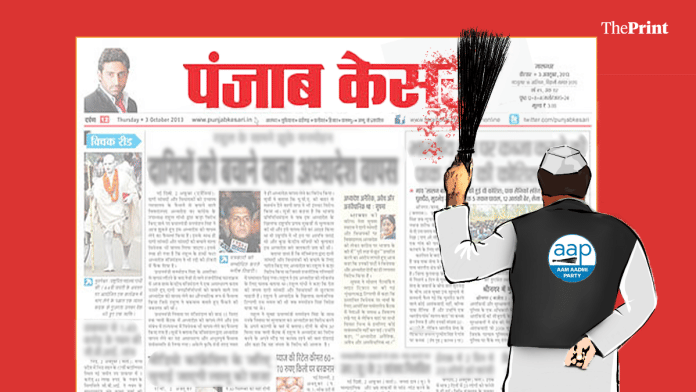



Chandigarh: The Supreme Court this week directed the Punjab government not to take any coercive action against the publication of Punjab Kesari, after the media group alleged that the ruling Aam Aadmi Party (AAP) was “intimidating” its editors by threatening to close its printing presses on the pretext of environmental pollution.
In two representations to the Punjab Governor, Vijay Chopra, the 93-year-old editor-in-chief of the Punjab Kesari Group, alleged a “targeted witch-hunt” through raids on their businesses after publishing a story about former Delhi chief minister and AAP convenor Arvind Kejriwal.
An official communication from the government, on the other hand, has stated that the group has been violating a host of food, excise, and pollution laws under the guise of running the newspaper, and that the actions against them had nothing to do with their journalism.
ThePrint reached Additional Chief Secretary and Financial Commissioner of Excise D.K. Tiwari for comment. He said it would not be appropriate for him to comment on a sub judice matter.
The Punjab government, in a statement issued Friday, denied any vendetta against the newspaper group.
ThePrint explains the tussle between the ruling AAP and Punjab’s leading Hindi daily.
Also Read: Did ED break own rulebook in National Herald case? Why court junked charge sheet against Gandhis
The raids
In less than a week, between 10 January and 15 January, four premises owned by the Punjab Kesari Group, including three printing presses and a hotel, were raided by the pollution control and excise departments. Orders for the closure of the hotel cited excise violations, and the printing presses were ordered shut on charges of creating pollution, power supply to at least one being shut down following the orders.
Three FIRs were lodged, and two of them charged employees of the presses with obstructing officials from performing their duties. The third FIR against the hotel owners, the Chopra family, was for two bottles of gin found at the hotel bar without the requisite hologram and QR code. Hundreds of bottles of expired draft beer were also recovered from the bar—another charge levelled in the FIR.
According to co-owner Amit Chopra, all the restrictions are being enforced by the AAP to browbeat the newspaper into submission and serve as a lesson for other media houses in Punjab.
“The message is—either you toe the line, or else…,” said Chopra, talking to ThePrint.
The message is—either you toe the line, or else…
The Kejriwal story
Chopra said their troubles began when Punjab Kesari reported the BJP’s allegations that Kejriwal was being allotted a large official residence in Chandigarh near the Punjab government Secretariat. When approached for comment, AAP asked them not to run the story, he further alleged, but the paper proceeded to publish it while including the party’s version. Subsequently, government advertisements in the paper stopped.
From then on, the government seemed to be under the impression that the paper would carry a “huge exposé”, according to Chopra. “One morning, they feared that such a story was being carried. So, they resorted to physically stopping the vehicles carrying our newspapers for delivery.”
“The police stopped the vans, checked them, and when they did not find anything adverse in the newspapers, they allowed the vans to go. As a result, at several places, the newspaper could not be delivered at all or was delivered late. The government gave a rag-tag excuse, saying they were looking for weapons and drugs,” he added.
“For the next one or two months, we received multiple requests from those running the show in Punjab about stories that should not be carried. But we stuck to our guns and decided on stories purely on editorial merit. That’s when they decided to bring down multiple government agencies upon us to intimidate us,” Chopra further said.
‘All hell broke loose’
According to Amit Chopra, all hell broke loose when the newspaper carried a purported statement made by AAP Atishi in the Delhi assembly. The BJP alleged Atishi was disrespectful towards Guru Tegh Bahadur during a session, according to the BJP. Atishi has denied the allegation.
In his representation to the governor, Vijay Chopra narrated the sequence of events that unfolded in less than a week from 10 January.
On 11 January, there was a raid by the Food Safety & Standards Authority of India at a hotel owned by the Chopra family in Jalandhar. The next day, the GST department and then the excise department raided the hotel. Simultaneous raids were conducted on 12 January at the Punjab Kesari printing press in Ludhiana and Jalandhar by the factories department.
On 13 January, the Punjab Pollution Control Board (PPCB) raided the hotel in Jalandhar and the excise department issued a show-cause notice for the cancellation of the hotel’s liquor licence. On 14 January, the liquor licence of the hotel was cancelled and its electricity connection was cut. On 15 January, the printing presses in Ludhiana and Jalandhar were again raided, this time by the PPCB.
“It was a premeditated, planned operation, with the sole motive of hunting us down and muzzling us. Even if the government is within its rights to conduct surprise checks, the manner in which these were done is shocking,” said Chopra.
It was a premeditated, planned operation, with the sole motive of hunting us down and muzzling us
“Their teams were climbing walls, beating up our men, breaking locks,” he said. In one case, they even disconnected the device recording the CCTV footage and took it with them, claimed the MD.
“We are not into the liquor business as is being projected. We opened a hotel in Jalandhar with all the requisite permissions and licences last year. It was contracted out to the Sarovar Group for running. The liquor licences for the hotel bar were given to us during the tenure of the AAP government only,” said Chopra.
He added: “The excise team that raided the hotel found that the liquor was not being stored at the proper place. They declared caskets of beer as outdated, and they found two bottles of gin without the QR code. And all this was enough to issue us a show-cause notice on the day of the raid, cancelling the licence the next day.”
Then, the pollution board found violations claiming that the soap water used in the hotel laundry was toxic to the environment, Chope said. “The entire action was around the Lohri holidays, so we had no time to even prepare a defence.”
“For those two allegedly unauthorised bottles of gin and the beer bottles, an FIR was registered against me. After the licence was cancelled and the pollution board action, the electricity to the hotel was cut within hours. We attempted to run the hotel with generators, but were stopped from doing so as well. Finally, we had to shift the guests from the hotel to another place,” said Chopra.
When contacted, Jalandhar Police Commissioner Dhanpreet Kaur said she did not know about the registration of an FIR and that she would find out.
‘Violations cannot be overlooked’
The Punjab government’s statement denying any vendetta against the Punjab Kesari newspaper group said that the “excise action at the hotel in Jalandhar resulted in the seizure of over 800 bottles of liquor stored at unapproved locations”.
It further mentioned the “discovery of liquor bottles without mandatory excise holograms and QR codes”, and “documentary proof that expired draft beer was sold to customers for days after it had become unfit for human consumption”. The government claimed that suspension of liquor licences “followed due process strictly”.
The government also claimed that the hotel was discharging chemicals used in laundry into the ground and sewer without treatment and that its mandatory permissions to run the hotel expired on 31 March 2025.
Chopra, though, alleged targeted action against three of their printing presses. “Apart from the labour and factories department, the Punjab pollution board teams raided the premises at Ludhiana and Jalandhar as if it’s a multi-city military operation, carried out in an enemy nation. According to them, the ink we used to print the paper is not discharged properly, though I believe it is not toxic to the environment.”
The regional officer of PPCB, Jalandhar, did not respond to questions sent by ThePrint.
In the note issued by the government Friday, it stated that inspections by the Labour and Factories department revealed “serious and repeated violations of labour laws, safety norms and statutory record-keeping requirements”.
“These inspection reports collectively revealed a pattern of regulatory neglect across excise, environmental and labour domains…When multiple statutory authorities record violations in writing, with dates, sections and signatures, enforcement is not discretionary. It is a legal obligation,” it added.
These inspection reports collectively revealed a pattern of regulatory neglect across excise, environmental and labour domains…
‘Witch-hunt’
Chopra, however, questioned the timing of the government action and the manner in which the entire operation was conducted. “So all these years, whatever we were doing was fine and legal, and within a few days, whatever we were doing was found to be unauthorised or illegal? How many other hotels in Punjab have been ordered to be shut down on the same day the Punjab pollution control board finds violations? If this is not targeted witch-hunting, then I don’t know what is.”
How many other hotels in Punjab have been ordered to be shut down on the same day the Punjab pollution control board finds violations? If this is not targeted witch-hunting, then I don’t know what is.
Chopra further alleged that the government wanted the group to shut operations and stop printing the newspaper, something that didn’t even happen during the Emergency. “At this point, we decided to fight back and not stop printing the paper at any cost. That is when we spoke up for the first time and gave a representation to the governor and moved the court.”
The newspaper’s representation to the Governor caused a political furore, with the opposition parties rallying behind the newspaper and attacking the AAP government.
The government categorically rejected allegations of “targeted attack”, stating that the Chopras’ claim is “an attempt to deflect attention from serious, recorded violations of law uncovered by multiple statutory authorities acting strictly within their legal mandate”.
Responding to claims of harassment, the government stated that enforcement of labour, safety and environmental laws could not be suspended under the pretext of press freedom.
The Punjab government also rejected the claim of a “predetermined witch-hunt”.
“Simultaneous action by different departments only reflects how long violations had remained unaddressed earlier. Lawful enforcement, even if delayed, does not become motivated simply because it is finally undertaken,” it said.
Commenting on the charge regarding the Punjab government’s advertisements, the state clarified that public advertising is not an entitlement and cannot be used as insulation against regulatory scrutiny.
“We are the most circulated newspaper in Punjab. So what is the government’s logic for disseminating information? Should it not give advertisements to those who have the highest reach, instead of only to those who will do their bidding?” said Chopra.
Legacy media group
The Jalandhar-based group publishes Punjab Kesari, Jagbani and Hind Samachar. The representations to Punjab Governor Gulab Chand Kataria are signed by Avinash and Amit Chopra, apart from Vijay Chopra.
The newspaper was started by freedom fighter Lal Jagat Narain, who was associated with Lala Lajpat Rai. Narain first became the editor of Bhai Parmanand’s Hindi weekly Akashvani and was jailed multiple times before independence for participating in the freedom struggle.
In 1949, Jagat Narain started Hind Samachar, an Urdu daily newspaper, in Jalandhar, Punjab, and Punjab Kesari, a Hindi daily, in 1966. In 1978, the group also began publishing a Punjabi newspaper, Jagbani.
During the days of militancy in Punjab, the newspaper was seen opposing militants, and Narain was assassinated in 1981. Romesh, who took over from Narain, was also assassinated in 1984. Following Romesh’s death, brother Vijay Chopra, a Padma Shri awardee, took over.
What next
The matter is now in court. On Tuesday, the apex court took up the newspaper’s plea following oral mention and ordered that the printing of the Hindi daily should continue uninterrupted.
The group earlier moved the Punjab and Haryana High Court, where the order on their plea was reserved after hearing the matter. The group then moved the Supreme Court, seeking immediate intervention, fearing a shutdown of operations.
The bench of Chief Justice of India Surya Kant, Justice Joymalya Bagchi and Justice Vipul Pancholi said the printing of the newspaper will continue uninterrupted.
On Friday, the High Court announced its judgement asking the newspaper group to approach the National Green Tribunal (NGT) for redressal over the various actions taken by the Punjab Pollution Control Board.
(Edited by Madhurita Goswami)
Also Read: Global support for press freedom high, but only 28% feel media Is truly free, finds Pew survey
Mai sarkaari gaadi nahi loonga mai sarkaari bamgla nahi loonga , said nobody ever