





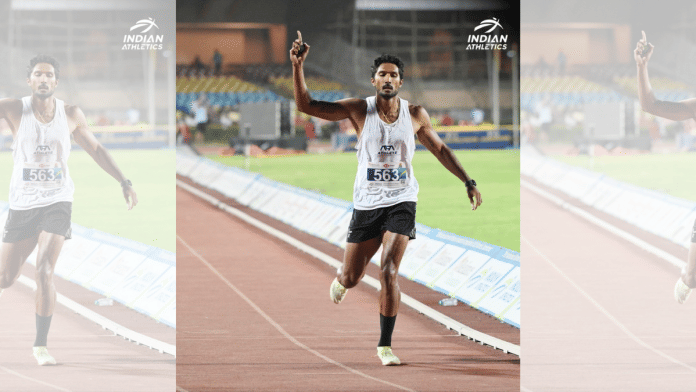

New Delhi: Tejaswin Shankar made history at the Athletics Federation Cup 2026 in Ranchi Saturday, becoming the first Indian decathlete to surpass 8,000 points—a landmark that announces his arrival as the face of a discipline long starved of elite-level visibility in India.
Shankar was not alone in rewriting the record books ahead of Commonwealth Games in Glasgow this year.
On an evening when three national records fell at Birsa Munda Stadium, Vishal T.K. clocked 44.98 seconds to become the first Indian to break the 45-second barrier in the 400 metres, while Gurindervir Singh blazed to 10.09 seconds in the 100 metres, the first Indian sprinter to go under 10.10 seconds.
Shankar’s record-breaking decathlon campaign saw him finish Day 1 with 4,511 points after standout performances in the high jump (2.25m), long jump (7.67m), and 100m (10.77s). He added another 3,546 points on Day 2 through the 110m hurdles, discus throw, pole vault, javelin throw, and 1500m to reach the 8057-point mark.
What is the decathlon?
The decathlon is a combined event comprising 10 track-and-field disciplines—the 100 metres, long jump, shot put, high jump, 400 metres, 110 metres hurdles, discus throw, pole vault, javelin throw and 1,500 metres.
Athletes accumulate points based on their performance in each event, with the highest cumulative score determining the winner. Its unofficial crown dates to the 1912 Stockholm Olympics, where Jim Thorpe won the inaugural Olympic decathlon and King Gustav V of Sweden memorably declared him “the greatest athlete in the world”.
The event has since become one of athletics’ most gruelling and prestigious tests. American decathlete Ashton Eaton dominated the sport in the early decades of this century, winning Olympic gold at both London 2012 and Rio 2016, and breaking the world record twice. The current world record of 9,126 points belongs to France’s Kevin Mayer.
India’s thin decathlon history
In India, the event has historically had few practitioners at the elite level. Sabir Ali—known as the ‘Iron Man of India’—was the country’s foremost decathlete for decades, having won gold at the 1981 Asian Athletics Championships in Tokyo. He died in 2023.
Shankar, who won silver at the 2022 Asian Games, is now widely seen as the first Indian decathlete in many years to carry genuine aspirations at the international level. His 8,000-point milestone at the Federation Cup marks a turning point—a barrier long symbolic of the distance between Indian decathlon and the world’s best.
Asian players have had a modest track record in global decathlon championships. Japan and Kazakhstan have traditionally been among the stronger decathlon nations. Kazakhstan’s Dmitriy Karpov won bronze at the 2004 Athens Olympics.
Japan has produced strong decathletes, including Akihiko Nakamura and Keisuke Ushiro, both of whom won Asian Games gold medals and competed regularly at the Olympics and World Championships.
Sprinting history rewritten twice in a day
Shankar’s achievement headlined an evening that had already delivered dramatic theatre on the track. The 100 metres final was the culmination of a day in which the national record changed hands twice before the final was even run.
In Friday’s semi-finals, Gurindervir (25) first clocked 10.17 seconds to break Animesh Kujur’s national record of 10.18 seconds. Minutes later, Animesh (22) answered with a 10.15-second run to reclaim the record. On Saturday, Gurindervir settled the argument with 10.09 seconds, taking the title ahead of Animesh (10.20 seconds) and Pranav Gurav (10.29 seconds).
The Federation Cup doubles as a qualification platform for the Commonwealth Games 2026, scheduled in Glasgow, Scotland, from 23 July to 2 August. To earn selection, athletes must surpass existing national records, though the final call rests with the Athletics Federation of India.
(Edited by Prerna Madan)
Also read: Vinesh Phogat, WFI, and the Delhi HC judgment that said motherhood cannot become a disability