





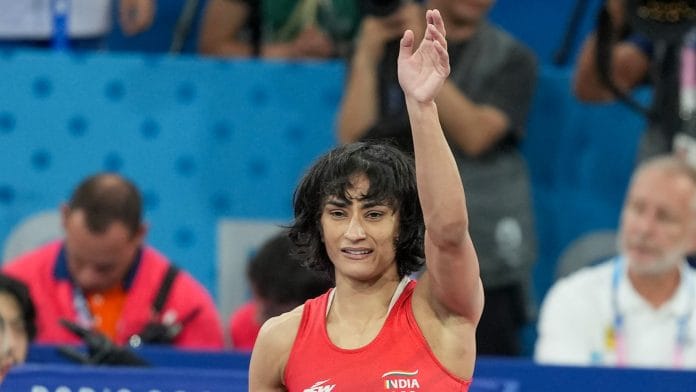


New Delhi: The Delhi High Court’s direction that wrestler Vinesh Phogat—a two-time Olympian and Congress MLA—must be allowed to participate in the Wrestling Federation of India’s (WFI) selection trials for 2026 Asian Games rebukes a policy that the court found had effectively converted her maternity leave into a disqualifying absence.
The bench of Chief Justice D.K. Upadhyaya and Justice Tejas Karia declared on 22 May that “becoming a mother can never become a disability” and held that any regulatory framework that “either expressly or impliedly disadvantages a woman on account of pregnancy or post-partum recovery” violates Articles 14 (equality before law) and 21 (right to life) of the Constitution.
The ruling reversed an earlier single-judge bench decision that had declined to stay the WFI’s selection constraints.
The two-judge bench also criticised the show cause notice (SCN) that the WFI had served to Phogat on 9 May, describing the federation’s attempt to revisit the circumstances of her 2024 Paris Olympics disqualification as “pre-meditated, vindictive and mala fide”.
In doing so, the HC noted that the Court of Arbitration for Sport (CAS) had already cleared Phogat of any wrongdoing. It also said that WFI’s characterisation of the Paris weigh-in incident as a “national embarrassment” in its show-cause notice was “retrograde and ex-facie misconceived”.
The wrestler had approached the HC challenging WFI’s selection trial policy and the show-cause notice issued to her.
The latest legal proceedings have unfolded against the backdrop of an ongoing criminal trial related to sexual harassment complaints by wrestlers against former WFI chairman and BJP leader Brij Bhushan Sharan Singh. In a video posted on social media recently, Phogat identified herself as one of the six women wrestlers who had made the allegations against Singh. She also alleged in the clip that the 15-page show-cause notice and the harassment case were directly linked.
Also Read: Why don’t Indian women play sports? Safety concerns, lack of time
The policy & its effect
At the heart of the dispute was the WFI’s Asian Games Selection Policy, dated 25 February 2026, and a subsequent circular dated 6 May 2026.
Together, they restricted trial eligibility to athletes who had won medals at specific domestic championships held in late 2025 and early 2026.
Phogat, who holds multiple Commonwealth Games and Asian Games gold medals, was on a duly disclosed maternity sabbatical from December 2024 to August 2025—her child was born in July 2025. In this period, she was unable to participate in competitions that eventually turned into qualifying criteria for selection to the Asian Games.
Her legal team argued that this policy was “mechanically exclusionary” and that it converted her maternity-related absence into a “disabling factor”, producing discriminatory consequences.
The WFI countered that the policy was applied uniformly to all athletes and that the federation lacked authority to grant exemptions.
The court rejected that defence. It found that the absence of “maternity-sensitive accommodation” was contrary to constitutional guarantees of equality, noting that Phogat had followed all international protocols—including notifying the International Testing Agency (ITA) and United World Wrestling (UWW) of her return to training after the birth of her child.
The bench observed that the post-partum period presents “extraordinary physical challenges” that are “insufficiently acknowledged” by sporting institutions, and that the law must ensure motherhood does not become grounds for the “exclusion or marginalisation” of female athletes.
The show-cause notice
WFI’s show-cause notice—to declare her ineligible for competing in any sanctioned domestic events until 26 June–rested on three grounds.
The first alleged that Phogat’s Paris Olympics disqualification—she was found to be 100 grammes over the 50kg limit on the morning of the final—had caused “national embarrassment” and damaged the reputation of Indian wrestling.
Phogat was disqualified from the 2024 Paris Olympics 50kg final after exceeding the weigh-in limit by exactly 100 grammes. Despite severe weight-cutting efforts overnight, she failed to meet the strict threshold on the morning of the gold-medal bout, resulting in immediate elimination and loss of her medal.
The second accused her of failing to observe the mandatory six-month notice period that UWW rules require of retired athletes returning to competition. The third alleged she had competed across two weight categories—50kg and 53kg—at the March 2024 selection trials for the 2028 Los Angeles Olympics
On the Paris allegation, the bench found that since the Court of Arbitration for Sport, an independent international arbitration tribunal for sports-related disputes, had cleared Phogat of wrongdoing, the WFI’s attempt to reopen these “closed issues” was mala fide.
The court also noted that the federation’s present rigidity was a marked “deviation” from its own past practice of exercising discretion to select “iconic players” without requiring them to undergo trials.
WFI is now headed by president Sanjay Singh, a close associate of former WFI chief Brij Bhushan Sharan Singh.
Court directions
Finding that Phogat’s exclusion from the trials scheduled for May 30 and 31, 2026, would render her petition infructuous—causing an “irreversible loss” of opportunity—the high court directed that she be permitted to participate. The WFI has been ordered to video-record the entire selection process.
The Ministry of Youth Affairs and Sports must nominate two independent observers, one from the Sports Authority of India (SAI) and one from the Indian Olympic Association (IOA), to oversee the trials and submit a report.
The bench celebrated motherhood as a “great virtue” and a “social moment”—in India and globally—and held that the law must reinforce that recognition, not erode it.
Indian wrestling selection trials for the 2026 Asian Games are scheduled for 30 and 31 May. The 20th Asian Games will be held in Japan from 19 September to 4 October.
Also Read: What happens when ‘women’s work’ becomes a profession? It’s still men who rise