


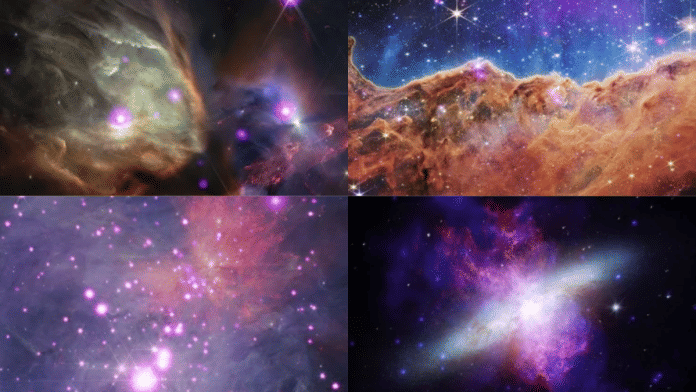
New Delhi: In a galaxy far, far away, what do baby stars sound like? NASA has released four new recordings that are sonic interpretations of the data collected by its Chandra X-ray Observatory and other space telescopes. Compiling the data, the United States space agency has created an album of sounds baby stars make across the galaxy and beyond, offering a whole new dimension through which to perceive the universe.
The recordings were released on 17 November, and feature the starburst galaxy Messier 82 (M82), the Orion Nebula, the Carina Nebula and the Rho Ophiuchi cloud complex. Each formation contains regions where stars are forming or have recently emerged, which allows astronomers to study the processes that helped form stars such as our Sun.
However, these are not actual sounds recorded in space. Instead, they were created with a technique called sonification, which consists of converting astronomical data into audible sounds by assigning different frequencies, volumes and musical instruments to observations of light and other properties.
Making an album
The recording begins with a radar-like scan, where brighter sources produce louder sounds. X-rays are represented by high frequencies, infrared observations by low drones and plucked notes, and visible light by different musical tones.
For M82, where stars are forming at a rate tens or even hundreds of times higher than in the Milky Way, researchers combined X-ray observations from Chandra with optical data from the Hubble Space Telescope and infrared observations from the James Webb and Spitzer telescopes.
In the Orion Nebula, Chandra detected more than a thousand young stars, whose X-ray emissions were converted into twinkling sounds. Infrared observations from Webb, revealing the surrounding dust and gas, were represented using lower tones, distorted string instruments and a digital harp.
The Carina Nebula’s “Cosmic Cliffs”, meanwhile, were translated into sustained musical notes, with individual newborn stars represented by short string sounds. In Rho Ophiuchi, where young stars produce powerful X-ray flares, the recordings combine high-pitched glassy tones with metallic plucks representing stars.
Making astronomy more accessible
The sonification project is led by Chandra visualisation scientist Kimberly Arcand, working with astrophysicist Matt Russo and musician Andrew Santaguida from SYSTEM Sounds, alongside accessibility consultant Christine Malec under the Chandra X-ray Center (CXC).
“Astronomy has always been very visual, but there’s no reason why we have to represent the data through that manner alone,” Arcand said in an earlier press release from Harvard University, explaining that scientific information could also be represented through sound.
NASA has been developing astronomical sonifications since 2020, partly to make space observations more accessible to people who are blind or have low vision, such as Christine Malec.
“They are an invitation to blind and partially sighted people to listen, enjoy, and then go deeper by reading to understand what exactly is being heard,” Malec explained in the press release.
(Edited by Insha Jalil Waziri)