



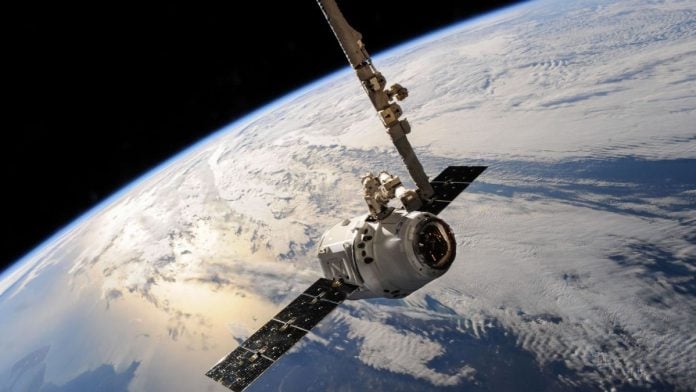
New Delhi: When high-energy particles in space collide with satellites, they can lose data, stop working, and even be knocked off course. To avoid this, scientists at the US Department of Energy’s Pacific Northwest National Laboratory are now using AI to understand how this damage occurs and speed up the development of electronics that can withstand such radiation.
Scientists call this process ‘radiation hardening’ or ‘rad-hard’. It involves designing and testing materials to make sure they are resistant to radiation. Such radiation hardening is particularly important for satellites that spend a decade or more in orbit. It is also important for materials used to make nuclear reactors where radiation is abundant and can gradually change the properties of materials.
What radiation, galactic cosmic rays, or heavy ions can do, is damage the tiny parts within a chip. These high energy particles can disturb the atoms that make up a material and impact the way electricity flows through it — leading satellites and their electronic systems to fail.
“Space is a highly energetic environment, with heavy ions and other particles bombarding our devices. We need to better understand how much radiation a chip can handle. But many of today’s best testing capabilities are designed for systems that are 25 years old or more. They simply don’t give us the information we need to understand the latest technology. Agentic workflows come at a time when there is need for better rad-hard testing techniques,” scientist Erin Barker said in a Pacific Northwest National Laboratory (PNNL) statement.
One of the key challenges in radiation hardening is that existing testing methods have not been developed to test new technology. To fix this, researchers are trying to combine lab experiments, detailed imaging, and analysis using AI to understand radiation damage faster.
Also read: ICE is the least-favoured of 12 US federal agencies, Pew survey finds
AI just takes hours
For their experiments, a team of researchers tested chips made from aluminium gallium nitride and gallium nitride, materials used to make electronics for satellites and radars. Scientists at the University of Tennessee used an ion beam to expose the chips to the kind of radiation they might accumulate over years in space.
Then they used a system called SciLink, which combines multiple AI agents to analyse the results of the experiment. Each AI agent is assigned a different role, from probing into the data to planning further tests.
“The system allows us to take into account all the measurements to piece together what has happened, to understand the damage that has occurred and why it happened. It’s like having several people who did different forms of testing come together and discuss the results — only it’s an agent pulling together the information instantly,” said PNNL scientist Jenna Pope.
According to the PNNL statement, the team of AI agents takes only hours to complete their analysis. However, the system is not designed to replace lab experiments or the scientists themselves, who are still essential in designing the tests, and checking the AI-generated findings for errors.
“Radiation hardening is critical for satellites that will be up for a decade or more, such as large communications satellites. You can protect your electronics by adding shielding, but that adds weight. You can add backup systems in case one fails. But for every bit of weight, power capacity and complexity that you add, you are adding costs and reducing the efficiency of the mission. Making sure the electronics can stand up to the radiation they will be facing can be much more effective,” said nuclear engineer Ben Kowash, who leads PNNL’s radiation-hardening efforts.