





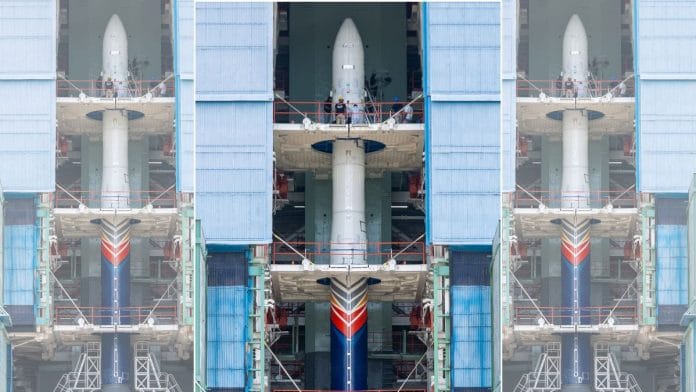


New Delhi: Hyderabad-based Skyroot Aerospace announced on Thursday that the Vikram-1 rocket is set to launch between 12 July and 4 August, marking the maiden flight of India’s first privately built launcher. The launch, titled ‘Mission Aagaman’, will happen at the Satish Dhawan Space Centre in Sriharikota, where the rocket is already stacked and in place.
“The moment Vikram-1 lifts off, India’s private space industry will cross a threshold it has never crossed before,” said Pawan Kumar Chandana, co-founder and CEO, Skyroot Aerospace, in a press statement.
The launch is an important milestone in India’s private space sector’s journey, with Skyroot becoming the first company after the Indian Space Research Organisation (ISRO) to be able to launch rockets.
A cab to space
Vikram-1 is a seven-story-tall rocket that is designed and built indigenously by Skyroot and is made of carbon fibre material. It is built to carry satellite payloads of up to 350 kgs to Low-Earth-Orbit, making it viable for most commercial satellite customers globally.
Currently, both Chandana and Naga Bharath Daka, his co-founder, and about 500 of Skyroot’s employees are in Sriharikota overseeing the launch. While the Vikram-1 rocket is assembled and ready, the exact date of launch will depend on the weather, safety conditions, and range clearance permissions.
The maiden flight of Vikram-1 is carrying a combination of domestic and foreign payload, according to Chandana. However, the main objective of this launch is to serve as a test flight and collect data about the mission.
“The single most important objective of Mission Aagaman is to capture the real in-flight performance data from every system on Vikram-1. We want to understand how the vehicle performs from lift-off through every phase of ascent,” said Chandana.
Also read: Eight-year-old Skyroot set to join the big leagues with upcoming Vikram-1 launch
India’s first space-tech unicorn
Founded in 2018, Skyroot Aerospace is India’s first space tech unicorn company, valued at $1.2 billion this year. Earlier in 2022, they had launched their first mission – the Vikram-S rocket – which was a successful sub-orbital flight of their indigenous launcher Vikram. However, while Vikram-S had just touched space at a height of 120 kms, the Vikram-1 launcher is expected to reach an orbit of 650 kms.
“With Vikram-1, we take our biggest step yet toward a reliable, high-cadence launch programme built in India, for India and the world,” said Naga Bharath Daka, co-founder and COO of Skyroot Aerospace, in a press statement.
Even as Vikram-1 is about to take off from ISRO’s launchpad, Skyroot is already building the next batch of Vikram-1 rockets for future test missions. After three or four test flights in 2026 and the following year, the company plans to be ready for commercial launches in 2027.
According to Chandana, Skyoot’s Vikram launchers are different from global launch companies such as SpaceX because they fulfill a different requirement for space customers. Speaking to ThePrint’s Editor-in-Chief Shekhar Gupta during a recent edition of ‘OffTheCuff’, Chandana explained their unique business model.
“Vikram-1 is like a cab to space. The bigger rockets, like the ones SpaceX has, are like trains to go to space. But we are like a cab – so you can book it and go to your unique destinations in space,” said Chandana. “We will provide services for different orbits, for different customers,” he added.
Skyroot Aerospace is also building the Vikram-2 rocket, which will have a cryogenic engine with a larger payload capacity of 900 kg. However, the Vikram-II test flight will not happen before the end of 2027.
(Edited by Janaki Pande)