





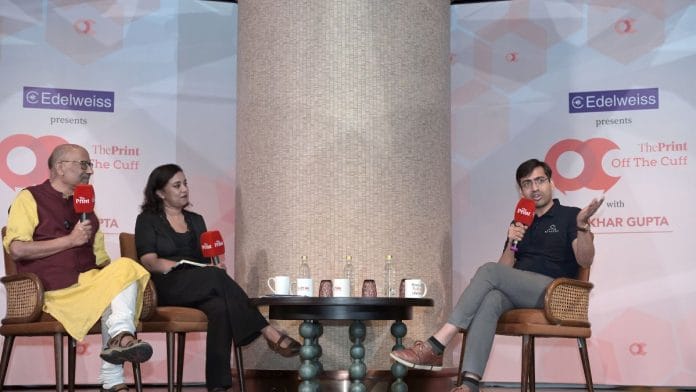


Hyderabad: Vikram-1, India’s first privately built rocket, will be like a car service for space, enabling customers to reach their desired destination in orbit, Pawan Chandana, the co-founder and CEO of Skyroot Aerospace, said days ahead of the launch of its orbital launch from Sriharikota. Chandana added that the company also had the ambition of eventually building reusable rockets, which would significantly reduce the cost of space travel.
Chandana was a guest at ThePrint’s Off The Cuff, organised this time at the Quorum Club in Hyderabad, with ThePrint editor-in-chief Shekhar Gupta and senior assistant editor Soumya Pillai.
“We are preparing for Vikram-1’s launch. It will happen in a few weeks,” Chandana said in response to Gupta’s question, adding, “Globally, around four five companies are launching rockets to orbit. Almost all are 20 year old companies. We’ll enter that club in a few days now, and we are not even an eight-year-old company.”
Skyroot’s soon-to-be-launched Vikram-1 rocket is an on-demand launch vehicle for rapid, precise, and customizable small satellite deployments. The company is also already in the works to release future versions of the Vikram series.
“Launch is the centre of the space industry. You can do anything when there is launch capability available. The biggest bottleneck for every space company is launches, because very few companies do it. It is rocket science after all. So this business is always in need,” the Skyroot co-founder said.
He said that about 70-80% of Skyroot’s market is global.
“That’s why we’re building a truly domestic product which is also truly global,” Chandana added.
Also read: Vikram-I rocket to be ready for commercial launches in 2027, says Skyroot CEO Pawan Chandana
A unicorn’s journey
Recalling Skyroot’s journey to becoming India’s first aerospace unicorn, achieving a valuation of $1.1 billion after securing nearly $60 million in funding, Chandana said that raising money for space is like rocket science–“investors will think you’re mad”.
“They’ll have so many questions. Looking at a 27-year-old, people didn’t get the hope that he will make a rocket. It was very challenging.”
Looking forward to an exciting future in the aerospace industry, Chandana said that his company does have a plan to build reusable rockets eventually. This, he said, will significantly reduce the cost of launches.
“It is on the roadmap, in the coming years,” he said.
While lauding government efforts and the guidance provided to India’s still nascent private space industry, Chandana said that government agencies will need to become “anchor customers” for private companies, which provide regular and large contracts to support private launchers.
“The government needs to back the space sector, give contracts. The government being the anchor customer is going to help a lot,” he said. “The government has very large requirements, we have an ambitious space programme, so the government being an anchor customer for private players would be helpful.”
He said that in the coming years, India’s aim will be to conduct around 200-300 launches.
“Globally, the requirements are about a million satellites. For national security, commercial reasons. Space is a $600 billion industry, set to become $1.8 trillion by 2035,” he said.