



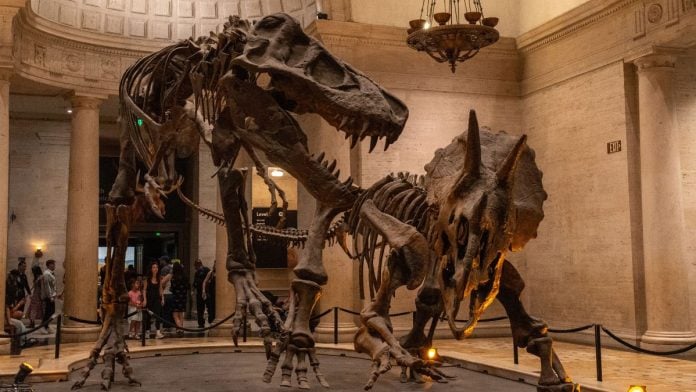
New Delhi: The Tyrannosaurus rex might be long dead, but its teeth have now told scientists that the creature was as warm-blooded as humans. The findings were published on 16 September in Science Advances by a team of researchers at UCLA.
“No one’s been able to make a temperature measurement like this before. We found T. rex was 36 Celsius (97 Fahrenheit), about the same as humans. The temperature is about what I would have guessed — higher than a reptile or a slow mammal like a sloth, but lower than an avian,” UCLA geobiologist and study co-author Robert Eagle said in a press statement.
However, the technology is not new. Nearly a decade ago, UCLA scientists had developed a “prehistoric thermometer method” which used bones to measure whether extinct animals are warm-blooded or cold-blooded. But testing their method on a T Rex needed far more bones than any museum was willing to sacrifice.
Over the past 10 years, the team improved the process and reduced nearly 90 per cent of the dental material that would be required for the test. Finally, the Natural History Museum of Los Angeles County agreed to give them parts of two teeth from Thomas the T Rex.
“We’re asked for fossils for use in destructive analysis all the time. The museum contains tens of millions of specimens of minerals, animals and fossils that are irreplaceable. We have to make decisions that balance the damage to the specimen against gaining knowledge about the natural world. Sacrificing small portions of two teeth to learn about T. rex’s body temperature is definitely worth the trade-off,” Luis Chiappe, curator of the museum’s Dinosaur Institute, said in a statement.
The findings are not particularly surprising especially since scientists had estimated for years that the T rex was indeed warm-blooded. But this is the first time they have managed to put a number to its body temperature.
Also read: China’s new spy satellite watches every satellite from mother-of-all orbit—GSAT, NavIC, Starlink
Analysing teeth
The team’s “prehistoric thermometer” essentially analyses the rare isotopes of carbon and oxygen that form bonds within the tooth’s enamel. The number of these bonds is higher in cooler temperatures and lower in warmer ones.
The team first used a drill to remove the enamel from the fossils and dissolve the powder into phosphoric acid. Once this releases the carbon dioxide trapped in the isotope bonds researchers measure that gas to reveal insights about the carbon isotopes.
“That’s the basis of using the isotopes as a thermometer. In theory, we can make measurements using any part of the skeleton, but the bones in our body are constantly being remodelled and dissolved and replaced. Tooth enamel has large crystalline structures that are extremely durable, making it the part of the skeleton that most resists chemical alteration by the environment over the eons,” Eagle added.
The temperature reveals that tyrannosaurs were active animals that had to fuel their fast metabolisms. Their body temperature is likely to have adapted over millions of years to a warming earth, especially during the Cretaceous Period when temperatures were nearly 11 to 25 degrees Fahrenheit warmer than today.