





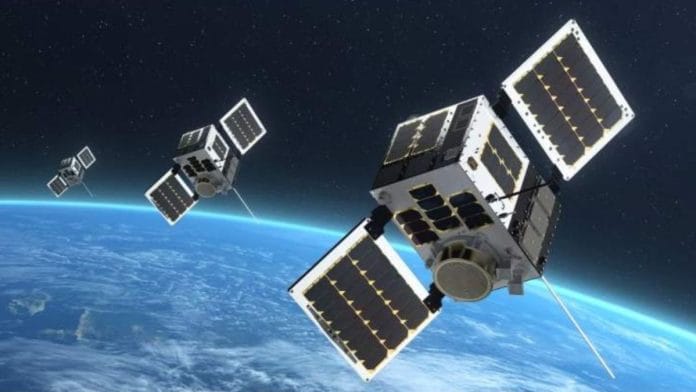


New Delhi: The explosive rise of satellites launched into space since 2019 is causing potent, long-lasting soot pollution in the upper atmosphere, states a study by the University College London.
The study, Radiative Forcing and Ozone Depletion of a Decade of Satellite Megaconstellation Missions, was published in the journal Earth’s Future on 14 May. It found that several rocket and satellite launches generate black carbon, or soot, into the upper atmosphere, where that residue lingers for far longer than on Earth.
The team, consisting of Connor R. Barker, Eloise A. Marais, and Eric Y, among other scientists, examined the impact of rocket launches, discarded rocket bodies, and dead satellites falling back to the Earth.
They found that several rocket and satellite launches generate black carbon, or soot, into the upper atmosphere, where that residue lingers for far longer than on Earth.
“Rocket launches are a unique source of pollution, injecting harmful chemicals directly into the upper layers of the atmosphere and contaminating Earth’s last remaining relatively pristine environment,” lead author Connor Barker, Department of Geography at University College London (UCL), said in a UCL press release.
Alarming predictions
Researchers analysed data from rocket launches and satellite deployments between 2020 and 2022. What they found is that the pollution caused by the launch and re-entry of large disposable satellites is accumulating in the upper atmosphere, slowly decreasing the amount of sunlight which reaches the Earth.
The effect, although unintentional, may be similar to geoengineering techniques which were proposed to counter the effects of global warming. While this could have a mild cooling effect, it may be negligible compared to the rise in temperatures.
“The space industry pollution is like a small-scale, unregulated geoengineering experiment that could have many unintended and serious environmental consequences. Currently, the impact on the atmosphere is small, so we still have the chance to act early before it becomes a more serious issue that is harder to reverse or repair,” said project lead Professor Eloise Marais in a UCL press release.
The team’s findings may be particularly important at a time when the number of rocket and satellite launches is only increasing. Megaconstellations, a large network of hundreds and thousands of satellites, are also an upcoming phenomenon. SpaceX’s internet-providing Starlink system has nearly 12,000 satellites in orbit so far.
While researchers projected that the atmosphere may have to accommodate another 65,000 satellites by the end of the decade, those figures are already seeming conservative. Megaconstellations may have come into vogue only in 2020, but annual rocket launches have risen from 114 in 2020 to 329 in 2025, driven by SpaceX’s Falcon 9 rockets.
Also read: Thailand is now home to Southeast Asia’s largest dinosaur. Meet Nagatitan Chaiyaphumensis
Lingering soot
Researchers found that the Falcon 9 uses a kerosene-based rocket fuel that releases soot particles into the atmosphere. Circulation in the atmosphere is slow, allowing that soot to linger for much longer than on Earth, where rain often washes it away.
The team estimated that by 2029, the space industry is likely to release nearly 870 tonnes of soot annually into the atmosphere.
“Though this soot’s impact on climate is currently much smaller than other industrial sources, its potency means we need to act before it causes irreparable harm,” said Barker.
The team also found that satellite launches release chemicals like chlorine into the atmosphere, which can lead to the degradation of the ozone layer that protects the Earth from harmful ultraviolet radiation from the sun. However, the amount of chlorine released by kerosene-fuelled rockets is minimal and may not impact the ozone layer much.
Researchers highlighted that the rise of satellite launches is a recent and unpredictable phenomenon. Amazon is in the process of developing Leo, its own internet satellite constellation. China, too, is building Guowang, another constellation of satellites. These could lead to thousands more satellites in space, needing many more launches.
(Edited by Saptak Datta)