


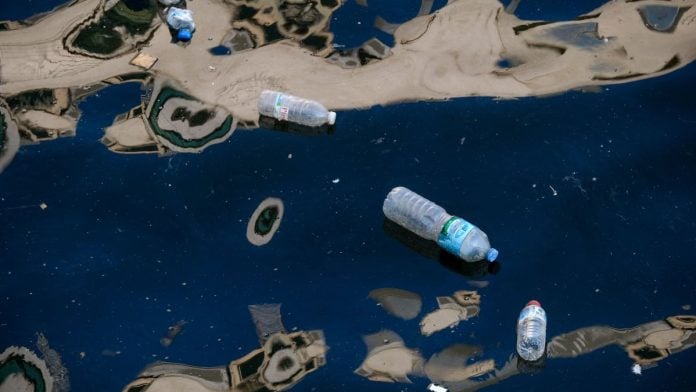
New Delhi: The Great Pacific Garbage Patch, a vast accumulation of plastic debris in the North Pacific Ocean, may be changing the colour of the surrounding seawater, according to a new study published on 5 November in Communications Earth & Environment.
The study, conducted by researchers at the University of Bergen in Norway, analysed three satellite datasets covering the period between 2002 and 2022. Researchers found that parts of the region have become brighter in blue and green wavelengths over the past two decades, a pattern that could be linked to the growing concentration of microplastics.
The researchers found that blue wavelengths increased by approximately 10% in some parts of the region, while green wavelengths increased by 2–4%. Together, these changes produce a brighter, more cyan-like appearance.
How are microplastics changing the ocean’s colour?
The Great Pacific Garbage Patch lies within a large system of circulating ocean currents, known as a gyre, between Hawaii and California. These currents trap and concentrate floating debris.
The team investigated the phenomenon by studying how microplastics interact with light compared with naturally occurring substances in seawater, including phytoplankton and minerals. Their experiments and computer simulations suggested that plastic particles absorb relatively little visible light but scatter it strongly, producing a distinctive optical signature.
“When we included microplastic particles in our simulations, this pattern we saw near the Great Pacific Garbage Patch of brightening in both blue and green light became more than four times as likely,” lead author Shea Cheatham told Scientific American. She added that researchers were initially surprised by the satellite findings.
“We were shocked, excited, and a little alarmed to see the same shift in ocean color on the map after we analyzed the first satellite dataset of the garbage patch,” she said.
Can satellites detect plastic pollution?
The findings could offer a new way to monitor microplastic pollution over large areas without relying entirely on collecting seawater samples. However, the researchers have not directly detected plastic particles from space. Their analysis identifies changes in ocean colour that are consistent with the optical properties of microplastics.
Other environmental factors could also influence the observations. Changes in phytoplankton, dissolved organic matter and mineral particles can alter how seawater reflects light. The researchers acknowledge that some combinations of natural changes could produce a similar signature.
“We’re still one step away from proving definitively that microplastics are causing the shift in color that we’re seeing,” Cheatham told Scientific American. “We just have to get in there [to the garbage patch] to verify.”
The team says it will need to collect seawater samples from the region and measure their microplastic concentrations and optical properties to confirm the hypothesis.
If validated, the technique could help identify other areas of concentrated plastic pollution. For now, the study offers a potential new monitoring tool, rather than definitive evidence that satellites can identify microplastics directly.
(Edited by Janaki Pande)