



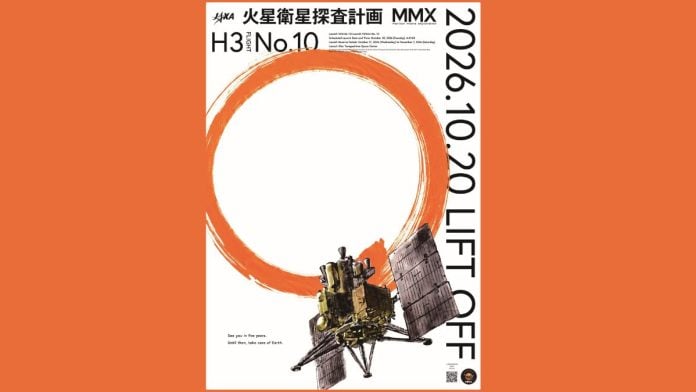
New Delhi: The Japan Aerospace Exploration Agency or JAXA will launch the Martian Moons exploration spacecraft on Tuesday, marking the first global mission to bring back samples from Mars’ moon Phobos. The five-year-old mission will also be JAXA’s first round-trip to the red planet, with the samples expected to arrive back on Earth in 2031.
The H3 launch vehicle will take off from the Tanegashima Space Centre early Tuesday morning, carrying the Martian Moons eXploration (MMX) spacecraft. This spacecraft has three main modules – one for propulsion towards Mars and its moon Phobos, then for exploration and sample collection, and finally for return and re-entry into Earth’s atmosphere.
“If we can land on Phobos, this might eventually lead us to establish a base on Phobos to conduct crewed activities on Mars,” said Imada Takane, lead engineer for the MMX spacecraft, in a press release by JAXA.
Almost 5,000 kg in weight, the spacecraft is expected to reach the Martian orbit by August 2027, but it will not land on the planet’s surface. Instead, it will analyse both its moons, Phobos and Deimos, with a specific focus on Phobos. The mission plans to land a rover, developed by Germany and France, on the moon and collect 10 g of regolith material from 2 cm below the surface.
“Exploring Martian moons could help uncover new findings to clarify the evolution process of the Solar System, including how the planets were born and shaped,” says Sawada Hirotaka, a JAXA scientist involved with developing the sampling equipment.
After collecting the samples, with the help of canisters developed by NASA, only the return module of the spacecraft will come back to Earth, departing Mars in late 2030 and arriving by 2031. The sample capsule is expected to touch down in southern Australia by 2031.
Why collect samples from moons?
According to JAXA’s press release, there are three main scientific objectives of this mission: understanding the origin of Martian moons, studying Martian surface material through Phobos’ samples, and demonstrating the feasibility of deep space round-trips for future missions.
The MMX mission is also a logical follow-up to JAXA’s Hayabusa-2 Mission, which was launched in 2014 to bring a sample from the asteroid Ryugu and successfully returned in 2019. Hayabusa-2 showed the Japanese agency’s capability to coordinate the retrieval of subsurface sample material from celestial bodies.
However, the new Mars mission is also a global first, as it would bring back the first samples directly from a Martian moon. Currently, the world has samples from Martian meteorites that landed on Earth, and while NASA’s Perseverance rover has collected samples from the Martian surface, they have not returned to Earth yet.
Scientifically, there are also many debates around the origin of Phobos and Deimos – whether they are remnants of asteroids that were pulled in by the Martian orbit, or whether they were parts of the red planet itself. Analysis of regolith directly from these moons would help clarify that debate, while also providing more insight into Martian geology too.
“As a small body that is thought to have undergone little change over time, Phobos should preserve valuable information about the history and evolution of the Martian sphere,” says the JAXA website on MMX.
The mission will also display a spacecraft that undergoes an interplanetary journey of 500-600 million kilometres twice, which will greatly increase global capability for Martian missions.
(Edited by Aakriti Handa)