





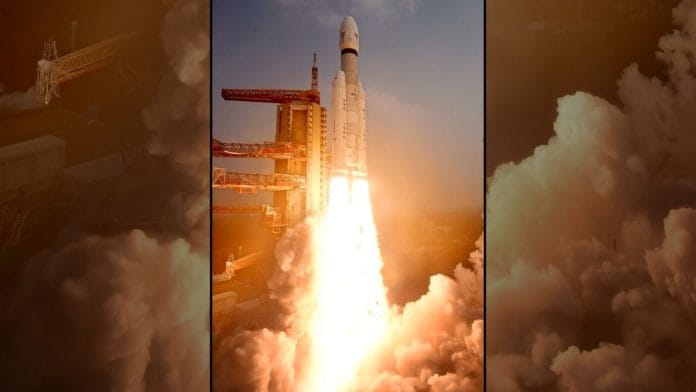


Bengaluru: The upper stage of ISRO’s LVM3-M5 re-entered the Earth’s atmosphere in the last week of July—about nine months after its flight in November 2025. This was part of a demonstration of planned efforts to limit the orbital lifetime of rocket stages, the space agency said.
The upper stage of ISRO’s LVM3, which was launched on 2 November last year from Sriharikota and successfully injected the CMS-03 communications satellite into a Geostationary Transfer orbit (GTO), re-entered the Earth’s atmosphere on 30 July this year.
The satellite was injected with a perigee—the point in an elliptical orbit where a celestial body, such as the Moon or an artificial satellite, is closest to the Earth—at 170km and apogee–the highest point of something, or the point in an orbit around the Earth where an object is farthest away—at 29,970 km. After spacecraft injection, the upper stage was passivated to limit any risks of accidental breakup and left in a highly elliptical, 21-degree-inclined GTO.
“ISRO’s System for Safe and Sustainable Space Operations Management (IS4OM) kept a close watch on the orbital decay of LVM3-M5 rocket body and regularly predicted its atmospheric re-entry during its final orbital phase. The Multi Object Tracking Radar (MOTR) at Sriharikota was also engaged to track the object wherever feasible, till a few orbits before its re-entry,” ISRO said in a statement on Friday.
It added that the most probable impact time was estimated around 12.08 UTC (5.38 PM IST) in the Atlantic Ocean.
“Only a few elements like gas bottles, nozzles, and tanks, which are made of materials with very high melting points, were expected to survive the intense aerothermal heating during the re-entry,” ISRO said.
Also read: India rolls out 3 AI-based models for faster, more accurate weather forecasts
An important goal
Reducing the lifetime of space objects is an important goal that space agencies and companies across the world are aiming to achieve. The longer a space object stays in space, the higher the chances of collisions in orbit.
The Inter-Agency Space Debris Coordination Committee (IADC) recommendations say that space objects in Low Earth Orbit (LEO), which have crossed their active life, should not stay in space for more than 25 years. In this mission, the LVM3 stage three was brought back within nine months.
“It also meets India’s Debris Free Space Mission (DFSM) requirement, which recommends a shorter orbital lifetime of 5 years for rocket stages which pass through the heavily crowded LEO region,” ISRO said.
(Edited by Saptak Datta)