



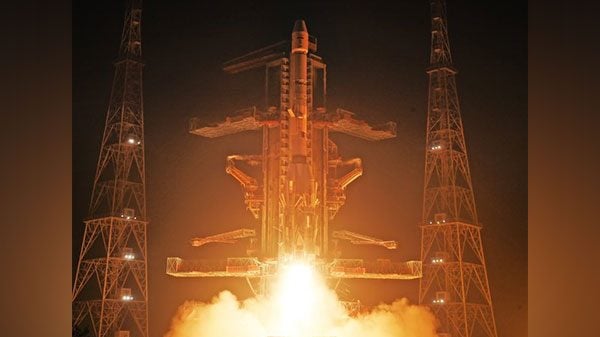
New Delhi: The Indian Space Research Organisation (ISRO) is scheduled to launch its much-awaited navigation satellite, NVS-03, on 30 October. The launch is expected to help revive India’s currently non-functional navigation system, NavIC.
Navigation with Indian Constellation (NavIC) was designed as India’s independent satellite navigation system, along the lines of the US’s Global Positioning System (GPS), Russia’s GLONASS and China’s BeiDou. The NVS series is the second generation of satellites, succeeding the Indian Regional Navigation Satellite System (IRNSS) series.
On Monday, ISRO opened public registration for viewing the NVS-03 launch, scheduled to take place from the Satish Dhawan Space Centre in Sriharikota at 11.51 pm.
“That is one of the launch dates we are looking at. Most probably, we will be able to launch NVS-03 on October 30,” a senior ISRO official told ThePrint on Monday.
ISRO scientists have explained that NavIC was developed to reduce India’s dependence on foreign navigation systems, particularly for critical applications such as military operations, disaster management, marine navigation and transport.
However, in recent years, the system has suffered setbacks, particularly following the unsuccessful NVS-02 mission in 2025 and the end of the operational life of earlier satellites. As a result, NavIC is currently unable to provide standalone positioning services.
How does NavIC work?
ISRO designed NavIC around a constellation of seven satellites and a network of ground stations operating round the clock. Three of the seven satellites are designed to be placed in geostationary orbits at 32°E, 83°E and 129.5°E, respectively. The other four are designed to operate in inclined geosynchronous orbits, with equatorial crossings at 55°E and 111.75°E and an inclination of about 29°. This arrangement places two satellites in each orbital plane.
According to NavIC’s mission document, the fully operational system is designed to offer two services: the Standard Positioning Service (SPS) for civilian users and the Restricted Service (RS) for India’s military and other strategic requirements. The network is designed to cover India and an area extending up to 1,500 km beyond the country’s borders.
“NavIC signals are designed to provide user position accuracy better than 20m and timing accuracy better than 50ns. NavIC SPS signals are interoperable with the other global navigation satellite system (GNSS) signals, namely GPS, GLONASS, Galileo and BeiDou,” the ISRO document states.
Recent setbacks
The biggest blow to the NavIC programme came with the failure of NVS-02 last year. ISRO successfully launched the satellite aboard its Geosynchronous Satellite Launch Vehicle (GSLV) on the GSLV-F15 mission and placed it in an initial transfer orbit. However, the satellite became stranded after valves responsible for admitting the oxidiser failed to open.
This prevented its onboard thrusters from firing, halting the planned orbit-raising manoeuvres.
NavIC’s deployment has faced challenges in the past as well. In 2016, the atomic clocks aboard IRNSS-1A, part of the first generation of navigation satellites that preceded the NavIC designation, became dysfunctional.
ISRO said the remaining six satellites in orbit at the time were functional, although hardware issues had also been detected in the rubidium atomic clocks aboard some of them.
Later, IRNSS-1H, launched on 31 August 2017 to replace IRNSS-1A, could not be inserted into its intended orbit.
In July this year, the Department of Space announced in a parliamentary reply that IRNSS-1F had also retired after completing its 10-year mission life. The NavIC constellation currently has three satellites—IRNSS-1B, IRNSS-1I and NVS-01—providing positioning, navigation and timing (PNT) services. At least four operational satellites are required to provide basic positioning services.
“The NavIC constellation cannot provide a standalone positioning service. However, the timing service is functional. Armed forces are using multi constellation GNSS including NavIC at present to promote operational services,” the parliamentary reply stated.
(Edited by Prashant Dixit)