



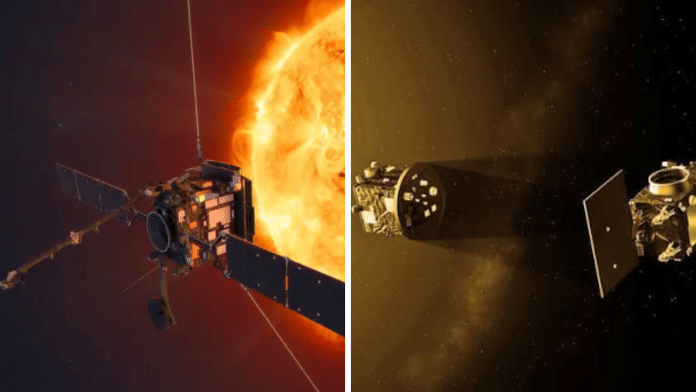
New Delhi: For the first time, scientists have jointly analysed observations from the same solar eruptions captured by India’s Aditya-L1 and the European Space Agency’s Proba-3, providing a unique perspective into the evolution of these events close to the Sun.
In a statement issued on 16 October, the Indian Space Research Organisation, which launched both Aditya-L1 and ESA’s Proba-3 earlier this year, said that researchers from Bengaluru’s Indian Institute of Astrophysics combined observations from the VELC payload on board Aditya-L1 as well as the ASPIICS payload on board Proba-3 to study coronal mass ejections. The study has been published in the journal Astronomy and Astrophysics; scientists measured the mass, density, and energetics of these CMEs in the region.
“The coronagraph onboard Aditya-L1 (VELC) and Proba-3 (ASPIICS) conducted joint observations of almost the same part of the solar corona in two different types of observations (spectroscopic from VELC and imaging from ASPIICS). These joint observations provide deeper insights into CME evolution than observations from a single spacecraft alone,” the ISRO statement read.
Fresh understanding of CMEs
Coronal mass ejections are large expulsions of plasma and magnetic field from the Sun’s corona. Measurements of CME parameters near the Sun are valuable for understanding the physical processes that shape these properties and their subsequent evolution.
However, researchers found that observing CMEs very close to the solar disk is challenging, and earlier space coronagraphs could only partially succeed in observing them. The equipment could not track the early evolution of faint CMEs, which resulted in a poor understanding of aspects like how their energy is shared between kinetic, thermal, and magnetic energy in the inner corona.
“Combining Aditya-L1/VELC and Proba-3/ASPIICS shows potential for a better understanding of it,” the statement read.
Also Read: TakeMe2Space launches AI-powered satellite on SpaceX, eyes orbital data centre
The latest findings
Between July and December 2025, thanks to the VELC and ASPIICS, scientists were able to record two CMEs on 14 and 16 September.
ASPIICS white-light and green coronal emission line observations provide sharp images that enable accurate estimates of a CME’s shape, dynamics, and mass. Whereas the VELC spectroscopic observations in the green coronal emission line provide information on CME gas at about two million degrees. This provides independent estimates of the CME’s density and thermal energy. The two instruments share a common field of view in the low corona.
“The 14 September CME was fast (about 645 km/s), while the 16 September CME was much slower (145 km/s). The density of the 16 September CME dropped more steeply with height than that of another CME, indicating its stronger early expansion,” the study findings read.
It also found that in the 14 September CME, thermal energy was only about 1 per cent of the total. In the next CME, however, the thermal energy grew until it matched kinetic energy. The estimated magnetic energy is comparable to or greater than the kinetic energy.
“The results demonstrate the scientific potential of synergetic ASPIICS and VELC observations to constrain the CME mass, density, and energetics in the inner corona, thereby providing new observational constraints on the early evolution of CMEs. The study shows that pairing a coronagraph that images the corona with one that measures its spectrum yields a more complete, cross-checked view of the origin and evolution of CMEs,” the ISRO statement said.