





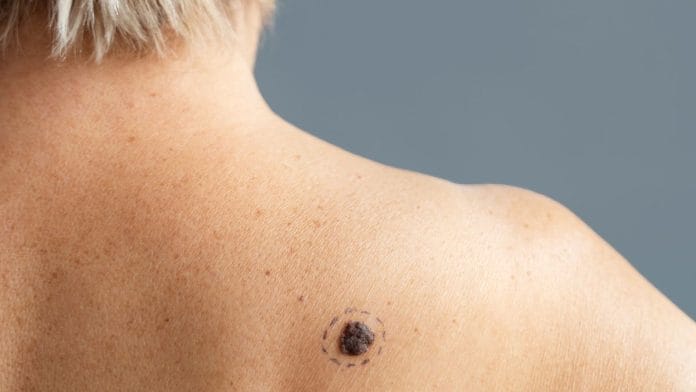


New Delhi: In most cases, skin cancer cannot be detected until there is a visible mark, mole, or textural change on the skin. However, researchers at the University of Quebec have developed a technique to catch cancer cells in their earliest stages by measuring temperature variations at the skin’s surface—their solution is a temporary “intelligent tattoo”.
“Because of their small size, (the melanomas, skin cancers) are usually excluded from clinical visual inspection, which leaves the threat unwatched. We want to detect them, so that intervention can be made as soon as possible,” said senior author Professor Jinyang Liang at Montreal University’s Institute for Research in Immunology and Cancer, in a press release.
The team’s findings, titled “Single-shot microneedle-encoded upconversion lifetime mapping for real-time in vivo thermo-dermoscopy,” were published in Nature Sensors on 20 May. While the system has so far only been tested on mice, researchers are confident that it could have a significant impact on human cancer research.
“Even though this study was conducted in mice, this animal model replicates the genetic changes observed in human melanomas and could therefore potentially benefit patients,” said researcher and co-author of the study, Sylvain Meloche.
A temporary ‘tattoo’
The solution, SMEAR-ULM, uses temperature to identify skin cancer since cancer cells are generally warmer than the body’s healthy cells. Cancer cells multiply rapidly and burn through glucose and oxygen at higher rates, which releases more metabolic heat than ordinary skin cells.
This heat signal has been too imprecise to be useful to clinicians for a diagnosis. However, the “tattoo” can turn the subtle temperature changes into a sensitive and measurable signal. The system is embedded onto a robotic arm, which can then be moved around to be positioned where necessary.
To arrive at a diagnosis, the SMEAR-ULM system uses a patch of micro-needles that leave nanoparticles just beneath the skin, creating a temporary “intelligent tattoo” that can act like a group of microscopic thermometers.
The nanoparticles emit visible light when lit up with near-infrared light. The duration of that light depends on the skin’s temperature. The nanoparticles in the area with cancer cells sense the extra heat and emit a visual signal for longer, which is then captured with a high-speed imaging technique. SMEAR-ULM then generates a thermal map of the skin, allowing a diagnosis of skin cancer.
Using this technique on mice, researchers were able to detect melanomas that were just four days old. The study highlighted that nanoparticles could also be used for bio-imaging beyond skin cancer, allowing doctors to better understand the body using temperature.
According to the World Health Organisation’s Global Cancer Observatory, melanoma accounts for nearly 1.7 per cent of all cancer diagnoses. Nearly 80 per cent of cases are reported from Europe and North America. Populations with fairer skin and those that face high ultraviolet radiation are more susceptible to it. However, current diagnosis relies mostly on visual examinations and then biopsies, which can often be invasive and sometimes even unnecessary.
(Edited by Insha Jalil Waziri)