





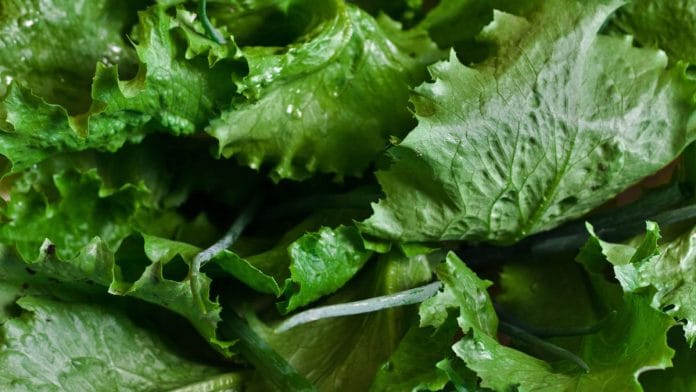


New Delhi: Researchers at the Imperial College London have created a new type of lettuce and tobacco plant that can produce myoglobin — the iron-rich animal protein which gives meat its red colour and metallic taste and flavour.
“We show that plants can be engineered to produce the animal protein myoglobin (Mb) in their chloroplasts, the energy factories for photosynthesis. This could provide a more sustainable way to produce an important ingredient for plant-based meat products,” said Dr Alexia Groff, a researcher at Imperial College London, in a statement.
The study, titled “Sustainable production of myoglobin meat protein in plant chloroplasts”, was published on 6 August in Frontiers.
This research is still at a ‘proof of concept’ stage and is likely to take several years before it turns into a product on the market. But if or when it does, it would prove to be a great alternative to livestock farming which is a major contributor to greenhouse gas emissions, deforestation, and even uses up a lot of freshwater.
To reduce the environmental footprint of meat, several consumers have turned to meat alternatives in the past few years. The global market for meat alternatives is currently worth between €6.7 billion and €8.1 billion per year and is growing steadily.
A common method for producing such ‘fake meat’ is microbial engineering where the gene codes for animal proteins are inserted into bacteria or yeast for mass production. But this study offers a new scalable solution.
Also read: US teen wins prestigious STEM award. She was studying ant memory
A bio-engineering feat
Researchers first cloned pig and cow myoglobin genes and then inserted them into tobacco and lettuce chloroplasts — an organ found inside plant cells that play a key role in allowing the plant to absorb sunlight. Researchers also inserted the myoglobin genes into the nuclear genome tobacco to compare what worked better.
With time, the engineered plants grew, flowered, and produced fertile seeds and passed on the inserted gene onto their offspring. The plant’s photosynthesis was not affected by injected protein.
The experiment revealed that by injecting myoglobin into chloroplasts the plant could generate three times more protein than if the myoglobin was injected into the plant’s DNA. This confirms that chloroplasts are better ‘protein factories”.
Researchers found that both tobacco and lettuce yielded around 800 mg of protein per kilogram. This is still significantly lower than the protein available in real meat, which is nearly 8.1 and 11.2 mg myoglobin per gram.
“Despite this, plant cultivation is far more resource efficient than livestock production; consequently, plant-derived Mb could achieve protein yields per hectare that rival – or even potentially exceed – those of animal agriculture, while also benefiting from substantially lower water use and greenhouse gas emissions,” the authors wrote in the study.
For now, researchers plan to extract the myoglobin from the leaves, purify it using industrial protein purification methods and then add it as an ingredient into plant-based meat alternatives to improve their colour, flavour, and nutritional value.
“We hope that edible lettuce, modified to express myoglobin, could also one day serve as a heme-iron-enriched biofortified food, depending on legislative approval,” added coauthor Kyoko Morimoto, chief scientific officer at Kyomei, a Cambridge-based plant biotechnology startup which partially funded the research.