





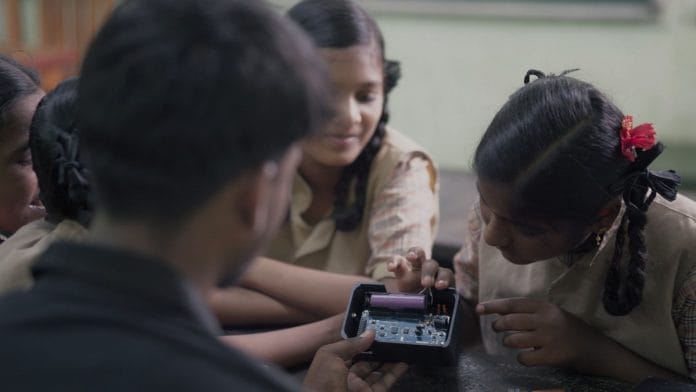


New Delhi: Schoolchildren in India will soon be able to build artificial intelligence projects on an indigenously designed, commercial-grade microchip.
Under a new partnership between Chennai-based tech startups Mindgrove Technologies and AtumX, a homegrown developer board called AGNI is being rolled out in government schools, starting this week with five schools in Chennai, with support from the Atal Innovation Mission. A developer board is a ready-to-use circuit board built around a processor or microcontroller, allowing users to develop, test and prototype electronic applications.
“AGNI is India’s first indigenous developer board, powered by an indigenously designed chip,” Shashwath TR, co-founder and CEO of Mindgrove Technologies—a chip design company— told ThePrint. “It’s the same silicon platform engineers and OEMs use to build real products, not a simplified or toy version made for education.”
The idea is for students to use the board to learn coding and electronics, build AI projects and experiment with robotics, while also creating an early talent pipeline for India’s semiconductor industry.
AGNI runs on Mindgrove’s Secure IoT SoC (System on Chip), which integrates the processor and other key computing functions onto a single chip. It is built on the open-source RISC-V architecture, allowing companies to design processors without relying on proprietary chip designs. AtumX has adapted the board for classrooms with a student-friendly programming environment that takes learners from block-based coding— a Lego-like, drag-and-drop method— to AI projects.
The first phase will reach 1,000 students across five government schools in Chennai, before expanding to more Indian cities in the coming months, according to Shashwath.
Also Read: IN-SPACe releases new guidelines for atmospheric reentry of space objects
Semiconductor ‘talent pipeline’
AGNI provides students and engineers with an Indian-designed alternative to developer boards based on foreign chip platforms.
“It is created in India and the board itself is designed and manufactured in India. This refers to indigenous design and manufacturing of the chip and board, rather than a claim that every single component on the board is domestically sourced,” Shashwath said.
The company says engineers and original equipment manufacturers (OEMs) building electronics in India have so far lacked a homegrown board that can be used from evaluation through deployment.
In a statement, the company said that AGNI is meant to introduce students, engineers and OEMs to its technology ahead of its upcoming chip launches— and as a way of building its talent pipeline before market entry, not after it.
Now, even school students will get “hands-on access” to a real, industry-grade chip and IDE (integrated development environment), rather than a simplified version made for classrooms.
“This means students who learn on AGNI in school are already familiar with India’s own semiconductor ecosystem by the time they reach college or careers, rather than needing to adapt from foreign platforms later,” Shashwath told ThePrint.
Meanwhile, AtumX— which develops STEM toys and robots for children– will conduct workshops directly for students, so schools will not need to train their existing teachers to use the boards.
“A school student who learns on an Indian chip today will do his college projects on an Indian chip, file his patents on an Indian chip, and build his startup on an Indian chip. AGNI is not just a microcontroller in a school. It is the first chapter of India’s indigenous technology story written by the students themselves,” Akash J, co-founder and CEO of AtumX, said in a statement.
(Edited by Asavari Singh)