







New Delhi: Researchers have made an AI tool that can create fictional languages from scratch. The discovery allows for a new way of exploring linguistics.
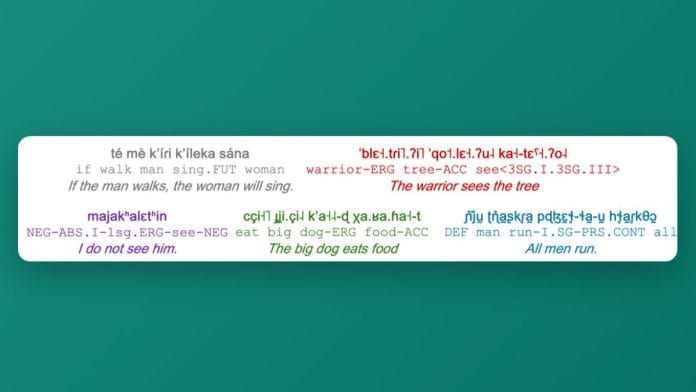
A recent paper published in the Proceedings of the Association for Computational Linguistics described a new tool that the authors have developed — ConlangCrafter, an automated system that can construct artificial languages with their own phonology, grammar, lexicon using large language models. The tool was developed by researchers at Tel Aviv University, Carnegie Mellon University, and UC Berkeley.
The ConlangCrafter website is open to the public to browse generated languages, explore their structure, and even try simple translation. It also links to HuggingFace, an open source platform described as the GitHub of Machine learning where developers, researchers, and even organisations can share their AI models and datasets.
“The idea of ConlangCrafter is — How can we make new languages that have different linguistic features than what we normally see in natural languages?” said Morris Alper, the paper’s first author and an incoming assistant professor in the Department of Computer Science at the University of Miami College of Arts and Sciences in a statement.
Also read: India’s banks show how AI is impacting jobs. Govt must focus on skilling
The birth of a new language
The authors of the research paper have used ConlangCrafter to construct over 60 different languages and have also shared their code so that others can experiment and create their own languages too. The tool allows researchers to create unconventional languages like ones that have no consonant sounds. They even tried building a language for an alien cephalopod species that use only colours and gestures to communicate.
ConlangCrafter even translates sentences from existing languages into the fictional ones and revise its own work, identify inconsistencies and fix them.
What makes ConlangCrafter different from existing LLMs like ChatGPT is that it is crafted to make sure languages are diverse and consistent with a set of internal rules that govern them.
“Imagine if you just say (to Gemini), ‘Make me a language.’ It will give you something that doesn’t make sense,” Alper said. “What we did is build this pipeline where you say, ‘Okay, what are the sounds? And then let’s check them. And then, what are the rules for building words? What about syntax?’ We split the problem apart and have the LLMs solve each sub-problem and combine them together.”
According to the researchers such a tool has applications beyond just entertainment. By creating new languages and experimenting with their format researchers can study how language evolves, they can test linguistic theories, create fictional languages for games or films, and even test out what communication systems beyond those found on earth could be like.