





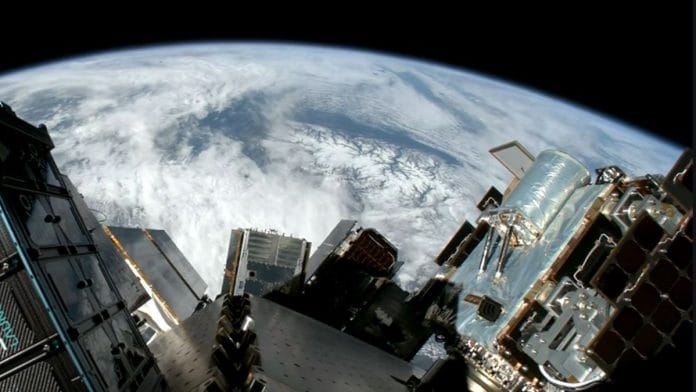


New Delhi: Bengaluru-based startup GalaxEye Space made history Sunday as it launched the world’s first OptoSAR imaging satellite, Mission Drishti, aboard SpaceX’s Falcon 9 rocket from California. By combining optical imagery and classic synthetic aperture radar or SAR, the new satellite will provide a new, improved form of earth observation.
Mission Drishti, GalaxEye’s first-ever space mission, is also the largest satellite launched by India’s private sector, weighing a whopping 190 kg. It can capture all-weather, day-and-night imagery and is expected to be used for defence, agriculture, disaster management, and even maritime monitoring services. While it was launched at 12:30 pm on 3 May, the satellite will begin to send initial imagery only after a few weeks.
The launch is also the first in a series planned by the startup, which aims to place a constellation of OptoSAR satellites in space over the next five years to expand earth observation operations.
“Mission Drishti marks a major achievement in our space journey. The launch of the world’s first OptoSAR satellite… is a testament to our youth’s passion for innovation and nation-building,” Prime Minister Narendra Modi posted on X.
GalaxEye Space was incubated in 2021 at IIT Madras by five master’s engineering students, led by Suyash Singh, an alumnus of the aeronautical engineering department. The company focuses on earth observation satellite imagery and has been working toward Mission Drishti for the last five years.
“The world today demands faster, sharper, and more persistent eyes in the sky. With enhanced resolution and performance, our satellite marks a significant leap in unlocking richer, more detailed analytical intelligence,” said Singh, co-founder and CEO of GalaxEye, in a press release.
The question that GalaxEye poses for global satellite imagery is: “Why must we choose between satellite data that is either clear or consistent?”
Optical imagery, which uses visible and infrared light—much like a regular camera—provides detailed visual images that capture colour and appearance. However, SAR, which uses radar signals, can work even through clouds, at night, and can capture the surface texture and shape. To use both these insights together, space organisations use two different satellites, such as Sentinel 1 and Sentinel 2 of the European Space Agency.
Until Mission Drishti, no satellite in the world could use both technologies on the same platform, as the sensors require different viewing angles and capture images in different time periods. More importantly, optical imagers and SARs also use different orbits.
Also read: Health vs. Heat—New study shows how India really wants its climate change messages delivered
What sets Mission Drishti apart
Mission Drishti’s solution was not to just mount two different sensors on the same satellite. Instead, the team integrated the sensors from the beginning. GalaxEye designed a Syncfusion Technology stack, which has both an SAR sensor and a Multi-Spectral Imaging (MSI) sensor on the same ‘optical bench’, meaning they’re aligned to look at the same point on the Earth at the same time.
Further, Drishti’s internal software design ensures that the data captured by both sensors is analysed in space, and a refined output is sent back to the ground.
“It (Mission Drishti) serves as a definitive proof-of-concept for India’s private space sector reforms and signals a transition from small-scale testing to sovereign, all-weather surveillance capabilities critical for national security and disaster response,” said Lt Gen AK Bhatt (Retd), DG, Indian Space Association, in a press release.
In 2024, GalaxEye Space won the Government of India’s iDEX-DIO challenge for defence innovation in satellite edge computing. It also raised $10 million in Series A funding in 2024 and conducted technology demonstrations aboard ISRO’s POEM mission in December 2024. The startup was supported by the Indian National Space Promotion and Authorisation Centre (IN-SPACe) for the initial testing phase.
“The sustained effort over the last five to six years on confidence-building, capacity-building, and the commercialisation of India’s private space technology ecosystem is now showing tangible results,” said Pawan Goenka, Chairman, IN-SPACe. “I compliment the GalaxEye team and wish them continued success.”
(Edited by Prasanna Bachchhav)