



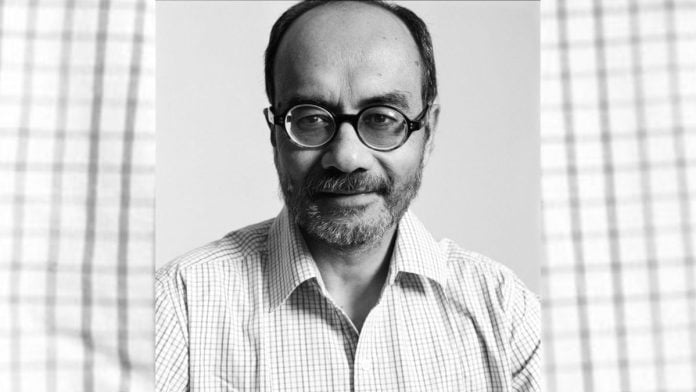
New Delhi: Physicist Ashoke Sen is the first Indian to be awarded the Oskar Klein Medal, a prestigious international honour in physics, for his research on string theory and black holes.
Sen is an ICTS-Infosys Madha Chair Professor at the International Centre for Theoretical Sciences (ICTS) in Bengaluru and his work focuses on string theory and research on black holes. The Oskar Klein Medal, awarded by the Stockholm University and the Nobel Committee for Physics of the Royal Swedish Academy of Sciences, recognises such scientists who have explored how gravity and the world of miniscule particles coexists and fits into theoretical explanations.
The award is an addition to the long list of awards that Sen has won. He received the Breakthrough Prize in Fundamental Physics in 2012, the Dirac Medal in 2014, the Padma Shri in 2001, the Padma Bhushan in 2013, and was elected a Fellow of the Royal Society in 1998.
Former director of the Council of Scientific and Industrial Research (CSIR) Raghunath Mashelkar congratulated Sen, recalled their first meeting, when both of them were elected as Fellows of the Royal Society. At the time, Sen was only 42, and had been nominated for the post “by Stephen Hawking himself”.
“What struck me was Ashoke’s incredible simplicity. His wife Sumathi Rao has reportedly said that Ashoke bought his first suit and needed some assistance to wear his first tie for that prestigious 1998 FRS ceremony in London, when one signs in the same book that Sir Isaac Newton has signed,” Mashelkar wrote in a post on X.
Also read: Scientists develop USB-sized electronic implant to lower blood sugar
String theory and black holes
Born in 1956, Sen studied at Presidency College in Kolkata before heading to the Indian Institute of Technology Kanpur for his master’s degree. He earned PhD from Stony Brook University in the US in 1982 and spent a few years in various research positions at Fermilab and the Stanford Linear Accelerator Centre.
Sen eventually returned to India in 1988 and joined the Tata Institute of Fundamental Research in Mumbai. He later moved to the Harish-Chandra Research Institute in Allahabad before joining ICTS in Bengaluru.
When the lay person thinks of the building blocks of matter, they imagine atoms. But atoms are also made up of smaller particles. Physicists like Sen want to understand what lies at the most fundamental level of matter. String theory offers one possible solution — that the basic ingredients of the universe are not particles but instead tiny strings. The different ways that these strings vibrate could produce different particles, in the same way that different vibrations on a guitar produces notes.
Sen’s research has led him to some of the biggest questions still puzzling scientists — can gravity and quantum science be understood through one theoretical framework? His work has also helped researchers better understand black holes and their properties.