





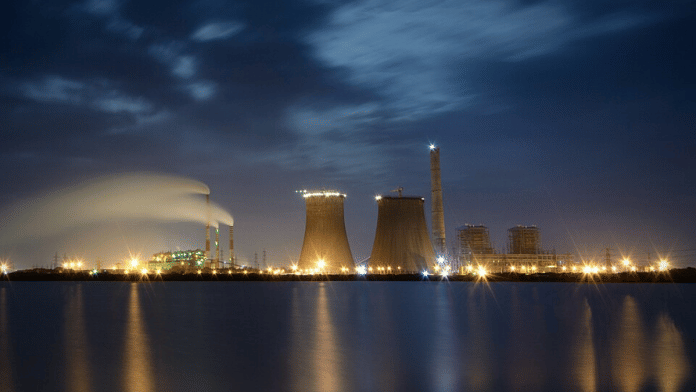

Chennai: The Tamilaga Vettri Kazhagam (TVK) government has been on a spree of cancelling several infrastructure projects approved or planned by the previous DMK regime, including the controversial Parandur airport, which was cancelled due to environmental concerns and to protect farmland. However, Chief Minister C. Joseph Vijay on 30 August announced a thermal power plant in Thoothukudi.
The power plant will have two units of 800 MW each, a total of 1,600 MW, at an estimated cost of Rs 20,800 crore. It would be built under a public-private partnership at the existing Thoothukudi Thermal Power Station complex. The five old 210 MW units, operating since the late 1970s and adding up to 1,050 MW, will be progressively replaced. The net addition to capacity would be around 550 MW.
The announcement was not received well by conservationists since it further threatens the environment in Thoothukudi villages, which was the main reason the DMK did not go ahead with thermal power plants in the district.
G. Sundarrajan of Poovulagin Nanbargal, an NGO focused on environmental protection, pointed out that the ash pond of the five-decade-old Thoothukudi station was already full. He alleged that slurry was being dumped into the sea, which was an environmental violation that would only worsen with a new plant. “There will be no space for an ash pond if a new plant is built. This will affect the fishery and the fishing activity,” he said in a statement, post the announcement.
Tamil Nadu has committed to net-zero carbon emissions by 2050, which is ahead of India’s 2070 target, and aims for 50 percent of its energy from renewable sources of energy by 2030. A new thermal power plant directly contradicts the plan of the state on reducing carbon emissions.
In a video statement on X, Prabakaran Veera Arasu of the Poovulagin Nanbargal also noted that the pollution levels will increase in Thoothukudi and will be higher than that of Delhi if another power plant is installed.
He also stated that the previous DMK government had taken a policy decision not to start new thermal projects because of environmental concerns, choosing instead to complete only those already underway. He also said that people living in areas where thermal power plants are installed are severely affected.
Activists also emphasise that the TVK government should address issues in transmission of electricity produced out of solar panels, and focus on renewables.
Tamil Nadu, despite its strong potential for wind and solar power, lags behind major Indian states in renewable energy capacity addition. Its solar capacity stands at just 14,121 MW, far below Gujarat’s 33,763 MW and Rajasthan’s 44,135 MW.
While Tamil Nadu Green Energy Corporation Limited (TNGECL) has not invited fresh applications for new solar and wind projects since March, there is a need for new 400 kV or 765 kV substations in high-potential areas like Tirunelveli-Kanniyakumari.
The TVK government that cancelled previous-regime projects on environmental and livelihood grounds, ironically plans to expand the energy project that DMK avoided on the same grounds.
The government had stated that old units would be replaced with more efficient supercritical technology, and thermal power remained necessary for peak demand and grid stability. Meanwhile, the government is yet to respond to the issue on whether it would reconsider the decision on the new thermal power plant.
(Edited by Viny Mishra)
Also read: Vijay cancelled Parandur despite economic costs. That is what keeping a promise looks like