





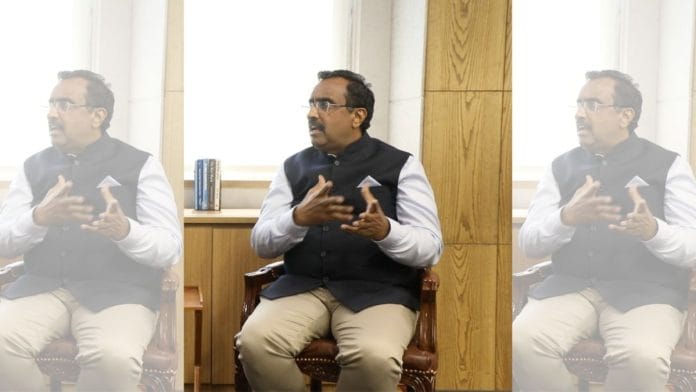

New Delhi: It is important for India to delink Indo-US ties from the prism of Donald Trump, Rashtriya Swayamsevak Sangh (RSS) national executive member Ram Madhav told ThePrint, adding that Trump has a habit of claiming credit even when it is not warranted.
In an interview with ThePrint, Madhav who also heads the think tank India Foundation said dealing with Trump remains a challenge not just for India but other countries as well, and that there is currently a lack of respect between New Delhi and Washington DC.
This however, was not the case with Russia, he said, adding that New Delhi and Moscow have a strong relationship despite Western pressure. Madhav, while maintaining that Trump remains a challenge for India, said New Delhi needs to deal with that challenge “carefully”.
“I would say what is required is strategic patience. That’s why that strategic maturity, strategic balance and strategic patience is what is needed in dealing with today’s America.”
Madhav further insisted that Trump and the US had no role in the post-Operation Sindoor ceasefire. “So Trump has the habit of taking credit for things that he doesn’t deserve taking credit for. He does so many things for everything under the sun…that is his style of functioning but we, our ministry, our government made it very clear that President Trump had no role whatsoever. For that matter, the US has had no direct role in that ceasefire.”
Adding, “Advice anybody can give. Anybody who is friends with us can pick up the phone and give advice, but even that Trump never spoke with our Prime Minister during the period of those four or five days of that limited conflict (during Op Sindoor). So for Trump or America to claim that they played a role is totally false.”
On how India-US relations have evolved over time, given the planned bilateral between Trump and Modi in France, Madhav said it is important to delink India-US relations from India-Trump relations. The meeting between Modi and Trump will be the first bilateral between the two since the Indian Prime Minister travelled to the US in February 2025.
Ties between India and the US nosedived in the months that followed, after Trump’s insistence on New Delhi curbing its import of Russian oil and claiming credit for mediating the ceasefire with Pakistan in May 2025.
“Look, we have to delink India-US relations from India-Trump relations. This is one challenge not just India is facing but many countries in the world are facing. It is an issue between the White House and governments in different countries. The European Union is facing it. Australia is facing it. Many countries face a very tough situation when it comes to dealing with the White House in Washington DC. So, on India-US, don’t give up on our pragmatism. What I’m saying is this relationship has been built brick-by-brick over the last 25 years,” he added.
Madhav recounted former Prime Minister Atal Bihari Vajpayee’s visit to the US in 2000 when he said that India and the US are ‘natural allies’.
“We are natural friends from then to today. Successive governments…have done so much to strengthen this bilateral relationship. We invested so much. That’s the reason why we today have more than $200 billion worth of bilateral trade happening between our countries. Not just trade, our technology dependence on each other is huge,” he said.
Adding, “We have a very important intelligence exchange mechanism, a very important strategic partnership. So this is what we have built between two big democracies in the world. We should not simply assume that because Trump is saying something, we should just destroy it.”
On the Trump White House’s equation with Islamabad, Madhav said India can’t decide who will be Trump’s friends and enemies. “No, that is America’s choice. I mean, we can’t decide who will be Trump’s friends and who will be Trump’s enemies. Trump wanted to deal with Iran through Pakistan for some time.”
Musharraf too, he said, was very close to Bush and Obama administrations.
He, however, maintained that India-US ties are also equally strong, “but in that we stand our ground very firmly. We don’t kowtow to any other country.”
Also Read: India-US trade deal to be signed after Trump administration decides new global ‘tariff architecture’
Ram Madhav on India, Russia & China
Madhav, while further outlining India’s relation with the US, said India is much more comfortable dealing with fellow democracies, which makes India and the US natural partners. “That’s why when necessary we defied the US also. We did not succumb to their pressures also.”
He also said that is the reason India did not buckle under pressure to limit its ties with Western powers. “I don’t think anything has changed in that (India-Russia ties). Certain pressures from Western power, there’s no doubt, but we did not succumb to those pressures. Our relationship with Russia has been built over the last four or five decades or even more, right from the time of our independence that we have built a strong relationship with the then United States and Soviet USSR. Subsequently, with Russia, that relationship continued. It’s a very important relationship, a trusted relationship.”
Adding, “Both the countries have enormous mutual trust and we respect each other, unlike you know the kind of situation we face today between US and India, where lack of respect is another big worrying factor in terms of Russia, we enjoy great mutual respect.
“The leaders of our two countries enjoy a great bonhomie between President Putin and Prime Minister Modi. There’s a good friendship, so it’s a very important relationship. We have constantly upheld that bilateral relationship with Russia, and today take the energy scenario in our country.”
Madhav said despite the blockade of the Strait of the Hormuz, India has managed its energy situation well.
“You know, where the energy prices have gone up by 50 percent in America and more than 40 percent in China, we maintained the same prices for the first 60 days. After 60 days when the situation became a little difficult, we enhanced them only by 10 percent. How could we do that? The reason is we were able to get supplies from Russia through a different route. Today, India’s energy imports, 40 percent of them almost, come from Russia. It’s an important partner when it comes to India’s energy needs. So India’s relationship with Russia is a very important relationship, and it’s a relationship that will continue,” he said.
Recounting 1962, Madhav said India faced a humiliating defeat against China and lost a huge chunk of its territory but New Delhi now follows the policy of proactive diplomacy while staying firm when it comes to issues related to border disputes.
“You can’t say that anything like that has happened under Modi in the last 12 years. On the contrary, there is a very important, strategic, strategic shift in the way we are now dealing with China. We now follow the policy of proactive diplomacy with China whenever there is a dispute, diplomatically engage with them, but we stand very firm on the ground. That’s a very big difference in our approach to tackling China,” he said.
Referring to both Doklam and Galwan, Madhav said the message to China is now clear: “We (India) believe in proactive diplomacy, but we will stand very strong on the ground also to protect every inch of our territory. This is a major shift in our China policy which I think those who talk about previous experiences must appreciate, must understand.”
(Edited by Amrtansh Arora)
Also Read: Narendra Modi flags trust deficit at G7 ahead of Trump meeting
I think something has broken in the India – USA relationship. President Trump 2.0 is undoubtedly a factor, a major one, but, on both sides, expectations were higher than the other side was willing or able to deliver. What this means for the always difficult relationship with China is a task the government must have taken in hand. Whether Russia can play a modest, constructive role again is the government’s best judgment.
Ram Madhav is an unelected person. Just because he’s RSS seven, he has the government’s ears (Modi-Shah)! How convenient?
Madhav ji seems to trying to save his skin after running our foreign policy into shatters. We failed to understand US and China for the last two decades.