





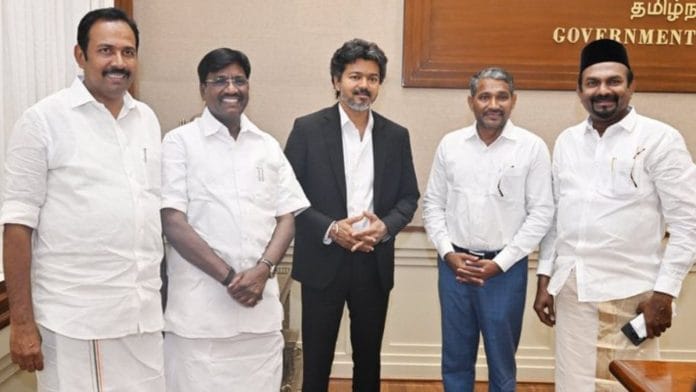


Chennai: The induction of ministers from the Congress, one each from the Indian Union Muslim League (IUML) and the Viduthalai Chiruthaigal Katchi (VCK) into Chief Minister C. Joseph Vijay’s cabinet marks a decisive shift from Tamil Nadu’s traditional politics–one dominated by the two Dravidian parties that did not find it necessary to share power with allies.
With Vijay’s Tamilaga Vettri Kazhagam (TVK) at the helm, a coalition government has been formed in the southern state for the first time since 1952, when the Congress was in coalition with the Commonweal Party.
The 35-member cabinet led by Vijay—31 from TVK, two from Congress (S. Rajesh Kumar from Killiyoor and P. Viswanathan from Melur), and one each from the IUML (A.M. Shahjahan) and the VCK (Vanni Arasu)—is backed from outside by the Left parties.
For TVK, formed barely two years before it came to power, the coalition structure offers both political cover and institutional memory it could not otherwise have built immediately.
Allies bring administrative experience that TVK, navigating its first term, visibly lacks.
“The coalition brings balance for the government. Our leader believes that every section can present their own opinions and needs, and create a more cooperative environment within the party. We were always willing for power sharing,” K. Siva, TVK functionary and Chennai District Secretary, said Friday.
Sharing power also distributes the burden of anti-incumbency. Course corrections on policy can be managed through internal consultation rather than external pressure—a degree of flexibility a single-party government typically does not have.
The Congress, which returns to ministerial office in the state after nearly 59 years, brings institutional memory of governance.
Congress MP Sasikanth Senthil invoked the K. Kamaraj era as the standard the party intended to hold the coalition to. Kamaraj was the chief minister when the Congress was in power the last time in the state in 1967.
“I think the partnership of TVK with Congress would work well because Congress also brings experience in governance. Congress did not have power for a long time but the Kamaraj’s era is still talked about for being secular, corruption-free and people friendly governance. We would like to maintain that in the future,” Senthil said.
The MP from Tiruvallur added that the Congress’s presence in Tamil Nadu’s government, and in neighbouring states such as Karnataka and Telangana, “would bring in a good synergy to the system”.
The Left parties and VCK, which have strong grassroots presence and a commitment to social justice and welfare, are expected to play an accountability function from within the cabinet—keeping the government responsive on issues where TVK, as a younger party, has less ideological investment.
Also Read: After MGR & Jayalalithaa, AIADMK pieced itself back together. This time, the cracks are deeper
The fault lines
Coalition governance introduces pressures of its own—and Tamil Nadu’s political history makes those pressures sharper.
“Tamil Nadu’s politics have been dominated by large personalities who were able to get a majority on their own. In 2006, DMK was able to get outside support by convincing the allies, but power sharing was not offered. While including allies in governance adds more stability, there is always a possibility of outside support being withdrawn and the government falling,” said political analyst Sumanth Raman.
Managing ideological diversity within the coalition can be another challenge.
The episode involving 25 AIADMK rebels backing the Vijay government served as an early test case and demonstrated that TVK’s allies actively shaped the government’s composition. The Congress and Left parties had opposed AIADMK’s inclusion in the cabinet, a view that TVK eventually heeded.
“We saw that, even as AIADMK support was extended to TVK, Left parties intervened and ensured that the rebel faction of AIADMK is not made a part of the governance, given that they are in alliance with the BJP and many leaders from the faction are close to BJP leaders. While there will be diverse ideological differences, this is the challenge that TVK will have to fight out,” political analyst A. Ramasamy said.
He said it will be helpful for TVK to have “broader consultations” as they are a new party and “key decision-making can be supported by the allies”.
End of Dravidian formula?
For nearly six decades after 1967, Tamil Nadu’s political landscape was defined by the DMK and AIADMK.
Both parties built cadre-based organisations with deep penetration across castes and regions. Their alliances with smaller parties were primarily electoral arrangements—partnerships that did not translate into genuine cabinet-level power-sharing.
The governing philosophy was articulated by DMK’s C.N. Annadurai, who had once said: “Self-rule in the state, coalition at the Centre.”
Within that framework, welfare populism and social justice rhetoric could be pursued without the friction of multi-party negotiation.
DMK spokesperson Saravanan Annadurai noted that this is the first time since 1952 that a Tamil Nadu government has lacked an outright majority, but cautioned against drawing early conclusions.
“We will have to wait and see how it plays out. The government is currently running with allies. Congress may remain silent on the issues given that they are looking at 2029 elections. However, the allies, including the Left and VCK, will keep the government in check and if they remain muted, they will become irrelevant, which they wouldn’t want,” Saravanan said.
Political analyst Ramu Manivannan argued that the current coalition reflects a constrained accommodation rather than a full reversal of tradition. “In the political scenario of Tamil Nadu where regional parties have historically limited the influence of national parties in state power structures, national parties like Congress are compelled to adopt a more accommodative and diluted stance on core ideological issues. This allows state-centric priorities, such as language policy, federalism and social justice, to take precedence over central agendas,” Manivannan said.
He said Congress’s prolonged spell in Opposition at the Centre had made it attuned to exactly this dynamic.
“The Congress has been in the Opposition in the Centre, so they understand how significant regional issues are in terms of maintaining support in states. Congress knows that TVK is very close to breaking the AIADMK alliance, so they would ensure that there is no break in the coalition or any indirect link of TVK with the NDA alliance too,” he said.
What comes next?
Durability of the coalition government will be tested, in part, through power-sharing negotiations.
“TVK will have to further evaluate how seats are allocated to the Congress in the future elections. Congress would like to expand its reach in the state and there can be stronger negotiations since they will want at least one third share in the parliamentary constituencies,” Manivannan said.
But Raman urged restraint in reading too much into the coalition’s significance at this stage. “This is not the first time the state has had a coalition. It has happened before in 1952,” he said.
Also Read: In TN, new CM Vijay faces big dilemma over big-ticket infra projects—which he once firmly opposed