





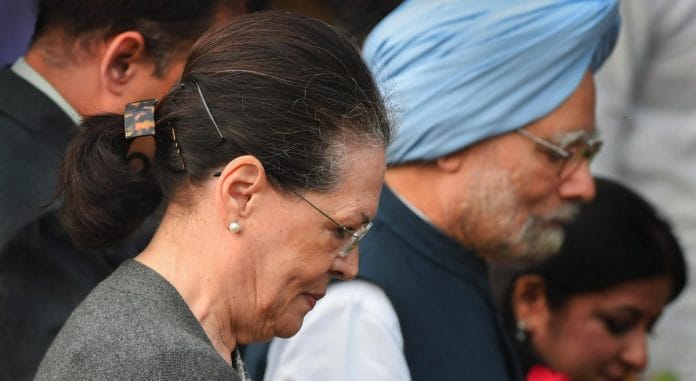


New Delhi: Congress Parliamentary Party chairperson Sonia Gandhi has asked Prime Minister Narendra Modi to “forgive himself” for his 2017 remark against former prime minister Manmohan Singh, in which he had said Singh knew “the art of bathing with a raincoat on”.
Referring to the recent Supreme Court ruling upholding the Central Bureau of Investigation’s (CBI) clean chit to the former prime minister in the coal block allocation case, Gandhi has written in an article in The Indian Express that there was a “witch hunt” against Dr Manmohan Singh. “The lobby against him was coordinated and well-organised, with actors stretching from the bureaucracy to the media, the judiciary, civil society, and most certainly to the Rashtriya Swayamsevak Sangh (RSS) and Bharatiya Janata Party (BJP). Today, their bogus crusade has come to its inevitable conclusion of nothingness. Dr Singh has been vindicated on every count,” she wrote.
Gandhi referred to PM Modi’s ‘raincoat’ remark against his predecessor as the lowest point of parliamentary history, and sought an apology, citing his recent Instagram video where he forgave students for using “abusive words” against him.
“It is not a coincidence that the Prime Minister was also among the most vocal proponents of the attack on Dr Singh. His snide and atrocious remarks in the Rajya Sabha on 8 February 2017, that only Dr Singh knew ‘the art of bathing with a raincoat on’, will go down as the lowest point of our parliamentary history. Since Mr Modi is these days ‘forgiving’ India’s students for attacking him, perhaps he can take this opportunity to forgive himself for his undignified slander against Dr Singh,” she wrote.
Gandhi’s comments come after the Supreme Court’s 29 July judgement upholding the CBI’s clean chit to Singh in the alleged coal block allocation scam. The court also pulled up the trial court for rejecting the CBI’s closure reports and making adverse observations against Singh without a “compelling reason”.
Gandhi further wrote the campaign questioning his integrity involved sections of the bureaucracy, media, judiciary and civil society, as well as the RSS and BJP. Gandhi also accused the Modi government of misusing the Enforcement Directorate (ED) and CBI to pressure political opponents.
“Leaders are either silenced through coercion or cynically folded into the BJP or, in some remarkable instances, rewarded with ministerial positions as well. When credible accusations of corruption emerge, the Modi government simply brushes them aside. Corrupt when you’re in the Opposition, suddenly clean when you jump ship!”
She also pointed to the economic growth during Singh’s 10 years as prime minister, along with rising consumption and private investment. Gandhi said the United Progressive Alliance (UPA) government recorded higher economic growth than the following 12 years and argued that millions of people were pulled out of poverty during the period.
“Dr Manmohan Singh’s government heralded profound economic change with unprecedented rates of growth and a consumption and private investment boom that propelled us into the ranks of middle-income countries. In 2008, when the global economy faced turbulence and collapse, India demonstrated its resilience. During his tenure, the shift in employment patterns became very discernible with lakhs moving into higher-productivity occupations. Over the last decade, however, this diversification has been reversed. Based significantly on the programmes put in place in the previous government and the acceleration in growth rates, India decisively began winning the battle against poverty and deprivation. Let us not forget that in spite of the re-working of how the growth of India’s GDP is calculated, the 10 years of the UPA government saw higher economic growth than the past 12 years, resulting in millions being pulled out of poverty.”
Gandhi said Singh’s “statesmanship, erudition, and fundamental decency” were “sorely missed in today’s conflicted times”. His record, she said, was increasingly being recognised as a period of “decisive economic, political, and social advancement”.
She also listed the Right to Education Act, Other Backward Caste (OBC) reservations in centrally funded higher education institutions such as the Indian Institutes of Tehchnology and Indian Institutes of Management, the Forest Rights Act, Mahatma Gandhi National Rural Employment Guarantee Act (MGNREGA) and the National Food Security Act, 2013, among the major measures of the Singh government.
On MGNREGA, Gandhi wrote that it was the “most powerful social security intervention”, pointing to its role during the Covid pandemic in reaching poor and vulnerable sections. She said the National Food Security Act was another major avenue through which the government was able to provide basic food rations to crores of families.
Gandhi also drew a contrast between the democratic environment under Singh and the present government. “Politically, the Dr Manmohan Singh decade as prime minister was characterised by the growth and strengthening of democratic institutions of the state and civil society. Dr Singh heralded a new era of transparency in government through the landmark Right to Information Act (RTI), which enabled citizens to access the government’s inner workings. The RTI now stands totally emasculated. There was an explosion of independent media, which was characterised by a fearlessness that appears more remarkable when juxtaposed with its current enfeeblement.”
“Civil society emerged as a force to be reckoned with, and our students had the freedom to protest against the government and even the prime minister, without being fired upon by metallic pellet guns or AK-47s,” she added.
She also pointed to Singh’s record of engaging with Parliament and the media, noting that he held more than 100 unscripted press conferences as prime minister. The Indo-US nuclear deal was another major achievement, she said, ending decades of nuclear discrimination against India and marking the country’s arrival on the global stage. “We all certainly regret that he is not here to see this day,” Gandhi said, adding that it was nevertheless a solace that Singh’s prediction from January 2014 was becoming increasingly evident.
History, she said, would remember Singh as “a quiet, gentle but a most consequential prime minister”.
(Edited by Nardeep Singh Dahiya)
Also Read: Row over Nehru’s papers nearing closure? Why PMML won’t move court seeking their return from Gandhis