





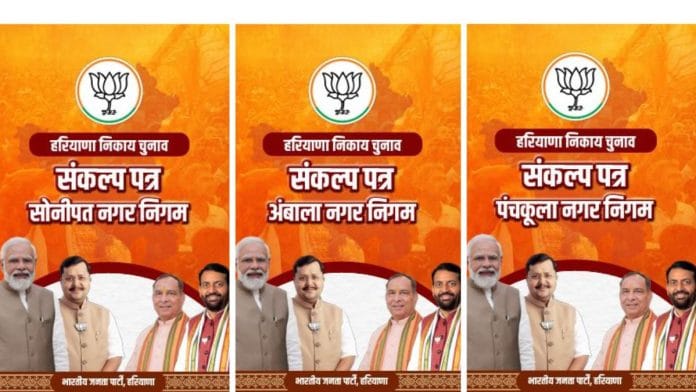


Gurugram: ‘Pink toilets’ with sanitary napkin-vending machines, a 25 percent house tax exemption on properties registered in women’s names, and infrastructure investments are key promises made by BJP in its civic election manifestos for Panchkula, Ambala and Sonipat.
Polling for civic corporations in the three Haryana cities is due on 10 May. Counting of votes will begin as soon as polling is concluded.
The BJP’s three Sankalp Patras—released under the tagline “Samarpit Seva, Sashakt Sushasan (dedicated service, empowered governance)”—follow a broadly identical template on civic commitments while attaching city-specific capital expenditure targets.
The BJP currently holds sway in 10 of Haryana’s 11 municipal corporations—Gurugram, Faridabad, Panipat, Karnal, Rohtak, Hisar, Yamunanagar, Ambala, Panchkula and Sonipat— either directly or with Independent support. The only exception is the newly formed Manesar municipal corporation, which is headed by an Independent mayor, although BJP-backed corporators hold a majority there too.
The party has pitched civic elections on the argument of a “triple engine sarkar”—central government, state government and municipal bodies—as the fastest route to delivering development.
Its main contest in the coming civic polls is likely to be the Congress, which is also contesting the elections on its own.
Also Read: BJP sweeps local body polls in Gujarat, Congress improves tally; AAP fails to pull off 2021 repeat
Women first
The common thread across all three manifestos is a women-centric package.
Every municipal corporation, the BJP has promised, will establish ‘pink toilets’: dedicated women’s facilities with sanitary napkin vending machines and infant feeding rooms attached.
The 25 percent house tax exemption for properties registered in women’s names would produce tangible annual savings for families that make the transfer.
Families living on plots for over 20 years without formal title will be eligible for legal registration, with registries in women’s name being preferred, the documents say.
The Ambala manifesto goes further on safety, devoting a section to the subject, committing to extend and strengthen street lighting with special focus on parks, walking tracks and outdoor exercise spaces for women.
Jyoti Mishra, a former researcher at the Centre for Study on Developing Societies (CSDS) and assistant professor of political science at Amity University-Mohali, told ThePrint that the BJP’s women-focused promises must be read against the party’s recent political positioning.
“Ever since the BJP made an unsuccessful attempt to pass a constitutional amendment bill, the ruling party has been aggressively trying to project itself as the champion of women’s cause,” she said.
Mishra was referring to the bill, which was tabled in Parliament earlier this month but was not voted into implementation. The government had linked the bill, which would have increased Lok Sabha seats from 543 to 850, to implementation of the women’s reservation law.
But the Opposition alleged that such a move would increase representation of northern states, where the BJP was more popular, compared to the south.
After the bill was thwarted in Parliament, the BJP-led state government also held a special session of the Haryana assembly on 27 April to discuss women’s issues. Mishra said the municipal manifestos should be viewed in the same context.
Panchkula: Rs 1,600 crore-plus investment
The Panchkula Sankalp Patra is the most capital-intensive of the three. Its centrepiece is 2,100 rehabilitation flats at Khadak Mangoli for residents of Rajiv Colony and Indira Colony—a problem that has lingered through multiple governments—estimated at Rs 300 crore.
Other headline promises include a Rs 280 crore Integrated Command and Control Centre for smart city administration; Rs 200 crore for stormwater drainage using machines; five new sewage treatment plants with a combined capacity of 76 MLD at Rs 160 crore; a world-class shooting range sports complex at Rs 170 crore; and aRs 80 crore sports complex at village Naggal.
On roads and connectivity, two flyovers on National Highway-05 are committed at Rs 80 crore. Model roads across the city’s main sector-dividing arteries will cost Rs 50 crore, general road improvements Rs 40 crore, a new lane towards NH-07 Rs 30 crore, and a new bridge alongside the existing one on the Ghaggar river another Rs 30 crore.
The cattle problem—a persistent irritant in urban Haryana—was also addressed in the manifestos. The party promised a Rs 30 crore complex to relocate dairies out of the city, and a Rs 10 crore shelter for stray cattle.
Restoration and beautification of two waterways passing through the city is promised at Rs 100 crore.
Ambala & Sonipat
The Ambala manifesto leads with water management. Sewerage networks for 11 villages newly included within the municipal corporation limits are promised, along with sewage treatment plants at three spots for a combined Rs 170 crore.
The headline commitment for Sonipat is also a Rs 390 crore overhaul of the city’s drainage network. New sewage treatment plants at villages Rathdhana and Devdu, and a Rs 50 crore strengthening of the city’s water supply, address what residents have long identified as the most basic failures of municipal governance.
Twenty promises are identical across all three manifestos: mandatory rainwater harvesting for all government and private buildings; smart libraries in every civic body area; CCTV networks with integrated control rooms; full digitisation of civic services such as property tax payments, birth and death certificates and building plan approvals; and dedicated vending zones with financial support for street vendors.
All three documents include a standalone section on stray animals—monkeys, dogs and cattle — promising sterilisation drives and permanent management solutions.
Political reactions
Haryana Chief Minister Nayab Singh Saini, after releasing the manifestos Tuesday, said the Sankalp Patras were an embodiment of God for the BJP.
“We have always fulfilled the promises we made to people during elections. During Vidhan Sabha polls in October 2024, we promised Rs 2,100 per month to women under the Lado Lakshmi Scheme. We made the provision for this in the very first budget my government presented the next year. Today, women are getting this amount,” said Saini.
He added under the leadership of Prime Minister Narendra Modi, the triple-engine government was working for the welfare of people.
Former Haryana CM and Congress leader Bhupinder Singh Hooda told ThePrint that the BJP seldom meets its promises. Giving the example of Lado Lakshmi scheme, he alleged that the government imposed “so many conditions that hardly 10 percent of women in the state get its benefits”.
Hooda said that civic amenities across cities in Haryana have deteriorated under BJP’s rule. “While the Congress genuinely works for the welfare of women, BJP merely does lip service,” he added.