


New Delhi: Rahul Gandhi has alleged that his father, former prime minister Rajiv Gandhi, was deliberately left without adequate security “so that he got killed”, saying the withdrawal of his protection was “not just an accident” but was done “on purpose”.
“My position on this was very clear. Papa’s security was removed so that he got killed. Papa’s security’s removal was not just an accident! It was done on purpose so that he got killed. And the atmosphere was created for him to get killed,” the Leader of Opposition in the Lok Sabha said.
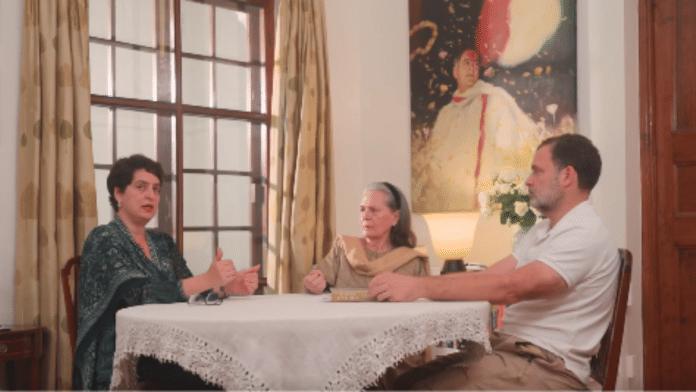
Rahul made the remarks in a new video titled ‘What Ma Left Out of Her Book’, shared on his YouTube channel, in which he sits down with his mother, Sonia Gandhi, and sister, Priyanka Gandhi Vadra, to discuss episodes from the family’s political and personal history that are not included in Sonia’s memoir, ‘Belonging: A Journey of Love’.
Recalling an incident when stones were allegedly thrown at Rajiv Gandhi while he was campaigning in an open jeep, Sonia spoke about the difficulties of ensuring security when a government was controlled by the Opposition or the BJP.
“If a government is a BJP or Opposition government, forget it! They are not going to give special attention to security,” she said.
Rahul, who had accompanied his father on the tour, recalled warning his mother about the danger to Rajiv Gandhi’s life.
“Mama, if we don’t do something about papa’s security, I know, I am going to come back for his funeral very soon,” he recalled telling her.
He said he had also raised the issue directly with Rajiv Gandhi and had argued with him about it.
Priyanka, meanwhile, recalled how her brother became increasingly anxious about Rajiv Gandhi’s security following the assassination of their grandmother, former prime minister Indira Gandhi, in 1984. She said Rahul would keep checking whether security arrangements were in place, while she would wait to hear their father return home at night before going to sleep.
Addressing her brother, she said: “For you, your deductions were very logical. For me, they were completely emotional.”
The conversation on Rajiv Gandhi’s security was among several topics the three discuss in the video, including Sonia Gandhi’s decision to decline the prime minister’s post in 2004, the abuse she faced in public life and the siblings’ experiences at school after the Congress lost power in 1977.
The proposal didn’t go according to plan and neither did my seventh birthday.
The decision in 2004 gave some of us relief but others joy.
There was an intention behind withdrawing Papa’s security.
And even after 500+ pages there are some things Ma has left out of her book.… pic.twitter.com/6fhw1mMFip
— Rahul Gandhi (@RahulGandhi) November 24, 2026
‘The truth behind the 2004 decision’
The three also revisited the circumstances in which Sonia Gandhi decided against becoming prime minister after the Congress-led United Progressive Alliance (UPA) won the 2004 Lok Sabha elections.
Rahul described the meeting in which his mother’s potential prime ministership was discussed with seven people in the room. He recalled that Sonia was initially undecided.
Referring to former prime minister Manmohan Singh, Rahul said only one person in the room had the “qualities” and “capabilities” to become prime minister. He described the others as “dreamers”.
“There is only one man in the room who can become Prime Minister… and there are 6 or 7 dreamers in there who cannot become,” Rahul said, as his mother and sister listened.
He then recalled his mother’s decision: “Then my mother decides ‘NO’; there was actually joy in the room.”
In his autobiography, former Congress leader Natwar Singh had written that Manmohan Singh, Pranab Mukherjee, Arjun Singh, Shivraj Patil, Ghulam Nabi Azad, M. L. Fotedar and Natwar Singh himself were present at the meeting.
Sonia, meanwhile, reflected on what she described as the “pull of power”. She said she had initially felt that she owed it to Congress workers and voters across the country, who had supported the party under her leadership, to accept the responsibility.
Looking back, however, she questioned whether this feeling was an excuse she had found to give in to the temptation of power.
“I am analysing… I don’t think it was but it could be,” she said.
Addressing Rahul, she described the episode as a lesson about power. “Once you are there and you have it (power), you may find many excuses to keep it,” she said.
‘She’s being very kind here’
The conversation also turned to the personal attacks and abuse Sonia Gandhi faced during her years in politics.
Rahul said his mother had left out several instances of the “filthy abuses” directed at her in the memoir.
“She’s being very, very kind here,” he said. Sonia remarked that old age made one forget such incidents.
Rahul recalled how he had watched his mother being subjected to public humiliation and abuse.
“I saw my mother being brutalised, humiliated, abused in a way that… it’s crazy,” he said. Priyanka agreed with her brother, saying she too remembered the incidents.
Rahul said he had been shocked by the “pettiness, nastiness, the abuse of a woman”.
“As a son, I found that to be completely disgusting,” he said. He added that even people who were considered “so-called honourable” had directed abusive remarks at his mother, many of which Sonia had chosen not to include in the book. “Which has not been said and she will not say. Maybe I will say one day,” he said.
Priyanka said the attacks on her mother were rooted in her efforts to assimilate into Indian society. She emphasised that although Sonia was born outside India, she had chosen to make the country her home.
Sonia, in turn, credited the people of India for accepting her despite the attacks. “Many said horrible things, but the bulk of the people, most people, they have accepted me and they welcomed me as one of their own, as their daughter. So, I don’t feel that ‘Oh, they said (such things)’. No, I don’t,” she said.
She ended the conversation on an emotional note, saying: “In fact, I love India because of that.”
Schooldays after Congress’ 1977 defeat
Rahul and Priyanka also recalled how their classmates treated them differently after the Congress lost power in 1977, the first time the party was voted out of government at the Centre since Independence.
Priyanka recounted an incident in which a boy approached her at school and said: “Tera chacha jail me hai, chor hai tera chacha (your uncle is in jail, your uncle is a crook).”
She said she slapped the boy, who started crying, following which her teacher scolded her.
Rahul recalled how he noticed that the two seats beside him in class were empty when he arrived at school that day.
“Anyway, I didn’t say anything, I sucked it up,” he said.
He also remembered a birthday party Sonia had organised in an attempt to help him reconnect with his classmates. Of the 32 students invited, only one turned up, Rahul said.
Although the siblings did not name the friend, Priyanka revealed that Rahul was still in touch with him.
‘Rebellious’ brother, rule-abiding sister
The conversation ended with Rahul and Priyanka exchanging light-hearted observations about their contrasting personalities at school and in Parliament.
Rahul described Priyanka as someone who followed rules, was “sweet” and “nice”, while he was the rebellious one who questioned authority and disrupted things.
“She followed the rules, she would be sweet and she would be nice. I was rebellious, asking questions and disturbing,” he said. Priyanka agreed, adding: “I was suited to the system and you were not.”
She also drew a parallel with their present-day roles in Parliament. “Even today, in Parliament, it’s the same thing.”
(Edited by Viny Mishra)