



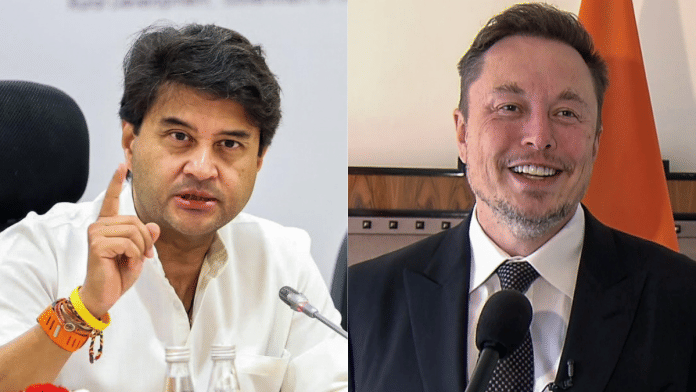
New Delhi: Union Communications Minister Jyotiraditya Scindia on Friday responded to SpaceX CEO Elon Musk’s allegations that “certain oligarchs” were blocking Starlink’s satellite internet services in India, saying the country “doesn’t allow monopoly in any sector”.
Musk made the allegation on X on Thursday while responding to a post by the handle DogeDesigner, which said 11,256 of India’s listed villages lacked 4G coverage as of May 2026.
He initially did not name any names and wrote, “You can guess who they are.” On Friday, Musk went further, questioning why Starlink had not received a licence to operate in India despite being licensed in over 165 countries. “Is Ambani the real boss of India?” he asked.
Starlink is licensed in over 165 countries and has spent five years complying with every single law and requirement of the government of India, so why still no license?
Is Ambani the real boss of India? https://t.co/KUSgfJRynZ
— Elon Musk (@elonmusk) October 8, 2026
Scindia pointed out that three companies—Starlink, Reliance Jio’s satellite arm and Bharti-backed Eutelsat OneWeb—hold satellite communication (satcom) licences. None has received security clearance so far. They can begin operations once the government finalises spectrum charges and each company fulfils the required security conditions, he said.
“We are very clear on our stand. There are three parties that have got a licence. As and when the government decides the charge system on a revenue basis, that spectrum will be assigned to them, and as and when they individually fulfil the security conditions, then they can start operations,” Scindia said.
Minister of State for Communications Chandra Sekhar Pemmasani said the Department of Telecommunications (DoT) had issued licences and provisionally allocated spectrum to satcom companies, but security clearances were pending with the Ministry of Home Affairs (MHA).
“Now the issue is pending with MHA for security clearance. As soon as it is cleared, they will get it. It has nothing to do with one company,” he said.
Scindia also criticised the Congress for backing Musk’s remarks, accusing the party of changing its position on the issue.
“As far as the Congress party is concerned, I don’t think they themselves know whether they are going left or right. They first had a problem initially with a certain person getting a licence. Now they have a problem, and they have allied with that person in terms of why he’s not getting the licence,” he said.
Leader of Opposition in the Lok Sabha Rahul Gandhi had responded to Musk’s tweet referring to Ambani, writing on X: “Welcome to India, Elon. Wait till you discover the other guy.”
Also Read: Elon Musk says Instagram is for girls. X users are not having it
‘Customers to choose’
Speaking at a CEO roundtable during the India Mobile Congress (IMC) on Thursday, Scindia said the government would not favour any company.
“The government is technology agnostic. Our job is to provide a bouquet of services. It is for customers to choose in a free market what they prefer,” he said.
He added that Amazon’s Kuiper must complete the licensing process before it can offer services. The Telecom Regulatory Authority of India (TRAI) and DoT were also “close to final decision on pricing regime for satcom spectrum”, he said.
On Wednesday, Lauren Dreyer, vice-president of Starlink Business Operations at SpaceX, told the IMC that the company had established 20 gateway sites in India and would store Indian users’ data within the country.
“We’re standing ready to serve India once India is ready,” Dreyer said.
Where approvals stand
Starlink received a Global Mobile Personal Communication by Satellite (GMPCS) licence from DoT in June 2025 and authorisation from the Indian National Space Promotion and Authorisation Centre (IN-SPACe) in July 2025. However, it cannot begin commercial services until it is allotted spectrum and receives security clearance. As a wholly foreign-owned company, it also requires foreign direct investment (FDI) approval.
On 3 September, the Digital Communications Commission (DCC), DoT’s highest decision-making body, approved a spectrum usage charge of 5 percent of adjusted gross revenue (AGR), with a reduced rate of 4 percent for rural and remote areas. The proposal requires ratification by an inter-ministerial panel and approval by the Cabinet.
In June, Bloomberg reported that security agencies under the MHA had withheld Starlink’s final clearances over the use of its terminals in Iran, where the company is not licensed to operate. Dreyer denied the report.
Spectrum dispute
In 2024, Reliance Jio and Bharti Airtel, which together account for over 70 percent of India’s telecom market, argued that satellite spectrum should be auctioned, like spectrum for mobile services. Starlink favoured administrative allocation, with Musk calling the proposed auction “unprecedented”.
Jio told the regulator that “any preferential treatment of satellite-based services” should be rejected. Reliance had spent about $19 billion on spectrum auctions.
The Telecommunications Act, 2023, provides for the administrative allocation of satellite spectrum, and the government opted for this route.
In March 2025, Airtel and Jio signed separate agreements with SpaceX to distribute Starlink equipment, subject to the company securing the necessary approvals. At the time, the Congress party alleged that the deals had been “orchestrated” by Prime Minister Narendra Modi to win goodwill with US President Donald Trump, whom Musk was advising at the time.
(Edited by Chingkheinganbi Mayengbam)
Also Read: Trump to honour Musk, Google’s Brin, Nvidia’s Huang with top US science medal