







Chennai: The beleaguered All India Anna Dravida Munnetra Kazhagam (AIADMK) is grappling with a fresh wave of resignations and open defiance by senior leaders, once again bringing the persistent internal fractures to surface.
The rift became evident after Natham R. Viswanathan and S.P. Velumani defied general secretary Edappadi K. Palaniswami’s directive to lead the party’s 14 August agitations on waiver of crop loans across Tamil Nadu and were questioned for their stance by EPS loyalists.
Moreover, on 12 August, AIADMK deputy propaganda secretary and official spokesperson Apsara Reddy tendered her resignation to EPS.
In her letter, Apsara wrote that her decision is “not born out of bitterness or disrespect but is an emotional and deeply considered decision to remain true to my convictions and to the principles that have guided my public life”.
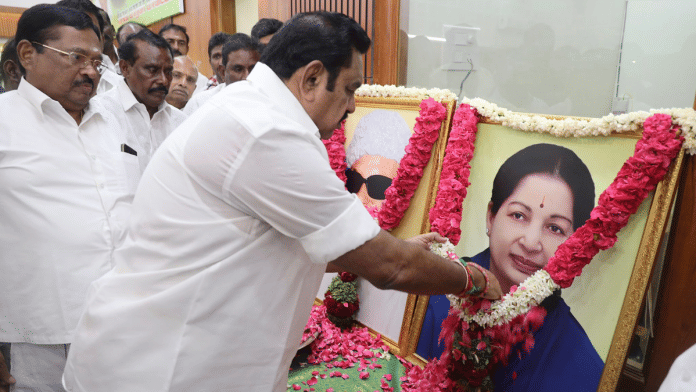
Apsara emphasised her deep admiration for the AIADMK’s late supremo Jayalalithaa, stressed that politics should focus on building, inclusion and uniting people rather than divisions, and expressed hope that personal respect with EPS would endure.
This comes days after AIADMK student wing state secretary Singai G. Ramachandran resigned from his post and the party on 23 July, citing disappointment with recent organisational developments and an inability to reconcile them with “his conscience”.
A few months after its poor showing in the Tamil Nadu elections, the successive exits of spokespersons, former leaders and the open non-compliance by senior rebels highlight the difficulty AIADMK faces in achieving lasting unity under the current leadership as it seeks to recover from its electoral and organisational setbacks.
The protests on Friday were scheduled to demand a complete waiver of crop loans for farmers and to press other issues against the Tamilaga Vettri Kazhagam (TVK) government.
A day before the protests, Viswanathan and Velumani issued a statement saying that they support the protest’s objectives but would not travel to the assigned districts outside their home turf as directed by EPS.
EPS had assigned Velumani from Coimbatore to lead the AIADMK’s Cauvery-related protest in Theni and Viswanathan from Dindigul to lead in Ramanathapuram. On Friday, the duo remained in the protest locations of their home districts. This led to EPS loyalists challenging the rebel leaders to resign and win the by-elections on their own.
AIADMK senior leader K.P. Munusamy raised pointed questions directed at former ministers Velumani and Viswanathan. “Even though Velumani and Viswanathan publicly refer to Edappadi K. Palaniswami (EPS) as the AIADMK general secretary, what is the reason they do not listen to or follow what the general secretary says, and why do they not fully accept him?” he asked Friday.
EPS loyalist Dindigul Srinivasan insisted that the two senior leaders resign their MLA posts. In a Chennai protest, Srinivasan said that if the two won their seats on personal influence and strength, they should step down and contest a by-election.
The crisis traces back to the state elections in which the party secured only 47 seats and slipped to third position in the Assembly, which is its poorest major performance in years.
Immediately after results, around 25 of the 47 MLAs, associated with a faction including S.P. Velumani and C. Ve Shanmugam, defied the party line and voted in favour of the TVK government’s confidence motion.
Palaniswami then issued a statement disqualifying the rebels and stripped many of organisational posts, including district secretaries.
A subsequent patch-up saw mutual disqualification petitions withdrawn, with some rebels being offered new positions, including deputy general secretary roles for Velumani and Viswanathan. However, both of them declined the posts saying they preferred to remain ordinary members. However, the truce proved fragile.
At least six MLAs, including former ministers C. Vijaybaskar and M.R. Vijaybaskar, resigned from the Assembly that eroded the AIADMK’s strength further. While around 16 former ministers and senior leaders quit, 12 of them joined the TVK.
Also Read: AIADMK teeters despite EPS-CVS ‘patch-up’; ex-minister Vijayabaskar latest in flurry of resignations
‘EPS lacks charisma’
Even at the functionary level, more than 300 district-level functionaries switched sides joining TVK at a common ceremony, many citing leadership issues, denied opportunities, and internal conflicts.
“The rebel faction leaders have worked along with Edappadi under Jayalalitha and now only his imposition of party decisions, without mutual consent is causing rifts. He is also moving towards isolation after leaving out Sasikala, Panneerselvam and TTV Dhinakaran, which only weaken the unity within the party,” political analyst Sri Kumar Kannan told ThePrint.
“It further makes AIADMK look like a very small third party with no individual influence or electoral power.”
EPS had also sacked 400 general council and executive committee members. Despite many leaders calling for the re-induction of V.K. Sasikala and T.T.V. Dhinakaran, he has not taken any steps towards it.
Analysts pointed out that core issues of the internal split include questions over EPS’s ability to project broad appeal beyond his base after successive electoral setbacks, including the 2021 Assembly and 2024 Lok Sabha elections.
Political analyst Sri Kumar Kannan added that AIADMK had revolved around one personality that led and held the party together and unless and until they get a single strong personality, the rifts will continue to persist.
“Immediately after the demise of MGR (M.G.Ramachandran), the party was in bits and pieces, but it rose to power gradually after Jayalalitha stood as the single figure who consolidated the party together. If Edappadi had won in 2021, the dynamics would have been different. He is not seen as an acceptable leader who can rise beyond the regional level politics.
“There are supporters of Sasikala and TTV Dhinakaran who could have stayed, but the Mukkulathor community was offended after he let them go. The community was a strong base for AIADMK but EPS has lost their support,” he added.
EPS is not Jayalalitha, who had charisma and women followers, the political analyst said.
“She was also a caste neutral leader, but EPS is seen as a leader of the Kongu Vellalar Gounder community only. It is high time that he accepts the reality and sees the need to bring the party together and focus on the issues raised by the party members,” Kannan added.
MGR had founded the AIADMK in 1972. He served as the Tamil Nadu CM thrice until his death in 1987. His protégé Jayalithaa then commanded the party until her demise in 2016.
Political analyst Arun Kumar said that TVK, with Vijay as the charismatic leader, has turned out to be an alternative for AIADMK leaders.
“The BJP was expecting the fall of Dravidian majors but it could not do so. The TVK has now done that to the AIADMK. The party has faced two consecutive losses and they have never stayed out of power for more than five years, which has brought displeasure among the party members,” he said.
Arun, too, said that EPS lacks the charishma of MGR and Jayalalitha. “The resignations are happening because they (AIADMK leaders) can see the same pattern of a charismatic leader in the TVK now, and this is why the shift.”
He added that the fledgling TVK also needs people with political experience, so “AIADMK leaders are being welcomed, making the exodus even more inevitable”.
(Edited by Tony Rai)
Also Read: EPS softens, Tamil Nadu Speaker drops action against AIADMK MLAs who backed TVK in floor test