





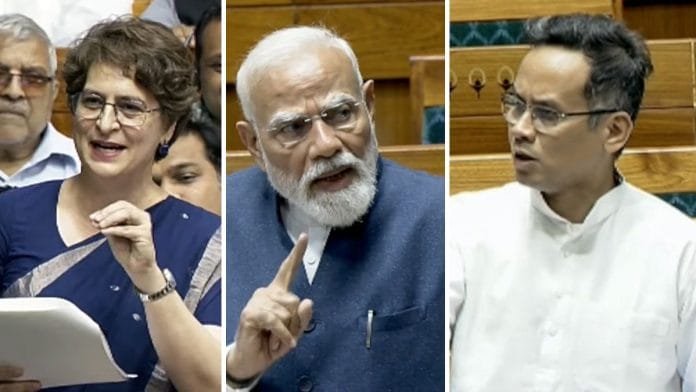


New Delhi: Prime Minister Narendra Modi’s “guarantee” that the Constitution (131st Amendment) Bill will not affect the proportionate representation of states in the Lok Sabha failed to persuade the Congress Thursday, with party MP Priyanka Gandhi Vadra dismissing it as “hollow” in the absence of any such written assurance in the proposed legislation introduced by the government.
The principal opposition party refused to budge from its position that the Bill would weaken the representation of the southern states in Lok Sabha. While seeking to avoid appearing against reservation for women in Parliament and state legislatures, the Congress repeatedly underlined its support for the proposal, highlighting its historical role in securing quotas for women in local bodies.
Priyanka’s speech made it clear the party recognised the pitfalls of being perceived as opposing women’s reservation. She said the government laid a “trap” for the Opposition by linking the implementation of the women’s reservation law with a proposed increase in the Lok Sabha’s maximum sanctioned strength and a nationwide delimitation exercise.
Pointing at Home Minister Amit Shah, Priyanka, wearing a smile, said even “Chanakya would have been surprised at his cunningness”.
“The entire scheme was kept ready: convening the House in the middle of elections; not holding any all-party meeting and sharing the Bills with MPs only a day before their introduction; initiating a discussion in the media beforehand about an impending major step by the prime minister. Basically, the idea is to land the Opposition in a moral dilemma. But it is one thing to be cunning in politics, and another to set aside the ambition of clinging to power and take decisions in the interest of the nation. Maybe we should not keep this expectation from the PM, who is under a lot of international pressure,” she said.
Congress MPs, including Priyanka, also underlined a central theme of their objection articulated by Lok Sabha Leader of Opposition Rahul Gandhi on Wednesday—that the Bill could curtail the rights of OBCs, who were not counted in the 2011 population census that may form the basis for the next delimitation.
Under Article 81(2)(a) of the Constitution of India, which the Bill does not seek to amend, delimitation is to be based on population proportion according to the latest available Census. This has prompted the Opposition to argue that the government could rely on the 2011 Census data, putting southern states at a disadvantage compared to more populous northern states that have seen higher population growth.
In his speech, Congress Deputy Leader in the Lok Sabha Gaurav Gogoi alleged that the proposed legislation seeks to carry out delimitation “through the backdoor” by packaging it as a measure for women’s reservation, while also raising concerns about the government’s stance on a caste census.
Gogoi claimed the Centre agreed to a caste census earlier only under Opposition pressure and questioned the basis for proposals to expand the Lok Sabha’s strength, asking where the figure of 850 seats had originated.
He further argued the government lacks the legislative competence to raise the Lok Sabha’s ceiling without conducting a fresh census, accusing it of “weaponising” delimitation for political ends. He said the exercise, originally meant to ensure fair representation, had instead led to distortions in places like Assam and Jammu and Kashmir, citing disparities in constituency sizes and instances of non-contiguous seats.
Warning against what he described as “gerrymandering”, a term he noted is used in the United States for politically motivated boundary changes, Gogoi alleged the government was attempting to replicate similar patterns nationwide.
Referring to Article 81 of the Constitution, he said delimitation is meant to follow the census after 2026, but the proposed changes would allow Parliament to decide the basis through ordinary law, effectively giving the ruling majority greater control.
Gogoi also invoked past decisions on state reorganisation and the freezing of Lok Sabha seats by leaders like Indira Gandhi and Atal Bihari Vajpayee, saying they acted with a “larger vision”. He questioned whether the present leadership considered itself “bigger statesmen” than its predecessors.
(Edited by Gitanjali Das)