





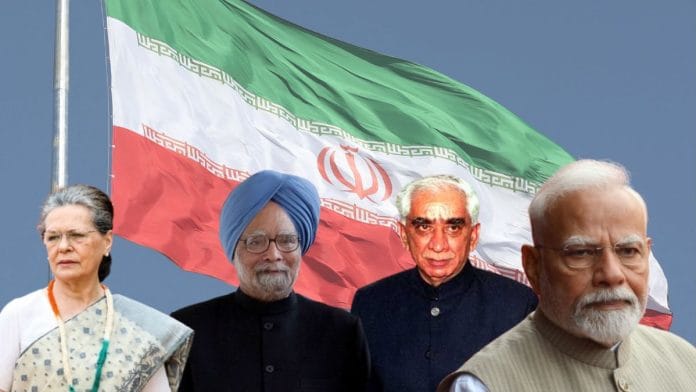



New Delhi: Congress Parliamentary Party chairperson Sonia Gandhi has berated the Centre over its “uncritical silence” on the joint US-Israel attack on Iran and the killing of its Supreme Leader, Ayatollah Ali Khamenei, calling it an “abdication” and an “abandonment of our legacy”.
In a column in The Indian Express published Tuesday, she underlined that New Delhi’s “reticence” in calling out the United States and Israel raises “serious doubts” about the direction and credibility of Indian foreign policy, which is particularly troubling in view of India’s “civilisational and strategic” ties with Iran.
Separately, Lok Sabha Leader of Opposition Rahul Gandhi said that the unilateral attacks on Iran, “as well as Iran’s attacks on other Middle Eastern nations, must be condemned”.
“India must be morally clear. We should have the courage to speak plainly in defence of international law and human lives. Our foreign policy is rooted in sovereignty and the peaceful resolution of disputes—and it must remain consistent. PM Modi must speak up. Does he support the assassination of a head of state as a way to define the world order? Silence now diminishes India’s standing in the world,” he wrote on X.
Escalating hostilities between the United States, Israel and Iran are pushing a fragile region toward wider conflict. Crores of people, including nearly a crore Indians, face uncertainty.
While security concerns are real, attacks that violate sovereignty will only worsen the…
— Rahul Gandhi (@RahulGandhi) March 3, 2026
Notwithstanding Rahul’s somewhat calibrated formulation, from the very outset of the latest round of conflict, which has intensified alarmingly over the last few days, the Congress has largely thrown its support behind Iran. It has labelled US-Israel’s actions as “imperialist” and fundamentally “incompatible” with a rules-based international order.
The party has also accused Prime Minister Narendra Modi of “genuflecting” before US President Donald Trump and Israeli Prime Minister Benjamin Netanyahu.
According to the party, India’s muted response marks a sharp departure from its traditional posture of strategic autonomy and principled non-alignment. Yet the moment carries a distinct sense of historical irony. Two decades ago, the roles were dramatically reversed.
It was on 24 September, 2005 that India had, for the first time, aligned with the western bloc in voting against Iran at the International Atomic Energy Agency (IAEA), the global nuclear watchdog. The resolution adopted that day stated that Tehran’s nuclear activities raised questions that were “within the competence of the Security Council”.
The BJP, then in the Opposition, had accused the Congress-led United Progressive Alliance (UPA) government of acting under external pressure, as the vote had coincided with the early stages of New Delhi’s negotiations with Washington over a landmark civil nuclear agreement.
The then Rajya Sabha Leader of Opposition Jaswant Singh had issued a strongly worded statement, flagging what he described as a “countrywide impression” that the UPA government had “surreptitiously engaged in a major recast of policy” directly affecting India’s national security.
“There is a strong belief, including among UPA alliance partners, that this has been done under international pressure, particularly of the US; that India, as a permanent member of the IAEA Board, has merely followed the initiative of others, like that of the EU-3 (UK, France, Germany), and that the UPA government has effected this major policy shift on the quiet, without adequate democratic consultations,” Singh had said in his statement.
The Manmohan Singh government had defended its move, maintaining that it had impressed upon the western bloc not to move the matter immediately to the United Nations Security Council (UNSC), and to allow it to remain within the IAEA framework, thereby buying time for Tehran to respond.
However, months later, on 4 February, 2006, India had once again aligned with the western powers in supporting an IAEA resolution that referred the matter to the UNSC. The resolution had expressed a “lack of confidence in Iran’s intentions in seeking to develop a fissile material production capability against the background of Iran’s record on safeguards”.
Speaking in Parliament, PM Singh had defended his government’s position, flagging Iran’s use of centrifuges “imported from third countries”, and adding that the source of such clandestine proliferation of sensitive technologies “lies in our own neighbourhood”—an apparent reference to Pakistan.
“This august House, Sir, I believe, will agree that India cannot afford to turn a blind eye to the security implications of such proliferation activities. The objectives of upholding Iran’s rights and obligations and addressing our security concerns arising from proliferation activities in our extended neighbourhood have shaped our position,” he had said.
But the BJP had been more unsparing this time. In a scathing statement, Jaswant Singh had described it as a “nationally humiliating experience” for the country to witness the manner in which the UPA government and its Left allies had “permitted themselves to be hustled and pressurised into voting in a particular manner”.
“This has rightly but sadly generated an impression that India has surrendered its sovereign right to take decisions on issues of national importance. The Government of India and its allies, the Communists, are responsible for this shoddy state of affairs. Statements coming out of the US Congress, other decision-makers in the US, and the US ambassador to Delhi threatening India have heightened suspicion that the US wishes to establish a hegemonistic relationship with India, not that of two sovereign equals,” Jaswant Singh, who had earlier served as external affairs minister in the Vajpayee Cabinet, had said.
On 27 November, 2009, the IAEA had adopted yet another resolution, spearheaded by the US, on Iran’s nuclear programme. India had voted in favour of that resolution as well. It called on Iran to “immediately” suspend the construction of a new uranium enrichment facility in the country’s Qom province.
The resolution had noted with “serious concern” that Iran had constructed the enrichment facility at Qom in breach of its obligation to suspend all enrichment-related activities. It had further observed that Iran’s failure to notify the IAEA of the new facility until September 2009 was “inconsistent with its obligations under the Subsidiary Arrangements to its Safeguards Agreement”, thereby deepening international scrutiny of Tehran’s nuclear intentions.
(Edited by Mannat Chugh)
Also Read: BJP condemns anti-UAE posts by Indians amid Iran conflict, days after jibe by own MP Nishikant Dubey
People including the esteemed netaji who wrote a column in an esteemed daily consumed glue when news about atrocities and murders of thousands of Iranian citizens was circulating just a few months back. Congress should learn penance first for the historic blunders it has committed since Independence. One might argue that why do people keep dragging Congress but many sour fruits are a direct result of Congress misdeeds when it was in power. Miss Sonia Gandhi should have written an equally heart rending opinion piece when the Iranian regime was murdering its own people. Not writing an article or expressing even an iota of concern for the Iranian protestors was true genuflection to political convenience.