








Thrissur/Kochi: In mid-May 2015, Pinarayi Vijayan levelled serious allegations against the then Kerala chief minister Oommen Chandy’s United Democratic Front (UDF) government.
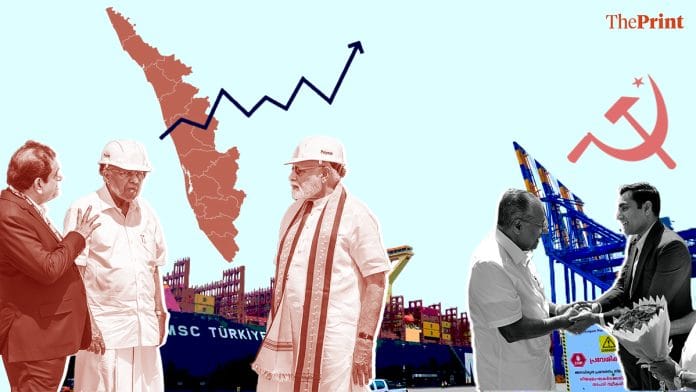
The Communist Party of India (Marxist) politburo member and then rising star of the Left Democratic Front (LDF), Vijayan accused Chandy of a “real estate scam” in the Vizhinjam Port Project.
Vijayan claimed that land worth Rs 8,000 crore was being transferred to the Adani Group project for Rs 6,000 crore “under the guise of Malayalee development aspirations” and called the deal a “huge conspiracy”.
But Vijayan’s view shifted within just a year. Upon becoming the chief minister in 2016, he faced a critical decision—continue opposing the project at the risk of derailing Kerala’s growth trajectory, or proceed with it.
He chose the latter.
He overrode the objections of his former mentor V. S. Achuthanandan who actively rallied the entire LDF against awarding the contract to Gautam Adani—a figure the Left frequently associated with crony capitalism and closely linked to Prime Minister Narendra Modi.
“Once a deal is made by the government of Kerala, the word will be kept. This is the message we wanted to give to every investor,” Thomas Isaac, Kerala’s finance minister under Pinarayi Vijayan’s government in 2016-21 and CPI(M) Central Committee member, told ThePrint.
In doing so, Vijayan seized the opportunity to be seen as a reformist, leading Kerala away from the widely held perception of being under the grip of militant trade unionism to embracing private capital.
In the last 10 years as chief minister, Vijayan, now 81, has carefully built and embellished this reformist image, hoping to cash in during the upcoming state elections. Kerala votes on 9 April.
Industrialists and business leaders say the Kerala CM is known for clearing his calendar to meet investors, simplifying approval mechanisms, and giving the message of policy continuity irrespective of the party that signed big-ticket projects.
From the 28th position in the Ease of Doing Business rankings around 2019, Kerala rose to be among the top states under the ‘fast mover’ category last year, reflecting the result of these reforms.
Also Read: India’s Silicon Beach: As Bengaluru sputters, a new IT haven is taking shape on Karnataka’s coast
An easier commute
For V. Vishnu, an IT company employee whose work involved travelling to other centres of his office in Kerala and outside, operating at the Technopark in Thiruvananthapuram has become a breeze.
The Technopark, Infopark, and other government designated IT hubs have pristine surroundings with maintenance services round the clock.
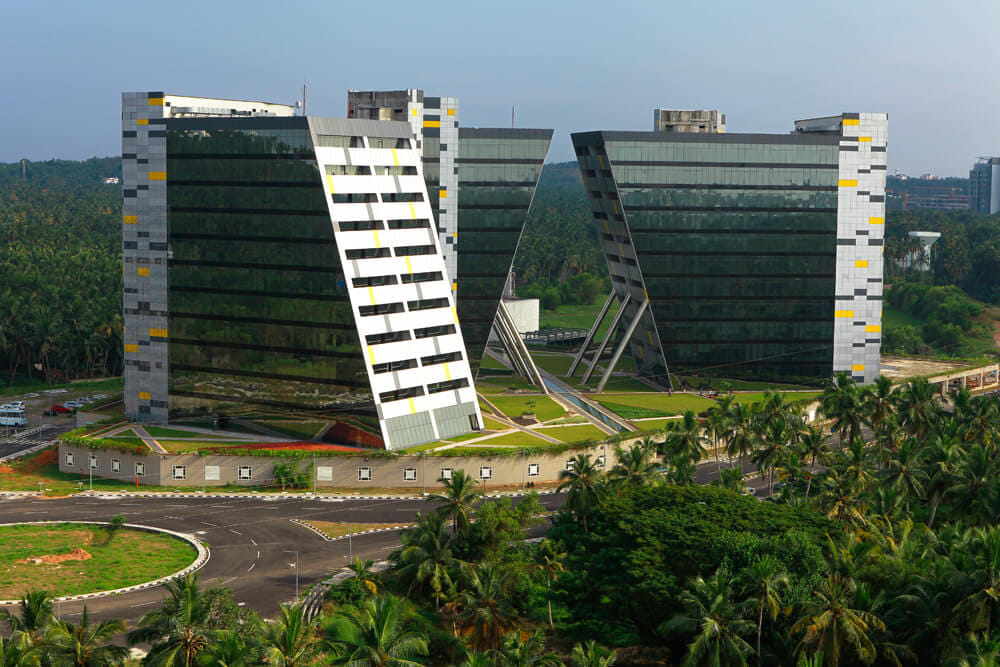
The airport, Vishnu explained, is just 15 minutes away from the Technopark, and the Kazhakuttam railway station is barely a couple of kilometres away.
In 2017, the Group of Technology Companies (GTech), an IT and Business Process Management industry body, in consultation with the state’s IT department, introduced ‘G-Ride’, a carpooling app to make commuting easier.
“The car-pooling app was meant to incentivise the driver by reducing his costs of fuel while others would benefit from the reduced cost of commuting,” Vishnu told ThePrint, adding that this regulated traffic congestion in the high-density corridors and reduced demand for parking spaces that took up a sizable chunk of the Technopark space.
Driving to Kerala and between its districts feels like traversing through a very big city with rarely any open stretches of road and single-lane traffic. For instance, the distance between Kochi and Thrissur is just about 85 km but takes well over two and a half hours. Similarly, Kochi to Thrivanantapuram is just 201 km but takes over five and a half hours.
But within the cities, commutes are a lot more free-flowing on account of wide roads and strict enforcements against illegal parking.
Additionally, regional transport buses operate directly from technoparks. These services allow employees to commute daily to various parts of the city and to their respective hometowns during weekends, without the delays of entering the city centre.
Martin, who works as an independent brand manager in Kochi, said that the highly qualified who sought jobs in Bengaluru, Hyderabad, Chennai and other places, now don’t have to move out but retain Kerala as their base.
“Earlier all shops and any semblance of night life ended at 9.30 pm. Now establishments around technoparks operate 24/7. Many cities in Kerala have all the facilities of a big city without the traffic and commute challenges,” he said.
New routes of the Metro will connect the city centre to the Infopark or SmartCity in Kochi as well.
The city design infrastructure has kept pace with the business interests in recent years. This has resulted not just in better opportunities for skilled labour, but also a better quality of life that is felt by people beyond these high-tech campuses.
‘Reimagining the left’
Pinarayi Vijayan had to make significant changes—in essence, reimagine the Left’s view of private capital.
He witnessed the collapse of the Left in West Bengal under Buddhadeb Bhattacharjee in the late 2000s when he tried to force corporate investments into the eastern state. After decades of Left rule under Jyoti Basu, Bhattacharjee attempted to usher in a new wave of corporate-backed investments.
But this led to his downfall and the routing of the party’s stronghold after violent agitations over the proposed Tata Nano project in Hooghly district and the decision to acquire land for a special economic zone in Nandigram.
Ratan Khasnabis, a fellow at Kolkata’s Institute of Development Studies, said that Bhattacharjee made several fatal mistakes in understanding how his own cadre works.
“He failed to understand the basic principle of communists: that its workers depend on mass mobilisation and not on implementation of projects through administrative instructions. Pinarayi Vijayan is surviving because he understands this basic rule of mass mobilisation,” he told ThePrint.
Vijayan, however, appears to have learned well, consolidating and coordinating grassroots support, and unshackling traditional burdens.
And in 2026, Adani is the single biggest investor in Kerala—projects valued at over Rs 30,000 crore are in the pipeline, with two major industrial corridors being planned around the Vizhinjam port.
On Monday at a rally in Pathanamthitta district—where the Sabarimala Temple is located—Lok Sabha Leader of Opposition Rahul Gandhi used his microphone as a prop to critique the lack of local manufacturing, noting that it was “made in China”. He questioned how youngsters from Kerala are expected to get jobs if nothing is made locally, attacking the purported pro-corporate stance of CM Vijayan.
“And how are we ever going to make things in Kerala if only one or two companies control the future of this Kerala? Your chief minister and the prime minister are handing this country over to Adani and Ambani,” Gandhi remarked.
However, it was the Oommen Chandy-led Congress and UDF government that had signed the Vizhinjam port deal with Adani in 2015. Incidentally, Shashi Tharoor, Congress MP from Thiruvananthapuram, has publicly said he had convinced Adani to bid for the project during a flight between New York and Delhi.
Adani, too, has spoken fondly of his past interactions with Chandy.
Vijayan is often viewed as a shrewd politician, one who rarely ever sports a smile and is seen as a stern taskmaster, earning him the moniker ‘Mundu Udtha Modi’ or ‘Modi in a Mundu (veshti)’.
Campaign posters across the state’s major cities feature a painted image of a smiling Vijayan rather than the local candidates. His political strength is underscored by his historic retention of power in the 2021 polls, defeating the trend of changing governments every five years, and his ability to keep the Bharatiya Janata Party (BJP) on the political sidelines in the state.
ഇടുക്കിയിൽ മറ്റാരുണ്ട് എൽഡിഎഫ് അല്ലാതെ#Vote4LDF pic.twitter.com/N8o1QBYRuW
— CPI(M) Kerala (@CPIMKerala) March 25, 2026
Despite this, the Modi-led BJP has made inroads in Thiruvananthapuram corporation, Thrissur Lok Sabha, and a few other pockets. These inroads have fuelled speculation regarding a growing proximity between Vijayan and Modi to keep the Congress out of power.
This alleged closeness was further emphasised by the perceived let-off of Vijayan in the alleged 2020 gold smuggling scandal.
The Opposition has relentlessly campaigned on the issue, but it could not stop the Vijayan juggernaut in 2021 and shows no signs of slowing him down in the upcoming polls.
The CM has positioned himself as a leader capable of resisting the BJP’s onslaught on issues such as delimitation, new labour laws, and what many see as federal overreach. For the Left’s core support base, the necessity of retaining power in their last remaining state has led many to overlook Vijayan’s corporate-leaning—an image the CM has vehemently resisted.
Though the Left under Vijayan has historically fought against privatisation, Vijayan has adopted a more pragmatic approach. In 1997, as electricity minister he signed a deal valued at around Rs Rs 375 crore with a Canadian firm, SNL Lavalin. The deal has since been the source of many problems for Vijayan as it was shrouded with allegations, including a CBI case on alleged graft. The Kerala HC has given him a clean chit but the CBI continues to oppose this.
In 2007, he had a spat with Achuthanandan, opposing the latter’s decision as CM to reclaim many acres of land allegedly illegally occupied by resorts and real estate lobbies in Munnar.
In February 2020, he, as chief minister, signed an MoU with US-Based EMCC Global Consortium for an upgrade and promotion of deep-sea fishing, facing backlash from the Congress which called it a betrayal of the state’s sizeable fishing community.
In 2021, he allowed the Kerala Infrastructure Investment Fund Board (KIFFB) to issue masala bonds at the London Stock Exchange so funds could be raised from the market to fund welfare activities in the state.
The second phase of the Adani-led Vizhinjam port is also underway.
‘14 windows to single window’
Vijayan is often compared by critics to Modi largely on account of his perceived authoritative style of functioning and systematic sidelining of any challengers within the Left ecosystem.
In his second term, he overhauled his entire cabinet, replacing top-performers like K.K. Shailaja and Isaac, but exempted himself from this exercise.
New appointments included his son-in-law, P.A Mohammed Riyas, as the PWD and tourism minister. K.N Balagopal took over the finance portfolio, P. Rajeev handled industries; and Veena George oversaw health.
Isaac defended Vijayan as grassroots-level leader, an able administrator who proved his mettle during the COVID-19 crisis. “He is the leader now and we should use it to our advantage. But it doesn’t affect the party structure, party norms.”
Industry captains said Vijayan as an administrator has been more straightforward, surrounding himself with domain experts, efficient officers, and not just “yes men”.
These, they pointed out, included the 2016 appointment of Harvard-educated IMF chief economist Gita Gopinath as chief economic adviser and continued engagements with domain experts and tech leaders like V. K. Mathews from IBS Software, Infosys co-founders Kris Gopalakrishnan and S. D. Shibulal, among others.
Vijayan also maintains ties with cultural icons like Mammootty and Mohanlal. The latter even interviewed Vijayan last month.
His government machinery functions on the backs of officers who have largely unblemished track records and those known to deliver on big-ticket projects. This includes former chief principal secretary K.M. Abraham, former chief secretaries Sarada Muraleedharan, V. Venu, and for Delhi-related political affairs, Rajya Sabha member John Brittas.
“Earlier, there used to be 14 windows,” said one businessman, suggesting businesses needed to individually approach ministers with possible demands for clearances and approvals.
“Now there is just one window,” he said, apparently referring to the comprehensive single-window system called K-SWIFT (Kerala Single Window Interface for Fast & Transparent Clearance) to expedite business approvals.
Most people ThePrint spoke to said that corruption had been reduced significantly if not entirely eliminated.
‘1st term, politics; second term, business’
Abraham, a 1982-batch IAS officer, plays a pivotal role in this administration. After briefly serving as the chief secretary, he was retained by Vijayan in 2017.
During Abraham’s tenure as the finance principal secretary between 1996 and 2002, the Kerala Infrastructure Investment Fund Board (KIFFB) was set up under the CPI(M) rule of E. K. Nayanar.
Thomas Isaac, the finance minister under Vijayan’s chief ministership between 2016 and 21, revived and infused new blood into this unit.
Works taken up by the KIFFB, including building roads, bridges, and tech parks serve as evidence of Kerala’s new developmental trajectory. In the last 10 years, Vijayan said that projects worth Rs 1 lakh-crore have been implemented. The CPI(M) is using this to dilute any possible sentiments of anti-incumbency.
Isaac told ThePrint that the accomplishments overwhelm any feelings of anti-incumbency.
“Infrastructure projects are halfway through construction, the investment climate has improved with nearly two lakh crore in the pipeline. So, we are asking voters if they want this to be disrupted or that the government completes them,” Isaac said.
During his first term, Vijayan consolidated his political position, remaining virtually unchallenged within the party.
A leadership vacuum within the Congress has kept the Opposition from going after Vijayan, aiding the focus on growing businesses and industry that has been projected as more in tune with the new aspirations of young Malayalees.
This allowed Vijayan 2.0 to make significant decisions without fear of internal opposition, diluting the ‘hartal culture’, and focusing on a more business-oriented approach.
This is not to say that he has approved every project that has come Kerala’s way.
In 2019, the LDF government vehemently opposed the Adani group being almost unilaterally awarded the contract of the Thiruvananthapuram airport for the next 50 years by PM Modi-led Union cabinet, dragging the issue through to courts. Both the Kerala High Court and Supreme Court, however, dismissed its petitions.
One Thrissur-based businessman, with investments in retail, liquor and real estate, said that even the process for granting approvals for panchayat works has been simplified.
“Earlier, we had to submit our plans to various departments like town planning before starting work. Now, we can submit our plans and immediately start construction which the panchayat and other local bodies can inspect, saving us valuable time,” he said, requesting anonymity.
But politics is also part of the same business.
M. Skaria, a small Thrissur-based businessman operating a car garage, said local leaders often cause problems. “If the majority of a road or region is inhabited by UDF supporters, then roads are not laid and panchayat permissions are difficult to obtain. The LDF workers cannot live without protests and their true nature will return if they lose power,” he told ThePrint.
Vijayan has leveraged several inherent historical advantages to his credit as he juggled many roles and navigated the challenges.
‘Mindset change’
While the CM is credited with simplifying the otherwise tedious processes, he inherited a robust decentralised administrative system that has helped him.
He has also minimised interference in business interests, particularly within the IT sector. He continues the process of companies operating in a government-designated park being given localised approvals, significantly reducing bureaucratic delays.
Mathews and Gopalakrishnan said there has not been a single day lost in the IT services sector due to hartals or impediments to free movement of tourists or travellers.
This marks a significant shift from the state would face bandhs even for events unrelated to the state, Iraqi dictator Saddam Hussain’s execution for example.
“The real change that has taken place during the last three decades and incrementally is not about any reform, per se, it is the mindset change of the Malayalee,” Mathews, who has served in various advisory roles for different CMs from the late 2000s, told ThePrint.
He said that the fundamental mindset shift that “(someone’s) profit means (someone’s) exploitation” has been done away with.
Business leaders said that there is less corruption compared to other states but Kerala has been the target of sustained propaganda, that the Left-ruled state is averse to private enterprise.
Gopalakrishnan highlighted that several regional chambers of commerce constantly engage with the CM and often write to him, flagging concerns. “The point is that they see benefit in writing to the CM,” he said.
While Kerala has traditionally remained a benchmark in the Human Development Index, Sustainable Development Goals, literacy, life expectancy, and per capita income, they are now specifically targeting high-value job creation to stem the brain drain.
Kerala is a linear state with the Western Ghats on one side and a long coastal corridor on the other, leaving just the middlelands where tech parks and other modern facilities can come up.
“Typically, IT services industries get exempted from the Hartal culture of Kerala. Tourism also gets this exemption because they know that these industries are special and require support from all walks of life,” Gopalakrishnan said.
Despite its new avatar, the state’s culture remains rooted in socialistic principles where labour is well aware of its rights, shielding them from exploitation. Yet there is a growing acceptance of “privatisation with participation”, observers added.
Also Read: After actor Mammootty’s township visit sparks CPI(M) criticism, Kerala CM issues public apology
‘Debt-model of growth’
While the state itself has been on an upward growth trajectory, it has not been free of concerns and challenges.
On Saturday, Congress leader Shashi Tharoor termed the ‘Kerala Model’ under the LDF government a “debt model” of development. Rajeev Chandrashekar of the BJP said that 92 percent of every Rs 100 Kerala receives as revenue goes towards debt servicing. He went as far as to say that Kerala’s economy has turned into a “Ponzi scheme”.
Isaac laughed at these allegations, saying the Centre has been harsh towards Kerala, denying its fair share of devolution and forcing states to fall back on borrowings to fund development projects.
The government in Kerala, like many in non-BJP-ruled states, has maintained that the Modi administration continues to deprive them of their rightful share.
In his budget speech, Kerala’s finance minister K. N. Balagopal talked of the Centre’s continued “neglect”. “There were mocking predictions”, he said the “state exchequer would be emptied, treasury would be closed, and salary would be cut”.
He added that the state managed to survive by cutting-down development-welfare expenditure and borrowing excessively.
“It is now clear to everyone that Kerala’s debt is not unmanageable when compared to that of the central government’s or other states’. Now, no sensible person is taking up the propaganda that Kerala is ruined by debt,” he said.
At the end of 2026-27, the state’s outstanding debt is estimated to be 33.4 percent of GSDP, marginally lower than the revised estimate for 2025-26 (34.2 percent of GSDP).
The fiscal deficit is estimated to reach 3.40 percent of GSDP (Rs 55,419.5 crore) while revenue deficit for 2026–27 is projected at 2.12 percent of GSDP (Rs 34,586.66 crore).
“During 2024-25, the debt was Rs 4,35,314 crore. The debt amount for the year 2025-26 reported in this budget is Rs 4,88,910 crore. If the debt had doubled, it would have reached at least Rs 5,93,802 crore (The debt was Rs 2,96,901 crore when this government assumed power). It is evident by any standard criteria that the debt of the state is within the bearable limits,” Balagopal said in his budget speech.
The debt to GSDP ratio is 33.44 percent. But the LDF argues that the debt ratio has been brought down from 38.47 percent since 2021, claiming it to be a major win.
Isaac said that the revenue deficit has been high over the years because the state spent on health, education and other social development, and the Opposition’s attempt to use this data to “scare people” may not fructify.
He added that if the interest rate being paid on borrowings is lower than the GSDP growth, it is sustainable. He added that the state cannot wait for another two decades to bring the deficit to more manageable levels and then focus on growth.
“Don’t worry too much about these ratios and the treasury. It can be managed. What is important is to keep growing, okay.”
(Edited by Ajeet Tiwari)