




New Delhi: The heated discussions around melting glaciers are back, especially after the devastating Nepal floods. The mighty Himalayas are not the lone victim of global warming. The glaciers in the Alps are receding too. But as they melt, there is a 60-year old Indian secret that has been bubbling up from deep in the Alps.
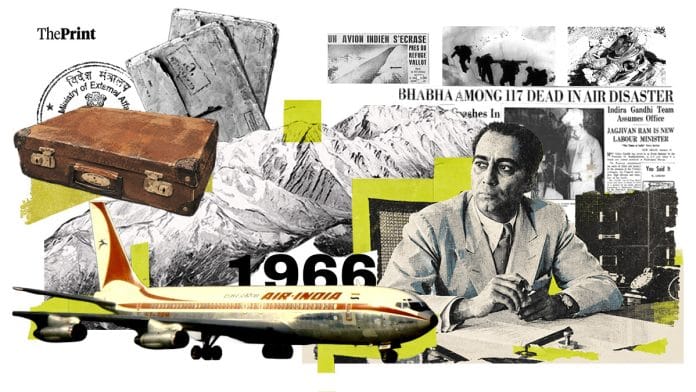
Nearly 60 years ago, in 1966, thousands of kilometres away, India’s top nuclear scientist and the father of India’s nuclear programme, Homi Jehangir Bhabha, was killed in a plane crash in the French Alps. Only minimal wreckage from the Air India Boeing 707, carrying 106 passengers and 11 crew members, could be recovered after the crash.
It was like the cold and unreachable mountains of Mont Blanc had swallowed the entire aircraft and its contents, leaving only mysteries and conspiracy theories behind.
But that was only until 2008.
A group of mountaineers trekking through the snowy trail encountered the first bits of wreckage from the aircraft. Then in 2012, a diplomatic bag, with the ownership of the Indian Ministry of External Affairs stamped on it, was recovered.
It is a dark, dystopian cocktail of climate change and historical artifacts.
These odd incidents initially seemed like a rare little gift that the mountains threw out. But this started worrying the scientific community when these items–buried deep beneath the ice caps for years–started surfacing more regularly. Newspapers, letters, plane parts and even human remains.
It was a warning sign that the glaciers were melting and receding at an alarming rate, and in doing so revealed everything that it had entombed and preserved in the past. In the Alps, the impact was milder; in the Himalayas, the warming took a more violent turn.
The rough rescue and the changing mountains
The 24 January 1966 coverage of the BBC headlined the crash as ‘117 die in Air India Tragedy’. At 7:02 in the morning, the Kanchenjunga–as the aircraft was more popularly known–had crashed into Mont Blanc, near the Franco-Italian border.
The first alert, according to the news portal’s On This Day archives, describes the rescue as “rough”.
The news report quoted Gerard Devoussoux, a mountain guide who was one of the first to arrive at the disaster scene. He said that if the plane had pivoted just about 15 metres, it would probably have missed the giant rock, upon which the aircraft is believed to have crashed. The accident left a huge crater in the mountain, according to rescue teams quoted in the report.
“Everything was completely pulverised. Nothing was identifiable except for a few letters and packets,” the BBC report said, quoting Devoussoux.
Another article in the New York Times during the crash also mentioned how the difficult terrain, poor visibility and extreme weather in these mountain ranges had made the rescue operations challenging back then. In fact, the rescue had to be called off within 24 hours because of bad weather.
Alps of Loppé’s paintings are gone
But the once unfavourable terrain has altered significantly over the years since the 1966 crash. And the changes are documented and alarming.
In 1919, a Swiss pilot and photographer, Walter Mittelholzer, flew over Mont Blanc and photographed the alpine landscape on a biplane. The photographs showed the mountains to be capped with thick layers of ice.
In 2019, 100 years after these photographs were taken, Dr Kieran Baxter and Dr Alice Watterson from the University of Dundee used a scientific process known as monoplotting to work out the precise locations from which Mittelholzer had taken his photographs. The researchers then went on to photograph the same locations–the Bossons glacier, the Argentière glacier and the Mer de Glace–on the northern side of the Mont Blanc massif.
This time, the peaks had noticeably shrunk, the ice had retreated, and the frozen terrain at such high altitude had given way to a greener landscape.
The 2019 images showed that Mer de Glace, the longest glacier in France, had experienced the biggest changes. Accounts of travel writers preserved by the French government mention that back then, the Mer de Glace glacier could be seen from the resort town of Chamonix, but by the early 2000s it had receded more than 2km up the mountain’s slopes.
In 2022, a British landscape artist, James Hart Dyke ascended Mont Blanc’s ancien passage north face to follow the route taken by its first climbers in 1786.
Hart Dyke said that the Alps of Loppé’s paintings no longer exist. He said that he wanted to capture the same mountains to highlight the damage that has been done over the years and to preserve glimpses of whatever remains of this range before it completely disappears.
“The bottoms of the glaciers have completely deteriorated: where Loppé saw pristine blue-white snow, I was looking at dirt and black ice,” Hart Dyke told The Guardian.
Top secret files in the mountain
For nearly 50 years, the Bossons glacier kept Mont Blanc’s deepest secret sealed in ice. A secret that detailed classified Indian government correspondence, intelligence service notes, and diplomatic reports. These were never meant to see daylight, but global warming tortured the truth out of her decades ahead of schedule.
Taline Ter Minassian, a French historian and author, who got access to the Indian documents, said in her interviews that the first diplomatic bag from the 1966 Air India crash was recovered in September 2012. The outside was marked, “On Indian Government Service, Diplomatic Mail, Ministry of External Affairs”. The bag was officially handed over by the Chamonix High Mountain Gendarmerie Platoon (PGHM)—France’s largest and busiest elite mountain rescue unit—to the Indian authorities.
This diplomatic bag, which weighed roughly 9 kg, was classified “C”. This means that it carried routine correspondence and copies of newspapers, calendars and diplomatic mails, which surprisingly, were all in perfect condition and legible even after being encased in hard ice for over five decades.
The editions published on 17 January and 22 January 22 of Hindustan Times, National Herald, The Statesman and The Hindu, were tucked inside the bag, with 1966 calendars and a personal letter addressed to CJK Menon, the then India consul general posted in New York.
The newspapers were proof of how India was at a crucial political juncture at the time.
The headline splashed the news of Indira Gandhi becoming the next Prime Minister of India. Only a week had passed since India’s then PM Lal Bahadur Shastri had died in Tashkent, Soviet Union, hours after signing the Tashkent Declaration with Pakistan–a peace agreement between the two nations to formally end the 1965 war.
Digging for buried treasures
Despite the loss of over 100 lives, why has just one Indian plane crash kept the imagination of historians, diplomats, and conspiracy theorists curious for so many years, more than any other crash before or after this has?
On 24 January 1966, Air India 101 had an important Indian on board. Bhabha, who had shaped the country’s nuclear programme, was on the flight from Bombay to New York, which was to stop at Geneva. If all had gone per plan, Bhabha was to travel from Geneva to Vienna for a meeting of the scientific advisory committee of the International Atomic Energy Agency (IAEA)—the central intergovernmental forum for scientific and technical cooperation in the nuclear field.
The 2012 documents were just a trailer to what the French Alps were set to reveal. The actual movie was released in 2016, when another Indian diplomatic bag surfaced.
This time, the contents were not regular mail; it was type “A”, classified correspondence–dated between December 1965 and January 1966–and a mass of documents of about 100 pages mainly from the Ministry of Foreign Affairs.
The French historian Minassian described these documents as “intelligence service notes and diplomatic reports, written exclusively in English and very similar in style to British documents”. She said that the glacier documents also had meticulously annotated commentary on the 10 January 1966 Tashkent Declaration, which ended the 1965 India-Pakistan war.
It is still unclear if these documents were being carried by Bhabha or some other unidentified government official on the flight. All of these documents, except for the newspapers and some letters, were handed over to the Indian government.
She has also mentioned in her interviews that the mystery around the Air India crash has also, in some sense, caused more people to crowd to Mont Blanc, digging for buried “treasure”, and in turn accelerating the warming.
“Everyone wants a piece of it. You will always find someone digging through all that snow in the hopes of finding something from the crash,” she said.
The death of a great visionary
Bhabha’s death came as the biggest blow to Indian science. He was not only a key architect of India’s nuclear programme, but also the driving force behind the creation of some of the country’s most respected scientific and research institutions, including the Indian Space Research Organisation (ISRO).
The 56 years of his life were marked by extraordinary scientific achievements, institution-building and an ambitious vision for India’s place in the world of science. Bhabha’s death continues to be shrouded in mystery, spawning questions and theories that continue to endure nearly six decades later.
Bhabha’s successor Vikram Sarabhai, who took over India’s nuclear programme leadership, said on 25 January 1966, a day after his death, “Those of us who had a personal contact with Bhabha know that science was an important part of life, but that he was a complete man in the best sense of the term as we understand today…He represented the best in the modern educated world, the best of science, the best of the arts.”
Françoise Rey-Franco, the author of Crashs au Mont Blanc: La Fin des Secrets? (The Crashes on Mont Blanc: The End of Secrets?) has on multiple occasions mentioned the lapses in the rescue efforts and investigations into the crash. However, she also mentions in her account how around five to six bodies that were airlifted right after the crash had to be “given back to the mountains” midway because of extremely hostile weather.
Those mountains do not exist anymore. They have become warmer, more barren and volatile.
“The gendarmes had two missions: find the case of Bhabha (which was accomplished the day according to the same witness), and of course to find the black box which officially is still hidden in the ice of Mount Blanc… and could re-appear in France or in Italy as the glaciers thaw,” Rey-Franco said in one of her social media posts detailing her findings about the crash.
The crash and the death of India’s visionary scientist have gone on to shape many of India’s future nuclear policies and regulations. Bhabha’s legacy was such that it transcended political differences and national borders.
In 2019, a memorial, designed by Bossonet Marbrerie, a well-known architectural firm of France, was built to honour Bhabha and other victims of the crash.
The memorial sits at Nid d’Aigle–translated as the Eagle’s Nest–which is the last station of the tramway that takes visitors to the foothills of Mont Blanc. This is where mountaineers start their ascent of the Alps.
It was inaugurated by Prime Minister Narendra Modi.
A museum for the exploits of Mont Blanc
Trinkets, jackets, and photographs, the gifts from Mont Blanc have become too many and have been coughed up too often to be tossed aside.
In July this year, a new museum was opened as a branch of the Mont Blanc Museum in Chamonix. This is meant to be the largest museum in France entirely dedicated to the mountain’s culture. The walls of the earlier museum had become too small to house all of the mountain’s finds.
For years, the remnants of the Kanchanjunga crash have been one of the most exciting exhibits for the museum. Visitors from across the world have flocked to see the ‘Bossons treasure’. It is their most prized possession.
In September 2013, during an early morning trek, a man found a metal box buried in snow. The box revealed several small sachets, some of which were marked ‘Made in India’. Containing emeralds, diamonds, and sapphires, the contents of this box were valued at 150,000-250,000 euros. For years, the box waited for its rightful heir, but when no one came to claim it, it was handed over to the Mont Blanc museum.
“Their value is both historical and patrimonial. It will be a question of paying tribute to the victims and to explain the journey of a plane that crashed on Mont-Blanc and whose stones continue their journey, to reappear several decades later,” Eric Fournier, mayor of Chamonix, had said during the inauguration of the exhibition.
The museum also mentioned another plane crash. Another Air India plane crashed in the same mountains, 16 years before Kanchenjunga–the Malabar Princess. Similar to the 1966 crash, the flight had crashed into Mont Blanc on 3 November 1950, killing 58 people.
“Rumour has it that the plane was transporting gold bars, although they have never been found,” the museum website reads.
Minor remnants from the Malabar Princess’ crash are also displayed at the Mont Blanc Museum.
Everyone holds a piece
Many cafes and restaurants in Chamonix have displayed small mementos and finds from the mountains. Now that the important items have been fished out by the government, tourists and local mountaineering groups often come back with a shiny item here, and a piece of paper there.
Most of the owners hold these as prized possessions. These often become a good lure for tourists, and almost always a great conversation starter among friends.
Timothee Mottin, who owns the cafe-restaurant La Cabane du Cerro, found a stack of Indian newspapers from 1966 in 2020. He told reporters that finding the remnants of the crash was not unusual anymore. Whenever he goes up the mountains with his friends, they come across pieces of the aircraft, carried and redistributed by the moving ice. Local accounts describe the high mountain glaciers as becoming something of a natural time capsule, one that is now slowly being opened.
The residents of Chamonix might be celebrating these pieces of history, but there is a darker reason why these objects are appearing now.
The ice is melting, and the glaciers are retreating. In the Himalayas, this is happening in the form of a violent deluge; the Alps are throwing back what was thrown at them.