



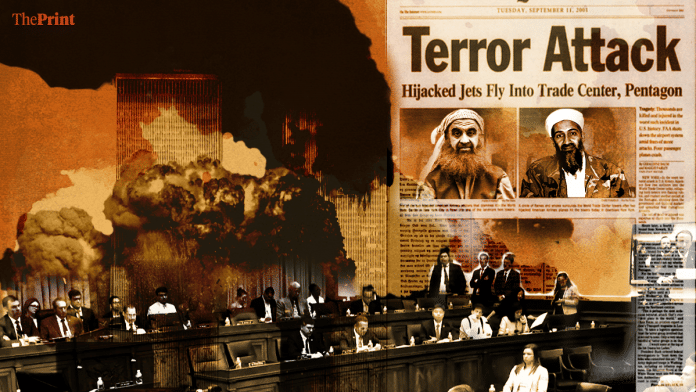
“The language of war is killing,” said the wild-haired, portly man, standing under the bright lights in the room with blue curtains and cream-panelled walls, performing the final dress rehearsal for a trial which would never happen.
“From A-Z,” the man said in March, 2007, “I was responsible for the 9/11 operation.” And to him, that extraordinary confession seemed the lesser point. “Forty million people were killed in World War One,” the man went on. “Ten million in World War Two. You know that two million four hundred thousand be killed in the Korean War.”
From his little stage in Guantanamo Bay, the man concluded his argument: “I’m not happy that three thousand [have] been killed in America. I feel sorry, even. I don’t like to kill children.”
We know from the account of a journalist who attended a separate trial proceeding at the military court in Guantanamo Bay that mood music could be heard incessantly: The clanking of chains of shackles on prisoners being marched through the hallway.
And then, as this music played, Khalid Sheikh Mohammed made his point again: “This is why the language of any war in the world is killing.”
When Al-Qaeda crashed four hijacked jets into New York and Washington on 11 September 2001, 2,972 were killed. The attack unleashed wars across the world, which are still playing out in Afghanistan, in Pakistan, in several parts of the Middle East, and of course, in large swaths of South Africa.
The victims never got a trial, though: A forum where the truth about who did what and why could be held up in the sunlight of a legal process, where evidence is tested before lawyers and judges. That failure has hung like an endless eclipse over the 9/11 story for these two and a half decades.
The opportunism of political leaders, the incompetence of security bureaucrats and the pure sadism of psychiatrists and intelligence officials have ensured at least some of the truth might be impossible to determine.
Trials ahead
Last week, the United States Government announced that it would not appeal a judgment by military judge Lieutenant-Colonel Michael Schrama, barring prosecutors from using Khalid Sheikh Mohammed’s confession—a confession made after repeated cycles of brutal torture by the Central Intelligence Agency.
Lieutenant-Colonel Schrama also excluded the confessions in the ruling made after Khalid Sheikh was moved to Guantanamo in 2007. America’s decision not to appeal Schrama’s verdict means the trial will likely begin in the summer of 2028, as scheduled.
There are many cans of worms waiting to be opened there, not the least being stark contradictions between Khalid Sheikh’s testimony and what we know about the 9/11 plot from documents recovered from Osama bin Laden himself.
Even before the five-defendant trial begins, the case against the alleged plotters, trainers and financiers held in Guantanamo is starting to fray. The confessions made by Abdul Aziz Ali—Khalid Sheikh Mohammed’s nephew —were thrown out last year by military judge Colonel Matthew McCall because of the torture he was subjected to by the CIA.
Two other accused, Walid bin Attash and Mustafa al-Hawsawi, are waiting for McCall to rule on their confessions, made in similar circumstances.
The fifth alleged 9/11 facilitator, Ramzi bin al-Shibh, may never face a judge. Found to be suffering from symptoms of psychosis and deemed unfit to stand trial, his case has been separated from the other four.
All of this poses some formidable ethical issues. Like other liberal democracies, America has founded its legitimacy on respect for the rule of law and the rights of human beings.
Those principles were tossed after 9/11, because the war against terrorism could not afford liberal moral scruples. Abandoning its principles, though, has ended up damaging America’s case—perhaps irreparably so.
There is an enormous mass of evidence which shows that Al-Qaeda did indeed carry out 9/11—evidence nobody will dispute. What is also true, though, is that America will come away from these trials, whatever their outcome, with its moral standing severely damaged.
And thus, the question has to be asked: How did we get here?
The Language of War
From the first time I saw Khalid Sheikh Mohammad’s testimony, in the weeks after it was declassified, one of his phrases stuck out: “The language of war.”
That isn’t a common phrase, but it’s known to people who study wars. The writer Oleksandr Mykhed used it as the title of his recent book on the conflict in his homeland, Ukraine.
Some books and papers use variants of that phrase, written by scholars of philosophy and linguistics. The masterwork which established that phrase in the canon, though, was in Book VIII of Carl von Clausewitz’s On War: “Is not War merely another kind of writing and language for political thoughts? It has certainly a grammar of its own, but its logic is not peculiar to itself.”
To Clausewitz, it seemed absurd to “imagine there is a skilful method of disarming and overcoming an enemy without great bloodshed, and that this is the proper tendency of the Art of War.”
There was an urge to turn away “from the real nature of the affair because the horror of its elements excites repugnance,” he went on. The truth, as he saw it, was that war meant the exercise of utmost violence.
Look back at Khalid Sheikh Mohammed’s testimony in that Guantanamo courtroom, and you’ll see this is just what he was saying. The United States, he said, hadn’t held back from bombing Saddam Hussein’s Iraq, or for that matter the homes of Osama Bin Laden and Ayman al-Zawahiri, even though it was aware there were women and children present.
The objective of Al-Qaeda, likewise, was to damage American economic and military potential. The innocents were: Well, the detritus of war, I suppose he would have said.
Where had Khalid Sheikh Mohammed picked up these ideas? They’re not in any al-Qaeda manual, nor part of the mainstream jihadist literature. The thing is, far more people have come across the distilled wisdom in Clausewitz’s On War than have read the actual book.
Perhaps Khalid Sheikh Mohammed came across the phrase online. Perhaps he came across it in college, or in a conversation with a friend.
And why does it matter, you might ask? The thing is, I’d have expected one of his interrogators to ask—this was, after all, the questioning of one of the most important figures in one of the greatest crimes of all time. Good investigators go over things line by line, backwards and forwards, trying to understand whatever there is to understand.
The CIA spent a lot of time waterboarding Khalid Sheikh Mohammed, subjecting him to 183 separate sessions where he was made to suffer the sensation of drowning. Like his co-prisoners, he was isolated, left in chains, forced to remain nude, and deprived of sleep.
There were cases where CIA interns slammed detainees’ heads into walls; several detainees were raped under medical supervision by having protein-filled fluids pumped up their rectum.
Lanny D’Acosta, the military judge who issued the first landmark torture decision, addressed these problems in the case of the alleged Al-Qaeda commander Abd al-Rahim al-Nashiri in the 2000 USS Cole attack.
Al-Nashiri, charged with directing the bombing of the warship USS Cole in October, 2000, was repeatedly tortured in 2003-2004. Expert witnesses for the CIA contended that al-Nashiri confessed of his own volition in 2017.
However, Colonel D’Acosta noted, though, that al-Nashiri had been conditioned by his long experience of having to choose between extreme pain and self-incrimination.
“The goal of the program was to condition him through torture and other inhumane and coercive methods to become compliant during any government questioning,” Michael Schrama similarly wrote in his Ammar al-Baluchi judgment. “The program worked.”
Little effort is needed to see what happened as a result. All nineteen perpetrators were killed on 9/11, and their commanders followed them. Al-Qaeda chief Osama Bin Laden was killed at his safe-house in Pakistan in 2011. Ayman Al-Zawahiri, his ageing deputy, was killed in Kabul in 2022.
Egyptian jihadists Muhammad Atef and Rajab Abd al-Rahman, the two deputies who were first entrusted with planning the attacks by Bin Laden, were killed in drone strikes in 2002. This means there are huge gaps in our first-hand understanding of what led up to 9/11.
There is no clarity on who recruited the 19 hijackers, all Saudi nationals. There is the suspected Saudi intelligence officer Omar Al-Bayoumi, who befriended the hijackers. He filmed their targets and made crude drawings of an aircraft crashing into the World Trade Centre in New York. But Al-Bayoumi was never arrested, nor was any effort made to extradite him, so what he was doing is completely unknown.
Had these interrogators been paying attention to what they were hearing—really paying attention—they’d have had some serious doubts about the story that was spinning. But they didn’t care about where Khalid Sheikh Mohammad had encountered Clausewitz. And they didn’t care about a bunch of more consequential stuff, too.
They were content to inflict pain and humiliation. I guess they saw it as some kind of payback, but vengeance isn’t the same thing as justice—especially when it leads you to the wrong suspects.
The story, according to Osama
“The Birth of the Idea of September 11”: That is the title of a crumpled piece of paper torn from a spiral notebook, among the tens of thousands of documents recovered from Osama bin Laden’s home in Abbottabad.
The two paragraphs record something no one outside his inner circle knew. “The idea [of 9/11] was conceived when I heard the news of a plane crash by its pilot, al-Batouty,” he wrote. Gamal al-Batouty was a pilot who was allegedly disgruntled with his employers and crashed EgyptAir flight 990 into the sea off New York, killing all 217 on board in 1999.
Bin Laden wrote: “This is how the idea of 9/11 was conceived and developed in my head, and that is when we began the planning.” At the time, we learn that “nobody knew of this idea except Abu Hafs and Abu al-Khair..”
The brilliant scholar Nelly Lahoud, whose research interests range from the medieval polymath Muḥammad bin Ahmad bin Rushd to the weeds of the jihadist movement, flagged this text in her compilation of the Abbottabad papers.
Top investigators either did not understand its significance, or have chosen not to, for it finds no mention in the prosecution of Khalid Sheikh Muhammad.
From Telegraphic Dissemination Report TD-314/69710-06—the code for a despatch from CIA personnel in the field, often reporting on unverified information from informants—we know Khalid Sheikh Mohammad was being accused of very different things. The evidence formed the core of the Department of Defence’s report on his case to the United States military’s Southern Command in December, 2006.
According to the document, Khalid Sheikh Mohammad formed a relationship with Osama bin Laden and went on to present the 9/11 idea to the al-Qaeda chief in late 1998 or 1999. Following this, Khalid Sheikh moved to Kandahar, where he “provided media facilitation and technical assistance to al-Qaida.”
The document records that hours after the 9/11 attacks began, Khalid Sheikh escorted Ramzi bin al-Shibh to a home in Karachi, where they were informed that the attacks were on television.
The contradictions between this story and the testimony of Osama bin Laden himself are glaring: The name Khalid Sheikh Mohammad figures not once in the Abbottabad documents. This could, possibly, be attributed to bin Laden’s desire not to commit secrets to writing—especially secrets with consequences for the freedom of men held in Guantanamo.
Also Read: What was India talking about on 9/11 morning? Agra Summit failure
Facts in question
The 2006 report is also at odds with Khalid Sheikh Mohammed’s confession the next year. In the 2007 confession, Khalid Sheikh describes himself as “Military Operational Commander for all foreign operations around the world under the direction of Sheikh Osama Bin Laden and Dr. Ayman Al-Zawahiri.”
For the commander of al-Qaeda’s foreign operations, his official interrogation records are curiously empty of references to plots that would be executed soon after his arrest in 2003.
The account of his role in 9/11 also sits ill with the high position he claimed to have held in al-Qaeda. He also claims to have been running a martyr’s house in Kandahar and having trained the hijackers there.
The 2006 Defence Department memo, though, states that he only handled media for al-Qaeda—and was in Karachi when it took place, watching events he purportedly masterminded on television.
According to the 2006 record, Pakistan-origin, Kuwait-raised Khalid Sheikh Mohammed finished high school in 1983, and then left for the United States to study at Chowan University in Murfreesboro, North Carolina. He later transferred to North Carolina Agricultural and Technical State University, graduating with an engineering degree in 1987.
Following his studies in America, Khalid went to Afghanistan and trained as a jihadist at a camp run by the al-Qaeda leader Abdullah Azzam. Khalid also appears to have been associated with the Afghan jihadist leader Abdul Rab Rasul Sayyaf, the Islamist warlord closest to Osama bin Laden and Pakistan’s ISI Directorate.
The official 9/11 commission of inquiry described Khalid as a terror entrepreneur, though it gave no examples of cash-for-terror transactions.
The 2007 confession also has Khalid list 31 operations he was singly or jointly responsible for—among them, the truck-bombing plot targeting the World Trade Centre in 1993, personally decapitating the journalist Daniel Pearl, plans to bomb nuclear power plants in the United States and a plot to hijack 12 separate American aircraft and crash them in the Pacific, killing 4,000 people.
The hijacking plot never moved past the planning stage. Although three conspirators were convicted in the case, Khalid Sheikh Mohammed’s alleged role did not surface until several years later.
In the 1993 World Trade Centre Bojinka case, he was never named or indicted. His name was not mentioned in the appellate proceedings of the Bojinka and WTC cases, which saw his nephew receive a life sentence.
Even today, the backstory of 9/11, the elements of the plot, the planners and the executors remain obscure.
The trial that wasn’t
The 9/11 story needn’t have ended like this—like an incomplete sentence left hanging in the air. The Government of President Barack Obama had moved, in 2009, to conduct a civilian trial of Khalid Sheikh Mohammed in New York.
There was plenty of precedent: From Ramzi Yousuf to would-be suicide bomber Zacarias Moussaoui and East Africa embassy bomber Ahmed Khalfan Ghailani, many al-Qaeda operatives had been tried and convicted.
However, the moment Attorney General Eric Holder announced the trial would take place, a chorus of outrage exploded, coming mainly from individuals who seemed to believe that a fair criminal trial would undermine America’s national security.
Faced with the uproar, President Obama backed down and handed the cases back to military courts, never intending to prosecute them. “The result was a moral and legal limbo that persists more than two decades later”, former prosecutor David Raskin has written.
I predict there will never be a completed military commission trial for Mohammed and the other Sept. 11 defendants. The case is now before its fifth judge.
The civilian courts had, by this time, shown they were competent tools for addressing transnational terrorism. Less than a year after the 1993 New York bombings, Mohammed Salameh, Mahmud Abouhalima, Nidal Ayyad and Ahmed Ajaj had been convicted for killing six in the World Trade Centre.
In a second trial emerging from the WTC bombing, prosecutors initiated action against the blind cleric Sheikh Omar Abdel Rahman, who was accused of murdering both Egyptian president Anwar Sadat and Israeli far-right leader Rabbi Meir Kahane.
Even as these trials were underway, Ramzi Yousuf was arrested for his role in the WTC bombing, which led on to his prosecution in the Bojinka case, together with his friends Abdul Karim Murad and Wali Khan Amin Shah.
These prosecutions reveal police forces willing to drill into tough investigative work, rather than producing easy-to-digest ideological narratives. Even though Ramzi and Khalid Sheikh Mohammed were known to move in the same jihadist circles as Osama bin Laden, none of these plots showed direct ties to al-Qaeda.
Abdel Rahman, the New York blind cleric, was the Emir of Egypt’s Gama’at el-Islamiyyah, which long predated al-Qaeda. Khalid Sheikh Mohammed, for his part, was not playing a significant jihad role until well after 1993.
From 1998, the tempo of attacks by al-Qaeda grew, beginning with the al-Khobar Towers bombing in Saudi Arabia, and the strike on the USS Cole in 2000; American security strategists began worrying they were doing too little. Law enforcement, some argued, was the wrong tool.
“Trials don’t work for terrorism”. Former prosecutor Andrew McCarthy wrote, “They work for terrorists.” “The only responsible national counterterrorism strategy is one that brings to bear all of the tools of government: military, diplomatic, intelligence, financial land, to a far more limited extent than throughout the 1990’s, law enforcement. Employing the criminal justice system alone imperils Americans.”
This thinking would give birth to the war on terror: The illusion that coercion would resolve what laws and norms could not.
For 25 years, America has pursued the men who attacked it on 9/11, despatching al-Qaeda’s leadership to their grave and levelling the terrorist group’s fledgling emirates. This victory, though, threatens to be a pyrrhic one.
Al-Qaeda and its successors today control far more territory than they did on 9/11, and have worn out the Western nation-states who vowed to annihilate the jihadists. Even at its moment of triumph, America seems diminished, uncertain as never before about its principles and values.
Praveen Swami is a Contributing Editor at ThePrint. His X handle is @praveenswami. Views are personal.
(Edited by Maryam Hassan)