







Before packed stadiums, cameras and million-dollar contracts, there was Pune.
It was April 1973 and a considerable crowd had gathered at Pune’s Nehru Stadium. The air was thick with equal parts excitement and amusement. The curious onlookers were trying to make sense of what was unfolding before them, unaware that history was being made right in front of their eyes.
Stretching across the ground was a huge banner that read ‘National Ladies Cricket Championship’. It was the first women’s national championship being organised by the fledgling Women’s Cricket Association of India (WCAI).
Just two-and-a-half teams turned up.
During the presentation ceremony, Pramilabai Chavan, Member of Parliament and WCAI president, handed the memento. Inscribed on it were the words she wrote: “The wings of ambition know no horizon.”
Five decades later, history came calling again. But this time, it was miles away from Pune. It was at Lord’s – the cradle of cricket.
Beneath its iconic red-brick pavilion, amid rows of its elitist members in navy blazers, cream chinos and the unmistakable red and yellow ties, another first was being written.
It was the first time in its 142-year history that Lord’s was hosting a women’s Test match. But the occasion itself was only half the story.
On that historic afternoon in London, the Indian women’s cricket team beat England by a staggering 270 runs.
Women’s cricket, and Indian women’s cricket in particular, has come a long way. The game has broken into the mainstream, and is now demanding equal attention — and equal pay. The past few years have brought unprecedented crowds, media attention and even a World Cup trophy for India.
Yet, women’s cricket has never been new, only newly noticed. Women were playing cricket well before cable television entered Indian drawing rooms. It’s just that, between the black-and-white images, the unseen colours of patriarchy kept their story largely untold.
The “mother hen”
The early 1970s was a decade of change. India was reinventing itself, having elected its first woman Prime Minister, Indira Gandhi, a few years ago.
On one side, the streets echoed with the slogan of “Garibi Hatao, Desh Bachao”; on the other, in the fields of Punjab and Uttar Pradesh, the Green Revolution was transforming Indian agriculture. And far from public view, scientists were preparing for what would become the country’s first nuclear test at Pokhran.
But away from the headlines, another revolution was quietly taking shape, in narrow lanes and dusty maidans across the country.
Young girls – with neatly braided plaits, scraped knees and fire in their eyes — began picking up a bat and a ball, which had remained a privilege reserved for the boys until then.
Few noticed them. Yet they were laying the foundations of a revolution that would one day reach Lord’s.
It started from a house in South Bombay, where one woman dared to imagine the unthinkable.
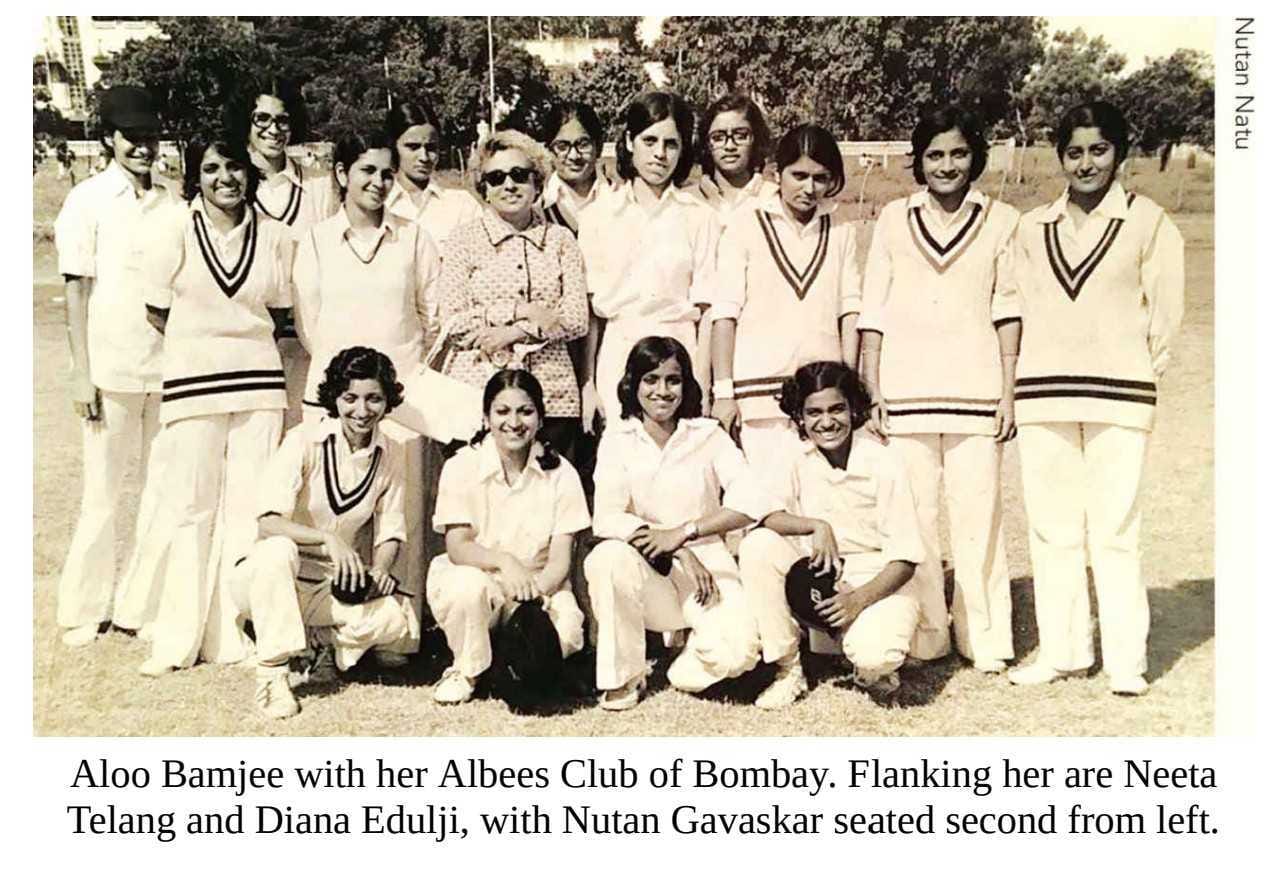
Aloo Bamjee, a Parsi woman, decided that girls deserved a cricket club of their own. She called it ‘The Albees’.
Among the girls who joined was a young Diana Edulji. Every weekend, Edulji would head to Badhwar Park to play tennis cricket with boys. Often, she would be the only girl in the field.
“She lost her two front teeth and the top of her gum when, playing on a matting wicket for the first time, she was hit by a fast bowler. But showing the keen fighting instinct… she kept at it,” wrote Karunya Keshav and Sidhanta Patnaik in The Fire Burns Blue (2018).
Edulji, who would go on to captain India and become one of the defining figures of the sport, played the rest of her career wearing dentures.
The Parsi connection is hard to ignore. As Aditya Bhushan writes in Her Story, Her Glory (2026), the community’s men first took to the game in India, using cricket as one of many ways to “demonstrate their status and prowess.”
Bamjee, however, meant business. And discipline was non-negotiable.
“She expected hard work and practice,” wrote Keshav and Patnaik.
But Bamjee knew equality could not be won through demands alone. If the girls were to be taken seriously, they had to “train and compete under the same conditions as men,” wrote Bhushan.
For Bamjee, Albees was not a pastime, and her dedication and commitment didn’t end with the boundary of the fields.
She would bring sandwiches for the players, and gloves and bats for those who couldn’t afford them. During Mumbai’s unforgiving monsoon, she turned her home into a practice pitch. Not even the rains were going to dampen her resolve.
With more than sixty girls under her wing, Bamjee needed a village to raise her child, Albees. The first one to join her was her husband, Homi. He would accompany her to the Cricket Club of India (CCI) every Wednesday and Saturday for training sessions.
Tough on the outside, yet a mother at heart, Bamjee never let a good day’s effort go unrewarded. The prize – a bar of Cadbury chocolate or a dastarkhwan of scrumptious Parsi delicacies.
As Behroze Edulji recalled in an interview with The Times of India on 19 December 2021, “She was like a mother hen.”
Tiny sparks everywhere
The spark had been lit. Girls’ cricket clubs began appearing across India.
In the suburbs of Bombay itself, Albees found a competitor – the Indian Gymkhana. And with that, a friendly yet fierce cross-city rivalry emerged. The driving force behind Indian Gymkhana were two young entrepreneurs – Neeta Talang and Nutan Gavaskar, Sunil Gavaskar’s sister.
“The two clubs were friends, competitors and co-conspirators when it came to imagining how to take the women’s game forward,” wrote Keshav and Patnaik.
A little south, in Pune, there was Narendra Nikam’s Challenger Club Camp. Its story began with a train ride, a girls’ softball team and a handful of Ranji trophy players. With it emerged a simple idea – girls who were “already playing softball, hockey and basketball, could also play cricket,” wrote Keshav and Patnaik.
Among those who joined was Nilima Joglekar, the future Indian wicketkeeper.
In Chennai, inspired after watching Mansoor Ali Khan Pataudi and Pat Pocock in action, three spirited 14-year-olds – Fowzieh Khalili, Sudha Shah and Susan Itticheria – formed the Sky Larks.
“When we started, there were just two clubs – the Skylarks Club and the Gandhinagar Club. We would play matches against each other, and it was tremendous fun,” recalled Sudha Shah in a conversation with ThePrint. “I mean, even a score of 20 was considered a big score.”
Bangalore had its very own, Falcon Sports Club. Further east, Kolkata’s Kalighat Club Ground became the cradle for women’s cricket. When newspaper advertisements invited women to trial for the second National Women’s Cricket Championship, nearly 400 turned up – transcending age and profession.
Back then, softball was the sport of choice for girls in schools and colleges. As Bhushan writes, it was these softball players who flocked to cricket clubs and eventually became the country’s first generation of women cricketers.
Yet, for all the enthusiasm, such clubs remained few and scattered.
“These clubs were not too many in number, perhaps more in the metros because in tier-2, tier-3 cities and rural areas, kho kho and catch-and-cook were common. But women playing a sport like cricket was very uncommon,” sports journalist Ayaz Memon told ThePrint.
Yet, despite the fire that burned in the hearts of many young girls, cricket remained little more than an after-school pursuit. A backyard game. Localised. Unorganised.
Then came Mahendra Kumar Sharma.
Women’s Cricket Association of India
Sharma was already organising girls’ tournaments in softball and handball. During one such national meet, where he had taken a team from Uttar Pradesh, an unexpected moment unfolded.
The girls noticed a group of boys practising cricket. Curious, they picked up the bat themselves. To their own surprise, they really enjoyed it.
His fellow organiser from Pune, Narendra Nikam of the Challenger Club Camp, who was also present at the meet, shared the story of how a chance train journey had inspired girls to take up cricket. Sharma saw the pieces falling into place, wrote Keshav and Patnaik.
He had an idea. Back in Lucknow, he wasted no time.
Aboard a rickshaw, a loudspeaker in his hand and an unwavering belief, Sharma set out through the winding lanes of the city. One message echoed trailing behind his rickshaw: “There will be cricket for girls, do come.”
The call worked. Over 200 curious spectators, mostly boys, gathered at the grounds of Queen’s Anglo Sanskrit College. Many among them, as Bushan writes, “turned up to watch women play in skirts.”
Buoyed by the overwhelming response, Sharma went a step further. He established the Women’s Cricket Association of India in Lucknow under the Societies Registration Act.
Sharma became its secretary, while Begum Hamida Habibullah, parliamentarian, educationist and social worker, became its first president.
“I think cricket is what it is today because of Mahendra Kumar Sharma. He was in his twenties, and he had this vision that women should play cricket,” said Sudha Shah.
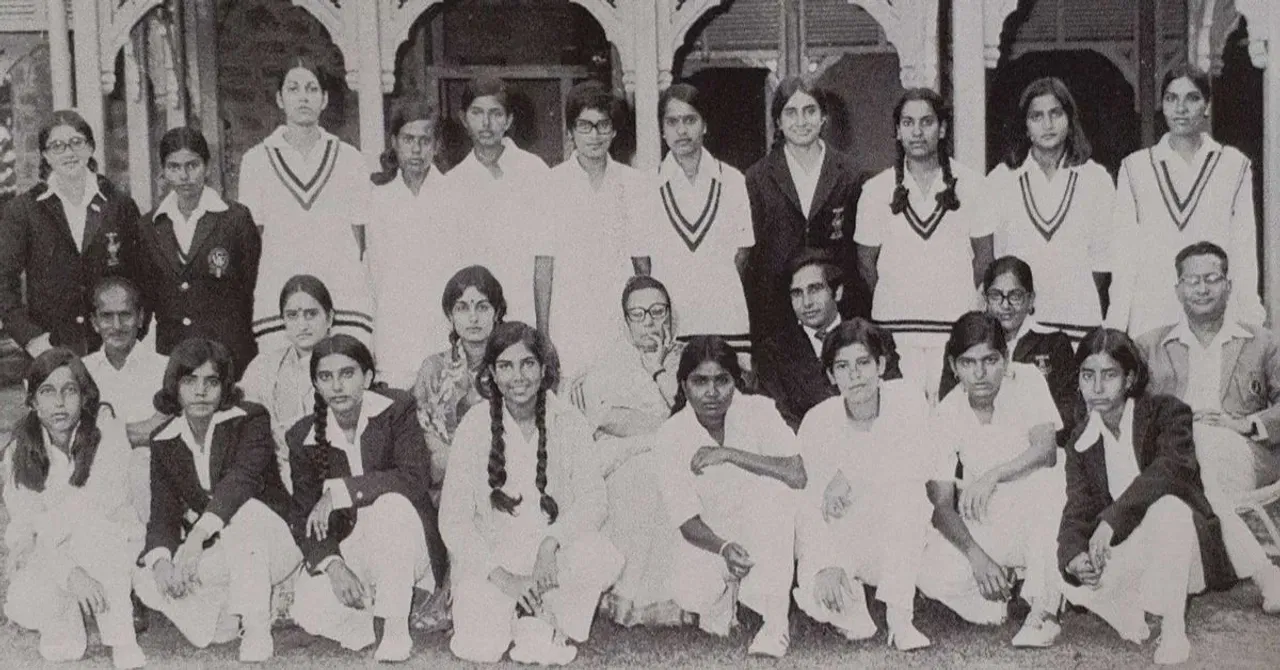
Shubhangi Kulkarni remembers Sharma much the same way.
“He changed what was a hobby into a national sport,” the former cricketer told ThePrint.
For a nascent organisation, taking the decision to organise tournament after tournament was something few would have risked, especially when the association barely had the funds.
“Yet, somehow, he could pull it through,” said Kulkarni, who later served as WCAI secretary before it was merged into BCCI in 2006.
Sharma would go out of his way to publicise the game. He would type out reports himself, Kulkarni said, and send someone to hand it over to the press. Among the players, he had acquired something close to a celebrity status.
“We used to call him Sharmaji. He was such a handsome guy – like Shashi Kapoor. And, you know, we were all schoolgirls then. Naturally, we were big fans of his,” recalled Shah.
That admiration once led to a hilarious incident. As Shah recalled, the girls were so naïve they hadn’t realised “Sharma” was a very common last name in Uttar Pradesh. One day, during a match, someone suddenly announced, “Sharmaji is here!” Everyone turned at once.
“To everyone’s disappointment, it was some funny-looking guy, with paan trickling down the corners of his lips,” Shah said, laughing.
A revolution had begun, and there was no turning back now. What had long been a gentleman’s game was about to be rewritten by women.
“Women’s cricket in India now had an umbrella. And, as Narendra likes to describe it, it found its mothers and fathers,” wrote Keshav and Patnaik.
With that, the stage was set for the first Nationals to be held at Pune.
The Nationals
Just two-and-a-half teams were in attendance – Bombay, Maharashtra and half a team from Uttar Pradesh, which fell short of players borrowed from Bombay and Maharashtra. Players from Andhra, Madhya Pradesh and Mysore attended as observers, wrote Bhushan.
One-day-25-over games were organised, and Bombay won the finals beating Maharashtra by 10 wickets.
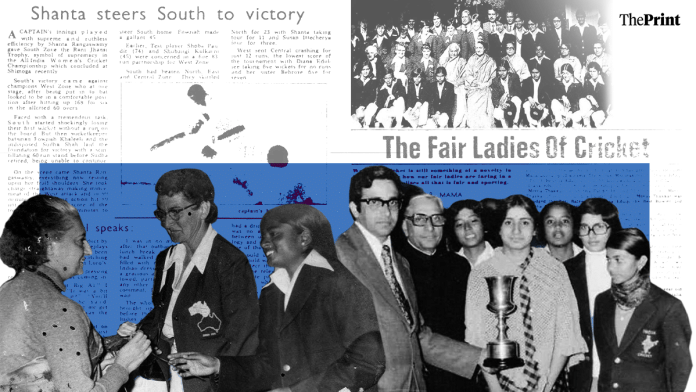
The Illustrated Weekly of India, in its 30 December 1973 issue, devoted a full page to women’s cricket’s baby steps – from Albees to the first National Championship in Pune. Titled “The Fair Ladies of Cricket,” it described the game as a novelty, inviting readers to “see how our fair ladies are faring in a game that symbolises all that is fair and sporting.”
“The crowds came too!” wrote Keshav and Patnaik. “Perhaps, it was just curiosity. Perhaps, it was good marketing.”
Nutan Gavaskar, who represented Bombay, would later recall that “a lot of people came to see whether we wore skirts or dresses.”
Much to the crowd’s disappointment, the women walked out in regular whites and trousers.
While England persisted with divided skirts until 1997, India chose the practicality of trousers from the beginning.
In December that year, a second Nationals would follow. This time it was held in Banaras with eight teams participating. Last national’s reigning champion, Bombay, was knocked out in the quarter-finals.
Bombay, however, was clearly not pleased with the outcome – and they soon made their displeasure known.
The morning of the final, in which Bengal defeated Karnataka by 70 runs, turned out to be a nightmare for the to-be champions.
The Bengal team was notoriously superstitious about its jerseys. So, when they woke up that morning to find their carefully washed whites splashed red with cough syrup, players were enraged. A trail of cough syrup drops led the search to the Tamil Nadu team’s room.
“So, in the morning, the Bengal captain was outside banging on the door, cursing. The curses were ‘idli’, ‘sambar,’ ‘vada’… that sort of thing,” Shah recalled.
The mystery didn’t last long. It was Bombay that had orchestrated the whole fiasco.
“There was no malice,” Shah said. “We were just having fun.”
And so, the second Nationals came to an end with a note of humour.
The next step, however, lay beyond India’s shores.
The first international Test matches
The year 1975 brought a new sense of rigour to women’s cricket.
There was a growing consensus that without international matches, the game would never reach its full potential.
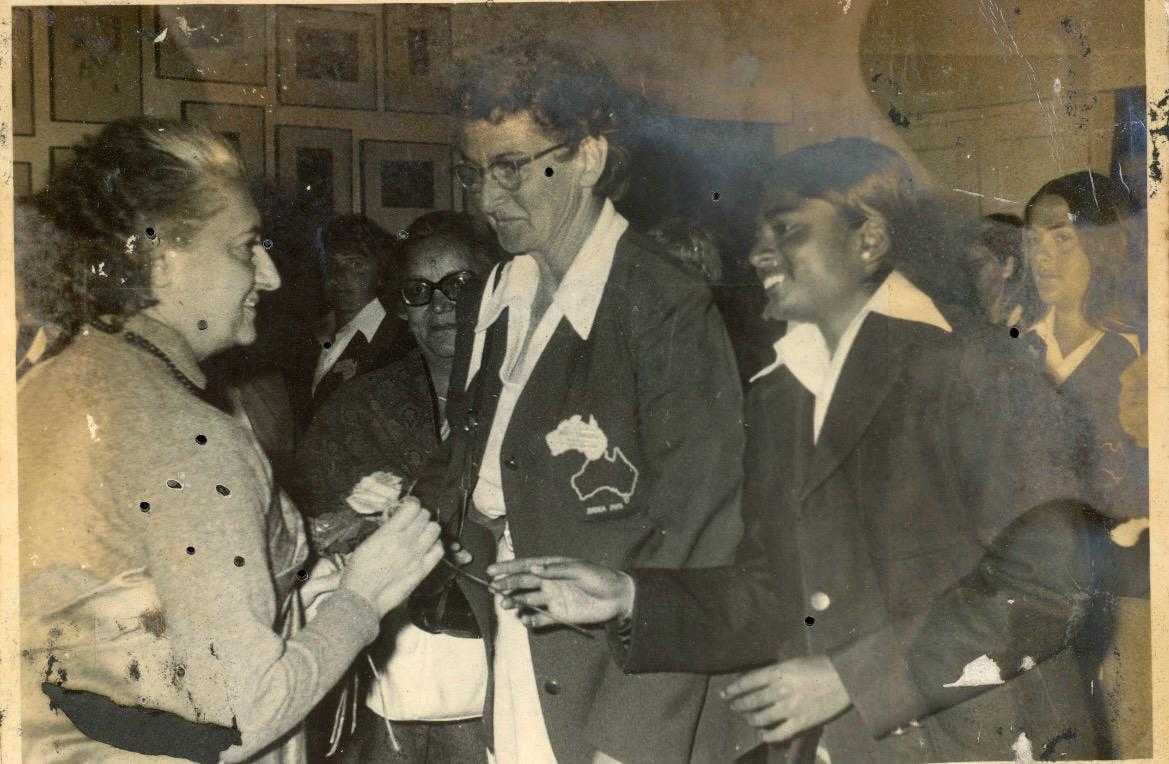
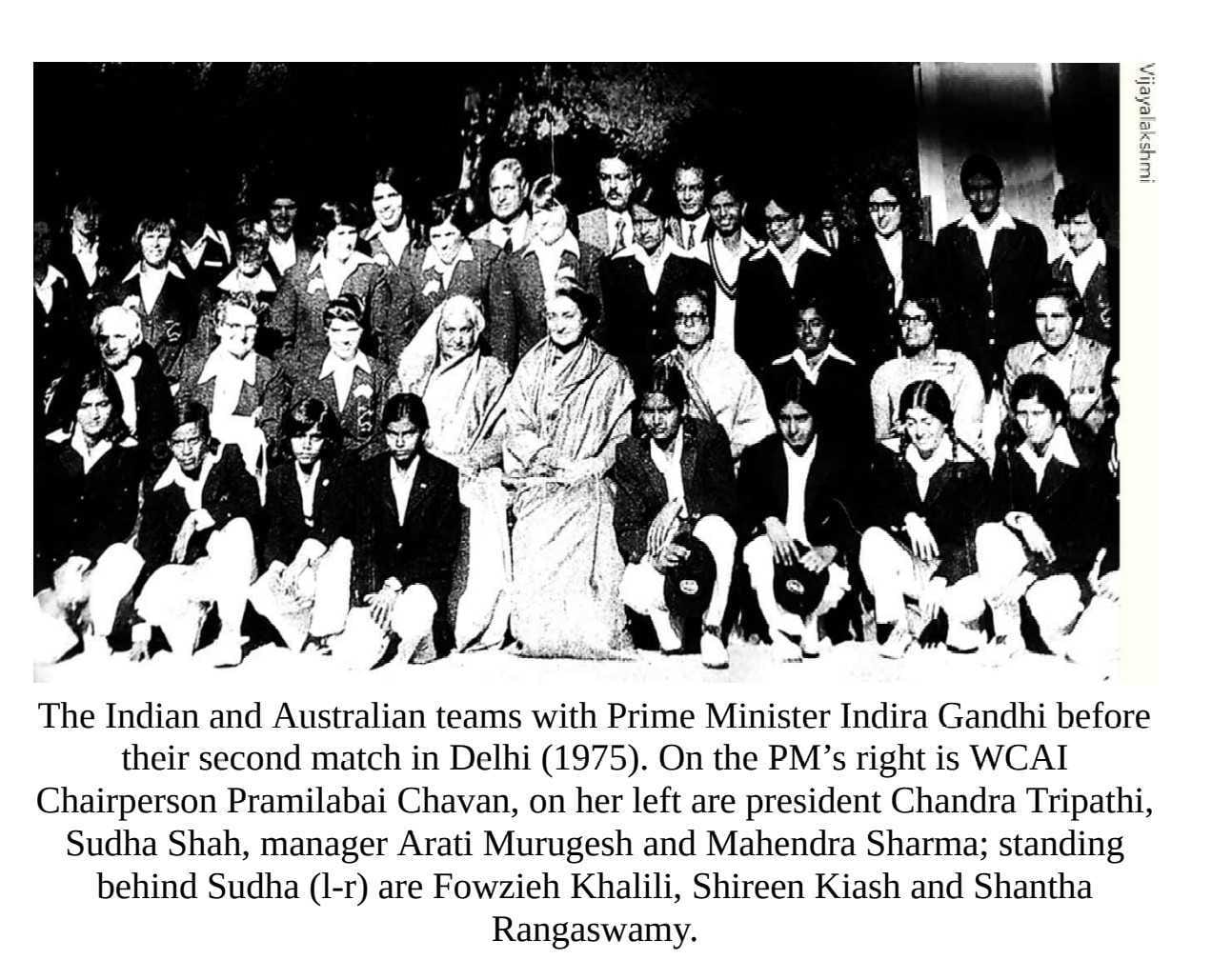
The WCAI, Bushan wrote, persuaded the Australians to send a team to India. It was in 1975, that an under-25 Australian entourage finally arrived.
One task, however, remained. The selection of a formidable national team.
To do that, the WCAI organised the inter-zonal Rani Jhansi Trophy. The South Zone, featuring future stars Shantha Rangaswamy, Fowzieh Khalili, Susan Itticheria and Sudha Shah, emerged victorious.
Soon, another hurdle emerged. Who would captain India? State association politics quickly came into play. Every association wanted its own player to lead.
The solution was, in many ways, quintessentially Indian – unity in diversity. The captaincy would rotate, with each host city getting its own captain.
With the debate settled, India finally took the field against Australia. The three-match series ended in a draw.
The following January, India hosted New Zealand for a five-Test series. This time, however, Shantha Rangaswamy was made the sole captain for the entire series.
And she didn’t disappoint. In the fourth Test at Pune, she became the first Indian woman to score a Test century. The series, however, ended 1-0, with New Zealand taking the trophy home.
Despite the remarkable strides Indian women’s cricket had made in those two series – Rangaswamy’s 627 runs and 14 wickets, and Edulji’s 39 wickets, as Bhushan wrote, a few years later, it all went down the drain.
With the merger of the International Women’s Cricket Council and the ICC, India’s Test matches against Australia and New Zealand were retrospectively stripped of their official status.
Yet, back-to-back matches kept the girls constantly on the move.
Soon after, a third season of Rani Jhansi Trophy unfurled. “Shanta steers South to victory,” flashed in Sportsweek on 17 October 1976, as the South Zone won the title for the second time.
The West Indies tour in 1976, however, finally made it official.
The six-Test series ended in a 1-1 draw. Yet, it remained one of the most historic series in the history of women’s cricket in India. The experience gained in this long Test series, Bhushan wrote, shaped the cricketers that they would eventually become.
The fourth Test, at Patna, proved especially memorable. It brought India’s first-ever official Test victory.
“On the day we won the Patna Test before a huge crowd exceeding 40,000 spectators, the whole city erupted, celebrating our win,” wrote Shantha Rangaswamy in her paper Journey of Indian Women’s cricket from the 1970s. “I remember a victory procession that took two hours from the stadium to a women’s college in the neighbourhood, as people had lined up along the streets to cheer us.”
It was no small ordeal. It was historic. Unprecedented.
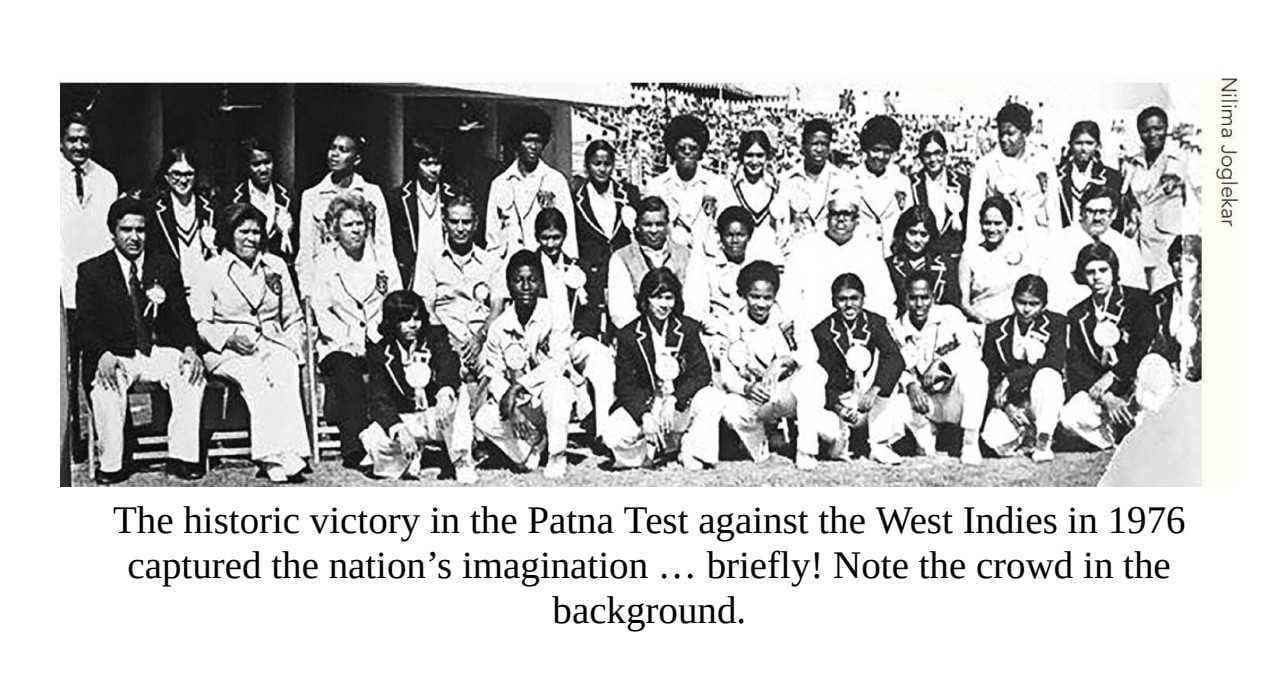
They had broken the glass ceiling – challenging a society that had long told women what they could and could not be.
It was a quiet, joyful revolution, one that involved swinging a bat.
With their maiden Test victory at Patna, the team’s confidence was soaring.
The years that followed would become a string of firsts for the team. And one came just within a fortnight.
No sooner had the West Indies series ended than the team boarded a flight to New Zealand for India’s first overseas tour.
For many of these young women, still in their teens or early twenties, it was their first journey abroad. It was daunting, but it also forged friendships and memories that would last a lifetime.
The four-day Test was action packed – a drawn match, Fowzieh Khalili’s broken teeth, hunt for vegetarian food, and Shantha Rangaswamy’s first official Test century.
A test in Australia followed next.
From its humble beginnings in 1973, Indian women’s cricket had, in just a few years, carved a place for itself on the international stage.
Then came 1978 – and with it, an opportunity, which India was quick to seize.
India was not just about to play its first Women’s World Cup – it was about to host it too, nearly a decade before the men’s Cup arrived on the Indian soil.
The first World Cup
The 1978 Women’s World Cup was originally planned to be held in South Africa. But plans soon changed.
The country’s apartheid regime had triggered a global sporting boycott. At the same time, many women’s cricket associations around the world were grappling with severe financial constraints. The West Indies and the Netherlands, as a result, withdrew from the tournament at the last minute.
For India and especially Mahendra Kumar Sharma, it was an opportunity too important to let go. They moved quickly.
As Bhushan writes, without Sharma’s constant efforts, India would never have hosted the event.
“He understood the symbolic power of hosting the event. A World Cup on home soil meant visibility for Indian players, inspiration for young girls and legitimacy for the administrators,” wrote Bhushan.
But hosting a World Cup required money – and there was very little of it.
Sharma went above and beyond. He even sold his personal property in Lucknow and organised, as Bhushan writes, high-profile fundraising matches, roping in Bollywood actors like Vinod Khanna, to raise funds.
Yet, an event of this scale was never going to be without drama. From the outset, the tournament was marred by controversies and allegations of poor management.
Shantha Rangaswamy, having just joined Canara Bank, refused to participate. It was Diana who eventually led the team.
Soon, the administrators themselves came under glaring spotlight. The WCAI and Sharma, the man who nurtured it, found themselves under intense scrutiny.
Amid all the pomp and publicity, the WCAI had not cleared the players’ pending dues. And Sharma’s repeated assurances did little to ease their concerns.
For the girls, enough was enough.
A drastic step was taken. Diana again led the team, only this time beyond the fields.
She and her teammates met the Bihar Cricket Association and made their position clear – unless their dues were cleared, they would boycott the match in Patna.
Hours of negotiations followed. Proposal after proposal were rejected until a compromise was finally reached.
It was decided – the cash collected from ticket sales would go directly to the players.
But the drama was far from over.
In the middle of the match against the Aussies, Diana informed the umpire and walked back to the dressing room, Bhushan writes. Only after being sure that the cash had arrived, did she join her teammates back in the field. WCAI had managed to saved its face.
For Sharma, however, the episode left deep scars. As Keshav and Patnaik write, the humiliation was beyond repair. Amid constant allegations of being dictatorial and accusations of corruption within the WCAI, a frustrated Sharma resigned. 1978 marked the end of his journey in women’s cricket.
For the WCAI, the controversy of 1978 was just the beginning. In the years that followed, resentment would only grow among the players.
In 1988, an article in The India Express titled “It’s time for action, WCAI” highlighted the body’s financial woes, poor tournament administration and questioned why its secretary, Ashutosh Sharma, had remained in office for over a dozen years.
Five years later, on 18 July 1993, the newspaper quoted Edulji, who blamed the infighting among the WCAI officials for the “sorry state of women’s cricket in India.”
The great merger
If Indian women’s cricket survived the 1970s, it was because it found people who cared enough to keep it alive.
Looking back, Kulkarni says that the formative years under Sharma saw more cricket than the following years.
“After the 1978 World Cup, our next official international was only in 1983. Then, from 1986 to 1991, we didn’t play any international cricket,” said Kulkarni.
The struggle was real — barely any money, parents to persuade, every step forward met with another hurdle. The girls travelled in unreserved third-class compartments, squeezed into corners near the toilets, slept on train floors, and stayed in schools and dormitories, making do with whatever was available.
“But, in retrospect, this was never looked upon as relevant because the passion to play overshadowed all these obstacles…I have never earned a rupee from the game in my entire cricketing career that spanned two decades,” wrote Rangaswamy.
Raising funds was their biggest challenge. Mahendra Kumar Sharma knew that better than anyone. His efforts to bring the WCAI under the BCCI’s umbrella never saw the light of the day.
It wasn’t until 30 years later that Sharma’s dream would become reality.
The 2005 Women’s World Cup proved to be a turning point. While India lost the final, the tournament delivered a bigger victory. Soon after, the WCAI finally merged with the BCCI, which, Bhushan writes, “would forever change the landscape of women’s cricket across the globe.”
At the heart of the merger were Shubhangi Kulkarni, then WCAI secretary, and Sharad Pawar, then BCCI president.
Pawar had to “virtually force” his decision on a reluctant BCCI, as Rangaswamy wrote. A BCCI’s umbrella meant “better practice and travel facilities, and access to trained coaches.”
But while the merger have women’s cricket a new home, it did not immediately bring the desired attention.
Many describe it as the “lost generation,” says Sharda Ugra. Between 2006 and 2013-14, women’s cricket received little more than cursory attention from the BCCI.
“The BCCI was run almost entirely by men. In my view, that male chauvinism is why it took so long for the WCAI to be absorbed,” says Memon.
It was the same story as 1978, only slower this time: the game hadn’t gone anywhere, just the attention had.
Things began to shift only when cricket itself came under judicial scrutiny. As the Supreme Court took an interest in the BCCI’s functioning, the women’s cricket, too, gained greater visibility.
That’s when Diana Edulji, in 2017, became part of the Cricket Advisory Committee. The change was long overdue.
“You can’t become a sporting nation if you keep half your population out of sports,” added Memon.
Full circle
From then on, there was no looking back for Indian women’s cricket. It had been, as Rangaswamy wrote, a journey “from ridicule to curiosity to appreciation to adoration,” five decades in the making.
Then came 2025. The country erupted in blue. Tricolours fluttered across the stands, fireworks lit up the skies, and under Harmanpreet Kaur, India lifted the ICC Women’s World Cup.
But there was one more first left to write.
Eight months later, on 13 July 2026, Harmanpreet led her team out at Lord’s — the same ground whose 142-year history had, until that morning, never once included a women’s Test match. Kaur would later admit she had been taken aback to learn it had come to this: that it had taken the sport this long to let women onto that pitch in whites.
India batted first and never really let go. Smriti Mandhana, Kaur and Deepti Sharma made half-centuries to register a total of 285. England were bundled out for 170. Kranti Gaud took a five-for, becoming the first woman to have her name inscribed on Lord’s Test Honours Board. Barely a day later, Yastika Bhatia joined her — a century, the first by any woman on that ground. By the fourth morning, chasing a target of 457, England were bowled out for 186. India had won by 270 runs.
Fifty-three years earlier, on a ground in Pune, Pramilabai Chavan had handed over a memento to a tournament that could barely fill two full teams. The words she had had inscribed on it could just as easily have been meant for the eleven women walking off the Lord’s outfield that July afternoon: “The wings of ambition know no horizon.”
(Edited by Prashant Dixit)