



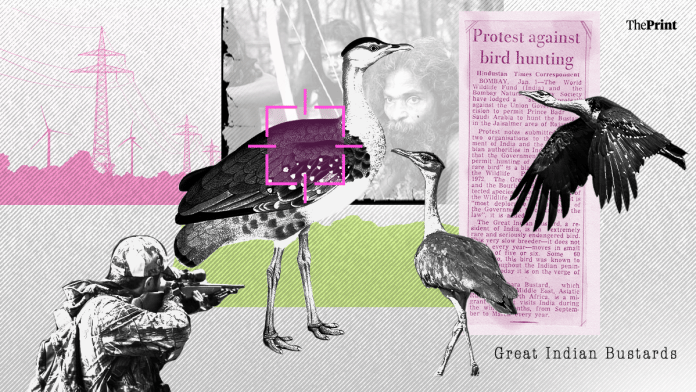
New Delhi: On 4 October, two captive-bred male Great Indian Bustards stepped into Rajasthan’s Desert National Park – doing what their ancestors did without a second thought: walking in the wild.
This ambitious comeback, however, has been years in the making.
Since 2019, wild eggs have been rescued, artificially incubated, and hand-reared at Rajasthan’s Sam and Ramdevra conservation centres. Today, 98 birds call the breeding centres their home. Yet, not so long ago, the bustard was everywhere, the undisputed monarch of the grasslands. The Great Indian Bustard’s history is grand, though rocky. Its future is mostly built on the unputdownable optimism of conservation biologists.
In The Game Birds of India, Burmah, and Ceylon, Allan Octavian Hume, ornithologist and the architect of the Indian National Congress, charted its extraordinary reach.
It “frequents bare open plains, grassy plains interspersed with low bushes” stretching from Mysore “throughout the Bombay Presidency” including “Kathiawar and Cutch” to “the Nizam’s Territory, Berar, the Central Provinces, as far east as Sambalpur, the Central India Agency, Rajputana…and the Punjab”. One bird species was found in 11 states of India.
The Great Indian Bustard was chronicled by Mughal emperors. Relished on royal dastarkhwans. It was a game bird for the British Raj.
From commanding Indian grasslands to surviving in desert pockets – what went wrong? The grasslands vanished, hunting was rampant and feral dogs were also after the Great Indian Bustards. And then came the modern and green adversaries: crisscrossing high-voltage power cables.
What followed was a long line of CPRs – a dedicated national project under its name, fierce battles in the Supreme Court, and an intensive conservation breeding programme. And now India is trying to put it back into the wild.
But before the bustard became a conservation emergency, it had another shot at making history.
In 1961, it was in the running to become India’s avian ambassador, the national bird. It lost to the peacock. Why? Partly over optics. Partly, phonetics.
The race to the nationals
When India went looking for its national bird in 1960, the Great Indian Bustard faced more glamorous Indian peafowl with an indigo neck and kaleidoscopic plumage.
But why did the peacock win? Was it just its beauty? Or cultural symbolism? Or was there something to do with the bustard itself? Its name, perhaps?
The race began when the International Council for Bird Preservation’s 1960 conference in Tokyo urged nations to select an avian ambassador.
Back home, the Indian Board for Wildlife drew an elite list of five: the Garuda, Sarus Crane, Swan, Peacock, and the Great Indian Bustard. Soon it turned into a parliamentary debate.
Deputy Agriculture Minister MV Krishnappa revealed that “in the Wildlife Board…the majority opinion was that the peacock should be considered”. But the government also wanted “to obtain public opinion”.
When MP NM Lingam asked about the selection criteria, Agriculture Minister SK Patil candidly replied, “It is generally the bird that is popular, possibly good-looking and some national sanctity about it.”
If that was the test, the peacock had quite a head start. It carried an ethereal aura – familiar, sacred, and regal – and unmistakably Indian.
It transcended faiths and empires – from Kartikeya’s vahana to the feather in Krishna’s crown. In the Rigveda, it was Indra’s favourite. For Kalidasa, an eternal muse. In the Mora Jataka tales, Buddha himself was born as a golden peacock, and in Persian imagery, paired peacocks flanked the Tree of Life.
Nothing, however, rivalled the tribute of Mughal Emperor Shah Jahan, who spent seven years crafting the bedazzling Takht-i-Taus – the legendary Peacock Throne.
Yet, the bustard, standing over three feet tall, was no underdog.
Chronicled, a royal feast and a trophy
The bustard had many lives: a royal delicacy, a trophy and a prize worth pursuing – that would also seal its tragic fate.
In his 16th-century memoirs, the Mughal Emperor Babur famously frowned upon Hindustan as a “country of few charms”, devoid of good looks, grapes, or melons. But the wildlife caught his eye – and his appetite too. In his chronicles, Babur praised the flesh of “Kharchal” (or bustard) as “delicious and excellent”.
Centuries later, Hume and Marshall, however, had a different culinary review. Describing the bustard as a “beautifully vermicellated and gamey plumage” but “by no means furnishing a delicate dish for the table”.
Flavours aside, Hume declared it “a prize worthy of a sportsman’s pursuit”. And pursue they did – recklessly. In Punjab, wrote Hume and Marshall, local fowlers crept close, wrapped in blankets and carrying gut nooses at their belts. Europeans had their own tricks – rifles, stalking and a well-timed shot.
In Sindh, wrote Hume and Marshall, a hunter named S. Doig recalled spotting 34 bustards near sand hills. He stayed still and then sprang up “in the middle of the flock, getting an easy right and left” – wounding a third. Near Malegaon, JE James walked into a tall jowar field and shot eight bustards as they rose “like so many Partridges”.
“There was a hunter named Mansfield; he killed 960 bustards in two years, just in Ahmedabad District,” veteran ornithologist Asad Rahmani told ThePrint.
The optics of the name
So, both birds passed the test of – Indianness, stature, and history. So why did the Great Indian Bustard lose to the peacock?
India in the 1950s and 1960s was a young and poor country, trying to establish itself on the world stage. Its image mattered.
“There was a whole aesthetic consideration when we were projecting our country, because we were trying to, you know, create a new narrative,” Bharti Chaturvedi, founder, Chintan Environmental Research and Action Group, told ThePrint.
The peacock offered grandeur. The bustard? A less glamorous name – one that risked mispronunciation. But, as Shakespeare asked, “What’s in a name?” India could have simply used its native name, Godawan, said Chaturvedi.
The bustard’s fiercest defender was legendary ornithologist Salim Ali. To him, choosing a national bird was to “pinpoint public interest and attention to some particular bird species that stood in the greatest need of protection.” The bustard was facing the threat of extinction.
“The bustard is a large and spectacular bird, indigenous to India, whose numbers…are dwindling at an alarming rate due to poaching by vandalistic [sic.] gunners and also encroachment upon its natural habitats,” Ali said.
His final warning was “to save the bird from its impending doom.” It would take nationwide efforts.
In 1963, the peacock was crowned.
Would the national title have saved the bustard? Perhaps not. But as its numbers dwindled, Salim Ali’s words echoed like a prophecy ignored – and fulfilled.
The paper protection
What followed was a slow-motion catastrophe. No national uproar. No grand rescue missions. Just a silent, staggering nosedive.
In 1971, RS Dharmakumarsinhji, the erstwhile Prince of Bhavnagar, published the decade’s landmark study – just 1,260 bustards remained in 1969.
Then came the Wildlife (Protection) Act 1972, a legal lifeline. Amid decades of unchecked hunting, habitat loss, and an international nudge by the UN Conference on the Human Environment, the Great Indian Bustard received the highest level of protection under Schedule I. A formidable shield? Yes. Except the numbers kept falling.
Less than a decade later, a 2012 WWF-India report traced the fall: 745 birds by 1978, barely 600 by the turn of the millennium.
The very next year came Project Tiger – with massive fanfare, funds, and global fascination. India remained, said Dr Rahmani, “much too tiger-centric”.
“The bustard is a bird of large landscape, of the short grass plains,” he said. And those plains – were being ploughed up or swallowed by development.
Nearly 50 per cent of globally threatened bird species found in India do not occur in Project Tiger areas, says Dr Rahmani. Their habitats lie elsewhere – often overlooked.
As the bustards kept disappearing, in the winter of 1978–79, the grassland bird found itself entangled in a high-stakes web of India’s oil diplomacy.
On 26 January 1979, as India celebrated Republic Day, a strange headline appeared in The Washington Post: “Will the Great Bustard Harm Indo-Arab Relations?”
Arabs, oil and bustards
It happened during the height of the 1978-79 global oil crisis. The bustard sparked a diplomatic firestorm as streets of Delhi echoed with “Eat custard, not bustard”. Protests were also held in Mumbai and Jaipur. Suddenly, it was bustard versus barrel – and the stakes were high enough to draw in External Affairs Minister Atal Bihari Vajpayee, who travelled from Delhi to Jaisalmer to meet the royal Arab hunting entourage.
It was winter and an Arab royal entourage descended into Rajasthan’s Thar desert: 87 retainers, 27 vehicles, a flock of trained falcons, and – an official hunting permit from New Delhi.
Among the visitors was Prince Bandar bin Mohammad bin Abdul Rahman, a relative of Saudi King Khalid. The Rajasthan government, The Washington Post reported, had arranged to make the five-day hunting trip “as pleasant as possible”.
This was, however, no isolated royal getaway. For five winters, Arab dignitaries – including UAE President Sheikh Zayed bin Sultan Al Nahyan and Saudi Crown Prince Fahd – had visited India to hunt.
An estimated 2,400 rare game birds had been slaughtered, silently. Until the press caught wind of it.
On 28 December 1978, The Times of India reported, “It is learnt that the prince may like to shoot the bustard, a ‘protected’ species”.
Just a month earlier, the newspaper reported that an Arab prince had reportedly killed 75 bustards in Jaisalmer.
For Harsh Vardhan, then a member of the Rajasthan Board of Wildlife, this was a fight years in the making.
When he first raised the issue with the state’s Revenue Minister, Vardhan recalled being told: “Better keep quiet, they are guests of the Government! Who are you to oppose it?”
But when the Arabs returned the following winter, the activists this time took the fight to the streets. Armed with banners and supported by the local Bishnoi and Jain communities, protestors launched the “Save Bustard Rally” on December 31, 1978 – marching straight to the governor’s house.
The governor, however, directed them next door to Chief Minister Bhairon Singh Shekhawat’s residence. His response? Go to Delhi and meet Prime Minister Morarji Desai.
“It is his decision, not mine,” Shekhawat said, Vardhan told ThePrint.
The agitation soon spread beyond Rajasthan.
On 2 January 1979, the Hindustan Times reported that WWF-India and the Bombay Natural History Society called it “most deplorable on the part of the government to contravene the law”.
In Delhi, schoolchildren flooded the streets chanting: “Eat custard not bustard” and “Don’t oil our palms for birds.”
By March, the Indian Express revealed that an Arab prince had hunted MacQueen’s bustards in Gujarat. Gujarat’s Forest Minister, Chandubhai Deshmukh, claimed that the prince, a guest of MLA Jaideepsinhji of Baria, had hunted only a few partridges and a rabbit.
By 23 April, the controversy landed in Parliament. MPs Hukum Chand Kachwai and Chhitubhai Gamit demanded answers over reports that six bustards had been shot near Limdi-Bhavnagar.
Agriculture Minister Surjit Singh Barnala admitted that India had permitted “certain very important persons from the Gulf countries to hunt the lesser bustards on a very restricted scale”, involving “14 such hunting parties between December 1974 and January 1979”.
The justification? “in consideration of India’s relations with these countries and its national interest.”
Two years after the Wildlife (Protection) Act. One year after Project Tiger. And hunting permits were still being issued in the “national interest”.
Kachwai shot back, “Is hunting the true test of relations? And if they are not permitted to hunt, will that ruin the relations?”
To the fray joined royal-turned-politician Dr. Karan Singh, who said, “We are not questioning the need for maintaining good international relations… But you must ensure that the Godawan is not killed because that is one of the rarest birds in the world.”
Barnala, however, maintained that no Great Indian Bustards were killed, claiming foreign guests were strictly briefed.
Question of New Delhi
So, were the bustards killed that winter?
The falcons were trained to hunt the smaller Houbara bustard, a winter visitor to Rajasthan, said Dr Rahmani, rather than the much larger Great Indian Bustard, which is too big for the falcons.
But Vardhan remains doubtful.
“Sheikhs came basically for the Houbara. But who knows what else they were hunting?” he told ThePrint. The visitors, he said, enjoyed government patronage – and had guns, too.
When activists petitioned the Jodhpur High Court, falconry was declared illegal. New Delhi, however, was trapped. Heavily dependent on Middle Eastern crude and Gulf remittances, amid the 1973 oil embargo and 1979 Iranian oil crisis, the relationship was too important to jeopardise.
Within days, External Affairs Minister Atal Bihari Vajpayee travelled to Jaisalmer to ask the royal “guests” to abide by the court order.
The high-stakes drama forced New Delhi’s hand. The controversy had, at last, forced the Godawan into the national spotlight. Sanctuaries came up in Rajasthan, Gujarat, Maharashtra and Madhya Pradesh. In 1981, Rajasthan declared it the state bird.
“The bustard population marginally stabilised because of the huge attention given to them,” said Dr. Rahmani. Grasslands saw renewed breeding. Hope flickered.
But as the century turned, the bustard began disappearing – again. This time, their home was slipping away.
The old enemies – and the new
In Where Have the Birds Gone? Asad Rahmani recalled that during the 1990s, the Great Indian Bustard still survived across six states: Rajasthan, Gujarat, Maharashtra, Andhra Pradesh, Karnataka and Madhya Pradesh. By 2011, just 296 birds remained.
“In my own 30 years of experience, I have seen the great decline of the Great Indian Bustard, even in western Rajasthan,” wildlife biologist Sumit Dookia told ThePrint.
By 2018, estimates put the national population at barely 150, with 128 concentrated in western Rajasthan, in two pockets: Desert National Park and the Pokhran Field Firing Range.
Beneath those numbers lies an ignored, grim reality.
Rahmani called these tiny clusters of three or four birds an “ecologically dead population.” Because bustards live long lives, they endure for years after breeding prospects vanish – offering a “comforting illusion that the species still holds its ground.”
But can a solitary female at Nannaj or two at Rollapadu save a dying species?
Even when Rajasthan pioneered Project Bustard in 2013, followed by New Delhi’s national Project Great Indian Bustard in 2016 backed by CAMPA funds, the collapse continued anyway.
The answer lay partly in an old enemy: habitat destruction. Dismissed for decades as “wastelands,” golden grasslands are scrambled – for highways, industrial farms, and sprawling solar grids.
Unlike birds that weave elaborate nests or retreat into tree cavities, a female Great Indian Bustard lays a single egg on bare soil, guarding it alone. That exposed egg is a free meal for growing packs of feral dogs – the exact same menace threatening Gir’s Asiatic lions.
One lost egg can mean an entire breeding season lost.
“We have to find humane ways to manage this population,” said Chaturvedi, pointing to sterilisation and other strategies to reduce conflict with wildlife.
As their homes disappeared, whatever remained transformed into a foreign landscape.
Conflicts of India’s energy transition
Across the Thar, wind turbines dotted the horizon and high-voltage cables criss-crossed through the bird’s last stronghold. India’s green-energy revolution was gathering pace – but for one of the world’s heaviest flying birds, it introduced a deadly blind spot.
Positioned on the sides of its head to scan the horizon, the bustard’s eyes fail to detect wires directly ahead. Heavy bodies left little room to manoeuvre. Each flight became a gamble against fate. A broken wing. An injury meant death.
An average of 18 Great Indian Bustards succumb to these power lines every year. With only around 100 to 120 birds remaining, every loss is disastrous. And across all species, the number is approximately 88,000 birds annually.
Desperate to stop the losses, wildlife conservationist MK Ranjitsinh took the fight to the Supreme Court.
On 19 April 2021, in M.K. Ranjit Singh v. Union of India, the Supreme Court ordered sweeping restrictions across 99,000 sq km of priority habitat – mandating that power lines go underground and existing lines be fitted with bird diverters.
A fierce tussle erupted: conservation versus green energy. Burying the power cables across vast desert was technically challenging, expensive, and hindered India’s green-energy transition. And so, the government and energy interests pushed back.
On 21 March 2024, CJI DY Chandrachud recognised the larger dilemma: “Without a clean environment which is stable and unimpacted by the vagaries of climate change, the right to life is not fully realised.”
He said “the preservation of the Great Indian Bustard, which is non-negotiable,” had to be balanced against the need to protect against climate change. But little has changed on the ground.
“Have they [wires] gone underground? No. Isn’t that contempt of court?” Ranjitsinh told ThePrint. So far, he said, one key result was that new lines had not been built.
He said his argument is not against development or a fantasy of restoring the bird to its former abundance. “That is wishful thinking.”
“We are not asking to stop making the power lines. We simply ask to go underground. Roads are necessary; all we ask is – just divert it,” he said.
Also read: Darjeeling’s Gorkhaland loop—four decades of protests, settlements and no solution
Reclaiming the wild
For decades, the Great Indian Bustard’s story has been one of retreat: fewer birds, shrinking grasslands and vanishing skylines. Today, there is a new twist – a fragile hope for survival.
With expertise from Abu Dhabi’s International Fund for Houbara Conservation, scientists learned to collect wild-laid eggs, incubate them and rear the chicks, said Dookia. Now, nearly 98 bustards live in captivity. The original plan, said Dookia, was to release the birds in some 30 years, but the progress has outpaced expectations.
Rejoicing the historic 4 October 2026 flight of the two birds, Union Environment Minister Bhupender Yadav credited the “nearly decade-long unwavering dedication” of scientists, researchers and ground staff working to ensure the Great Indian Bustard “reclaims the deserts of Rajasthan”.
Inside the breeding enclosures, a silent, daily ritual unfolds. In scorching desert heat, young researchers in white hazmat suits, standing completely motionless for hours, catalogue behaviour and curate a gourmet menu: fresh watermelons, wild kachri, worms, and crickets – some bred by the team itself.
The aim, said Rahmani, is to release 20-30 birds annually, eventually restoring the species to Maharashtra, Gujarat and Andhra Pradesh. But reintroduction is not simply a matter of moving birds across state borders. The politics of conservation, said Dookia, can make a state reluctant to part with a species it considers uniquely its own.
Moreover, no breeding programme can manufacture a grassland. The bird’s future depends on protecting the ecosystem it evolved to inhabit.
“The bustard will always remain conservation-dependent. And conservation is never final,” said Rahmani.
Back in the Thar, the two birds cuddled tightly. Beaks bound. Two Great Indian Bustards scanned an uncanny world. Then came the release. The first hopped forward, paused, and looked around with searching eyes. The second hesitated, calculating. Then came a flutter, a few uncertain wingbeats – and suddenly, two silhouettes against Jaisalmer’s orange sky.
Those two captive-bred males roam a world that is overwhelming, strange, and entirely wild. Unaware of heavy hopes riding on their wings, they carry something far more precious across the dunes – a flicker of hope.
(Edited by Ratan Priya)