


New Delhi: Unprecedented scenes unfolded on Delhi’s Jai Singh Road on 2 November. It was 8.30 am. Outside Gate No. 1 of the Delhi Police Headquarters, around 100 police personnel had gathered. Within hours, their numbers swelled to 500.
No riot shields. No lathis. No barricades. Instead, the men in khaki carried posters bearing photographs of two retired IPS officers and ACP Manasvi Vashishta, whose transfer had set the protest in motion.
Through Delhi’s thick November smog, slogans rang out: “Vardi ka apmaan nahi sahenge!” And, as at countless rallies before, “Bharat Mata ki Jai!”
WhatsApp messages and a reel featuring Vashishta had brought the policemen together. The transfers of Vashishta and Shahdara SHO Arun Kumar, following a scuffle between policemen and lawyers on 23 October, had lit the fuse.
By the time the protesters sat down with Police Commissioner Anurag Kumar, they had five demands. The next day, Vashishta was suspended with immediate effect, and an agreement was reached to form a joint coordination committee comprising representatives of the Delhi Police, Bar Council of Delhi and district bar associations to resolve police-lawyer disputes.
It was an uncanny sight–the very men tasked with keeping the streets in order had taken to them in protest. But the slogans and the show of defiance carried an unsettling sense of familiarity. Delhi had seen something like this before.
At 9:30 pm on 22 June 1979, almost 1,700 jawans of the Central Reserve Police Force assembled under the cover of darkness at the Jharoda Kalan Group Centre on Delhi’s outskirts. By morning, the country’s premier internal security force was in open defiance.
What can the state do when the men meant to enforce discipline refuse to obey it themselves?
On Raisina Hill, the fragile, two-year-old coalition government scrambled for a response. With its options running out, it turned to its last resort–the Army.
But this forgotten rebellion didn’t start in the national capital, nor did it begin with the CRPF. It began far away in the fertile plains of Punjab, where police stations echoed with cries of “Punjab Government murdabad!” What followed was a summer of mutiny that spread across states and forces, shaking the country’s security establishment.
The year was 1979.
The men in khaki rebel
Discontent had been simmering quietly beneath the khaki for years. Until it finally boiled over.
It all began in Patiala’s Mandi Gobindgarh–with an MLA, a constable and a salute that never came.
On 6 May 1979, Dalip Singh Pandhi, an Akali Dal MLA, accused a traffic constable of being drunk on duty after he failed to salute him. A medical examination later revealed that the constable was running a high fever. Yet he had reported for duty anyway.
But Pandhi’s outburst was hardly an isolated incident.
Barely a month earlier, on 14 April, another constable had been assaulted at Anar Chowk in Patiala after intervening in a dispute between a rickshaw-puller and a friend of Akali MLA Sardara Singh Kohli.
Different names. Different incidents. But a familiar pattern had taken root in Punjab–and beyond. For policemen, humiliation had become part of the uniform. They had become pawns, forced to serve as chauffeurs, domestic servants or punching bags for politicians.
And the indignities did not end with political interference.
“The underlying cause of their discontent was poor service conditions – low pay, long working hours and inadequate housing facilities, leave and allowances,” said N.P.S. Aulakh, former Punjab DGP, who was posted in Patiala at the time.
Long hours kept them away from their families for months. Housing was inadequate, police stations were dilapidated and basic infrastructure was missing.
Even the uniform itself was an insult.
“They demanded terrycot uniforms, as opposed to the cotton uniforms they had,” former IPS officer Iqbal Singh Lalpura told ThePrint. The polyester-cotton blend was a more practical alternative. Yet constables were still made to wear shorts, even during parades – a colonial-era relic that had outlived the Raj.
Worse, they had no voice. Bound by the Police Forces (Restriction of Rights) Act, 1966, they were barred from forming associations without government sanction, a right already granted in states like Bihar, Uttar Pradesh and West Bengal.
They needed to vent the steam.
And on 7 May, the pressure valve finally blew.
“I still remember a day before their procession, there was a parade to be conducted. But they simply refused to participate,” recalled Aulakh. The next day, policemen marched out of the police lines in Patiala.
The procession then moved towards the city, made its way through the streets and headed straight for the Deputy Commissioner’s office on Mall Road. Along the way, cries echoed through the city: “Punjab Government murdabad!” and “Dalip Singh Pandhi murdabad!”
“It was just three of us residing in the police lines at that time – a DSP City, Inspector of Civil Lines, and I. We all tried to reason with them,” Aulakh told ThePrint.
Patiala, however, was just the beginning. Sangrur followed. Within days, the revolt had spread across the Malwa belt and reached Amritsar, Hoshiarpur, Ropar and beyond.
Punjab was in a state of rebellion. And New Delhi could no longer look away. Within days, the unrest had reached Parliament.
A Parliament in panic
On May 10, Parliament convened in a state of panic, with sharp slurs, political scapegoating, and some spine-chilling prophecies.
“The situation is so serious that it is unprecedented anywhere in India since Independence,” said CPI(M) MP Jagjit Singh Anand in the Rajya Sabha. And then he exposed the sheer scale of the crisis.
In Patiala, 200 of the force’s 400 policemen had marched. In Sangrur, 60 of the 80 had joined the procession. And in Bathinda, nearly the entire force – 200 of 215 policemen–had taken to the streets.
Worse, Anand alleged, the Punjab government had chosen denial over intervention. When his colleague Sat Pal Dang raised the matter in the state Assembly, Chief Minister Prakash Singh Badal had “deliberately misled the House”, claiming no such incident had taken place.
But the debate soon acquired a familiar flavour–political blame-game.
“Isn’t this CPM’s infiltration into the Punjab police force causing harm?” asked Kamal Nath Jha. To which Anand replied, “Do not find a political scapegoat.”
Then Pratibha Singh, of the Congress, took the floor, citing a string of mutinies – Delhi in 1967, Uttar Pradesh in 1973, and now Punjab.
“Why is there more frustration in the North Indian belt?” she asked. She also questioned whether the custodians of law and order could be allowed to stage such protests.
Outside the high walls of Parliament, public sympathy was in short supply. A Washington Post article published on 27 May 1979 reported that many people in Punjab found it difficult to sympathise with low-paid constables, who they believed made up for their poor salaries through bribes. Bus shelters became canvases for the public’s discontent, painted with slurs: “The price of the Punjab police is a bottle of liquor.”
Meanwhile, the government moved swiftly. The Border Security Force (BSF) was deployed, taking over police duties in some places. Some 320 policemen were arrested and 125 dismissed, according to an Indian Express report published on 16 May. Most, however, were later reinstated, Lalpura told ThePrint.
Within days, the streets had fallen quiet.
“I remember this well because my marriage was on 13 May that year, and I had got a day’s leave. By then everything was quiet and under control,” said Lalpura.
Salaries and allowances were raised. Union Home Minister H.M. Patel told Parliament that the police force was once again functioning as a “disciplined force”.
It looked like the storm had passed. But it hadn’t. A precedent had been set–agitation could work.
Congress MP Amarjit Kaur recognised the troubling lesson in the Punjab government’s hasty concessions. She warned the House: “A precedent has been set that until such time agitational methods are not resorted to, nothing can upset the deaf and dumb attitude of the Government”.
Within days, Kaur’s words echoed like a prophecy both ignored–and fulfilled.
As the men in khaki returned to their barracks in Punjab, the winds of bagawat had already spread far beyond its borders. Only this time, the unrest would not be confined to the police.
Also Read: Govt revokes blocking orders for 95 betting sites after Rajasthan, Allahabad HC flag ‘fake’ orders
The summer of rebellion
By June, the localised spark had transformed into what an India Today article published on 30 June described as a “countrywide agitation by policemen that rocked seven Janata states in the country.”
In Madhya Pradesh, the agitation had spread like wildfire–leaders were emerging from within the ranks, secret meetings were being held across the state and messengers were on the move, spreading the word and coordinating “the voices of discontent”.
In Indore, over a thousand constables defied senior officers to stage a five-hour rally, issuing a 25-point charter of demands to the state. They gave the authorities seven days to respond, threatening “direct action” if their demands were not met.
Soon, the agitation reached the deserts of Rajasthan. Policemen in Udaipur, Ajmer, Barmer and Chittorgarh staged rallies and relay hunger strikes, while in Kota, officers organised torchlight marches through the streets.
But it was in Gujarat, the home state of Mahatma Gandhi, that the rebellion took a more dangerous turn. In Ahmedabad, a peaceful demonstration by the wives and children of policemen ended with the Army being called in.
According to the 30 June India Today report, the Army opened fire on 1 June near the Sabarmati Ashram, on a “5,000-strong militant mob of striking policemen”. Seven policemen were injured.
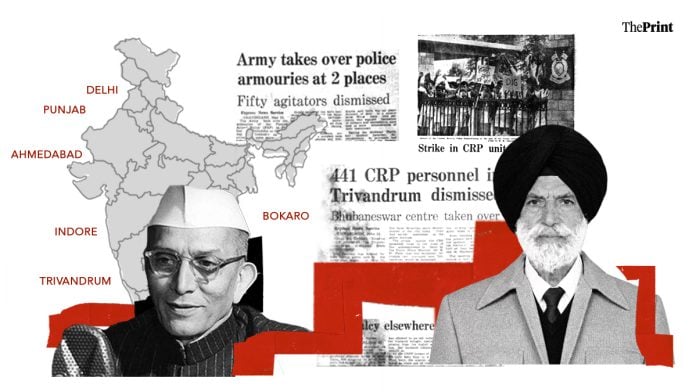
A protest that had begun with a handful of disgruntled constables in Punjab had by now become a nationwide crisis. Prime Minister Morarji Desai, already reeling under political pressure and struggling to reconcile rival party factions, turned to its central forces–the CRPF and BSF–to hold the line where local police had abandoned it.
“Paramilitary forces stood in for strikers, and in Gujarat the military did too,” K.B.S. Sidhu, Special Chief Secretary, Punjab, told ThePrint. Chief Ministers rushed to Delhi on 6 June to discuss emergency police reforms. Later, in mid-June, Patel convened Staff Councils for the CISF, BSF, CRPF and ITBP to hear their grievances.
But it was too little, too late. But it was too little, too late. A dangerous precedent had taken root: agitate, rebel, and force rewards.
And even as the government struggled to contain the police unrest, discontent was growing within the very forces it had called upon to restore order.
At a CRPF centre in Kerala, another rebellion was about to erupt, raising an even more troubling question.
Who would guard the guardians?
A southern fire
Inside CRPF communication rooms across the country, wireless sets crackled as usual. But beneath the routine chatter, ran another message: of rebellion.
While the nation’s attention was fixed on local police strikes, coded messages were secretly travelling across the country. In his memoir From Poona to the Prime Minister’s Office, former Cabinet Secretary B.G. Deshmukh wrote:
“The trouble started at the CRP group centre in Pallipuram in the south and spread rapidly throughout the country… The group centres kept in touch with each other and their battalions through the wireless network and used it widely to spread the movement.”
On June 21, a section of CRPF personnel at Trivandrum’s Pallipuram Group Centre went on strike with a 14-point charter of demands. The agitation escalated rapidly–striking jawans assaulted loyal officers on duty and seized control of the unit’s massive armoury, sending panic through senior command.
Word travelled quickly through the wireless network. Other units, including those at Bhubaneswar and Neemuch, were soon drawn into the unrest.
With persuasion failing, the government called in the Army. On the afternoon of 22 June, troops moved in and secured the Pallipuram armoury in a swift, bloodless takeover.
As order was forcibly restored in the south, another storm was brewing far to the north. As darkness fell on 22 June, over 1,700 CRPF jawans were quietly assembling at another group centre.
Only this time, it wouldn’t be bloodless.
Midnight at Jharoda Kalan
At around 9.30 pm on 22 June, right after supper, more than 1,700 CRPF jawans assembled at the Group Centre in Jharoda Kalan, near Najafgarh, on Delhi’s outskirts.
Under cover of darkness, a decision was taken: strike, disobey, and paralyse the camp–until their demands were met.
By morning, the rebellion was in full swing. Parades were boycotted. Duties abandoned. Orders ignored. The jawans locked the main gate, sealing off entry and exit, as anti-government slogans rang across the grounds. The centre was effectively under their control.
As later detailed in Constable Mani Ram Gajraj v. Union of India (2016), striking jawans intercepted a transport bus bringing in Signals Battalion officers, dragged them out and threatened them with dire consequences.
Moments later, they stormed the Signal Centre–the nerve centre of the force’s communication network. Communication systems were disrupted, and and on-duty staff were physically forced to desert their posts.
For two tense days, Group Centre Commandant C.M. Pandey attempted to reason with the men, as detailed in an Indian Express article published on 24 June. But every plea fell on deaf ears.
A force meant to maintain order was now holding its own camp hostage. But when persuasion failed and the enforcers refused to obey, what came next?
By 25 June, the answer arrived in another uniform–the Army.
25 June–The day of reckoning
In the pre-dawn hours of 25 June, the quiet neighbourhood around Jharoda Kalan was shaken awake by bursts of automatic gunfire.
In a covert, commando-style operation, Army personnel, accompanied by a First-Class Magistrate, encircled the camp, cut through the barbed-wire fencing and moved in.
And then, flashes lit up the campus as gunfire reverberated from both sides.
Who fired first? The Delhi High Court, in the Constable Mani Ram Gajraj case (2016), pointed to the striking jawans. According to the court’s account, despite the magistrate’s repeated appeals to “disperse immediately and hand over their weapons”, they opened fire on the Army. The troops retaliated.
By the time the firing stopped, three CRPF personnel were dead and eight others injured. The rebellion had been crushed. But what had driven members of a disciplined force to take up arms against the state?
The grievances beneath the revolt
The answer lay in the exact same embers that had ignited Punjab.
“Jharoda Kalan is best read as the last link in a chain that began in Punjab,” said Sidhu. The complaints were familiar: poor pay, inadequate housing, punishing working conditions and a humiliating orderly system.
Punjab had offered lessons to the CRPF jawans too. When the state granted liberal pay raises to Punjab’s policemen, higher than Pay Commission’s recommendations, the message was loud and clear.
“The lesson, as I read it, was that agitation pays,” said Sidhu.
A CRPF jawan had captured that sentiment in an interview published by India Today on 15 July 1979: “We would never have dreamt of going on strike, but when the policemen were granted their demands, we felt we had as much right to air our grievances as them.”
The anger, however, had been building for years.
“In those days, the pay was very, very bad. They were not getting as much as even the lowly place clerks were getting,” Sujoy Thaosen, former DG of CRPF, told ThePrint.
Leave was another problem. Stationed far from home, jawans had little time off to spend with their families. Even getting home was a struggle: trains were few, tickets hard to get and transport from remote group centres scarce.
The group centres were dilapidated, and allowances for food and rations were inadequate. Another jawan quoted by India Today described life in the force as living in a “dictatorship”, forced to do “sweeping, cooking, washing, gardening”.
“The promotional avenues, from Constable to Lance Naik, Lance Naik to Hawaldar, were very less, slow and not enough,” said Thaosen.
And the force was perpetually on the move. Deshmukh wrote that battalions were supposed to return to their group centres once a year for rest and training. Many, however, went years without that break. The jawans even gave their force a new name: not the Central Reserve Police Force, but the “Chalte Raho Pyare Force”.
But as the unrest was settling and spreading, simultaneously, in the industrial heartland of Bokaro, Bihar, another central force was ready for a violent confrontation–the Central Industrial Security Force (CISF).
The siege of Bokaro
The Supreme Court’s 1985 ruling in Union of India v. Tulsiram Patel later recounted the events that unfolded in Bokaro in 1979.
In March, CISF personnel had formed an all-India association, with Sadanand Jha as its general secretary. After Jha was arrested during demonstrations in Delhi and later released on bail, unrest intensified at Bokaro. Around 1,000 of the unit’s 1,900 personnel openly defied orders, marching through the streets with a slogan that left little doubt about their inspiration: “Punjab ki jeet hamari hai, ab CISF ki bari hai!”
By 24 June, the CISF lines resembled a war zone. Striking jawans fortified their positions with sandbags, floodlights and barricades. They had 65 rifles, 11 Molotov cocktails, 20 kg of sulphur and 20 kg of glass chips.
At 3 am on 25 June, nine magistrates and Army units surrounded the encampment. An ultimatum was issued, but the strikers refused to surrender. What followed was a three-hour gun battle that left 22 people dead, including an Army major and two soldiers.
The Supreme Court would later describe the collective actions of the CISF personnel as having “virtually amounted to a mutiny”.
By the end of June 1979, the discontent had travelled far beyond one force, one camp, or one state. If the state police had revolted, and the CRPF and CISF had taken up arms–what if the Army was next?
The carrot, the stick and a government on the brink
The government’s response to the 1979 mutinies was a calculated mix of punishment and concessions. There was a heavy hand first. And the benefits announced soon after, appeared designed to ensure that the Army itself would not stage an uprising.
The stick came swiftly. A 1987 Committee on Petitions report recorded that 1,773 CRPF agitators had initially been dismissed. After reconsideration, 1,525, described as followers, were reinstated. The remaining 248 stayed dismissed.
The committee also reproduced the Home Ministry’s admission that “the life of the CRPF personnel was not very pleasant….They were hard-pressed. But somebody had to do that type of duty.” In its conclusion, however, the committee asserted: “Keeping the staff of such an organisation contented…is the bounden duty of the Government.”
Then came the carrot. In Parliament on 30 April 1981, Minister of State for Home Affairs Yogendra Makwana outlined a series of improvements.
Housing compensation was raised from 14 to 35 per cent of pay, ration money increased, and Rs 80 lakh sanctioned for welfare in 1980-81. The government also upgraded 2,300 posts in the CRPF, 4,500 in the CISF and 2,500 in the BSF. Leave rules were liberalised, too.
“After the June uprising, a very liberalized policy for leave was introduced,” former CRPF DG Sujoy Lal Thaosen told ThePrint.
Leave was recalculated to begin only after personnel reached major transit hubs, rather than from remote outposts. Family quarters were expanded, house rent allowances introduced, Kendriya Vidyalayas established inside campuses, and free buses provided for children attending schools outside, said Thaosen.
The forces were back in the barracks. But the government that had struggled to contain them was itself coming apart.
The police unrest unfolded amid a deepening crisis of authority for the Janata Party. India Today, in its 31 July report, counted “100 instances during the Janata Party’s 26-month-long rule” in which the Army and BSF had been called in to perform duties “outside their normal operational orbit”.
On 10 July 1979, as Parliament opened a stormy session amid a no-confidence motion against Morarji Desai, Indira Gandhi said in an interview with New Solidarity that “the police unrest is only part of the general unrest” against the government. Punjab’s policemen, she argued, were being “used for political purposes” and to “support criminal activities”.
As the mutinous summer of 1979 drew to a close, so did Morarji Desai’s tenure as Prime Minister.
Five days later, on 15 July, Desai resigned.
(Edited By Raunaq Lekhi)