



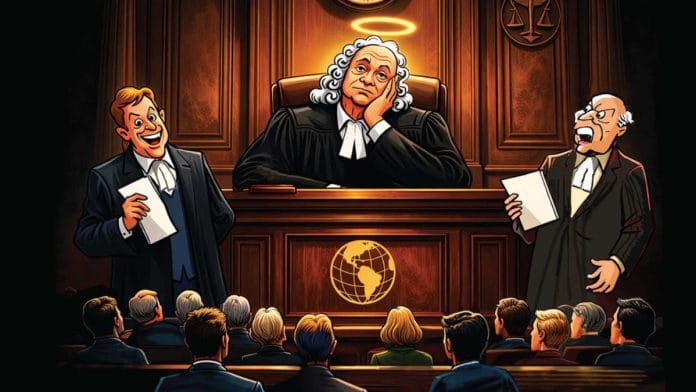

The law is, by common consent, a stressful business—at least if lawyers and judges are to be believed, and they are curiously unanimous on this point. Advocates spend their days drowning in the mind-numbing minutiae of files, fielding the incessant demands of clients or navigating the creative obstinacy of judges (politely described within the profession as ‘firmness’ of Hon’ble Judges). Judges, for their part, labour under staggering caseloads, inadequate infrastructure, lamentable litigants and the migraine-inducing submissions of counsel who insist they are merely ‘assisting’ the Court.
As the American lawyer and jurist Clarence Darrow once remarked, ‘the trouble with law is lawyers’—and judges must deal with them daily. Judges wading through endless briefs produced by said lawyers may also recall Franz Kafka’s line: ‘A lawyer is a person who writes a 10,000-page document and still calls it a brief.’ Yes, it’s a stressful job indeed, and all that stress must find an outlet.
This chapter is about those judges and lawyers who recognized that need, surveyed the available healthy, rational, and effective coping mechanisms—and then proceeded to do the exact opposite. What follows is a catalogue of drink, drugs, and debauchery—a jurisprudence of self-inflicted chaos. It would, of course, be quite wrong to suggest—as some sceptics do—that judges are intoxicated by power. That is unfair. Some judges, it turns out, are intoxicated by drugs and alcohol as well.
The first example comes from Summerlin v. Stewart, decided by the US Court of Appeals for the Ninth Circuit. Summerlin was a convicted murderer, found guilty of killing a woman named Brenna Bailey. He was described as a schizophrenic suffering from an ‘explosive personality disorder’. His father had been a bank robber who died in a shootout; his mother was an alcoholic who had repeatedly subjected him to electroshock therapy in his childhood. Summerlin was apprehended after Brenna Bailey’s mother informed the police that her daughter had been killed. This, however, requires a brief detour.
When asked how she knew, the mother explained that her information came from her daughter’s ‘extra-sensory perception’. Put plainly, she claimed that her daughter’s ghost had contacted her from beyond the grave and revealed the crime. Acting on this spectral tip, the police recovered Brenna Bailey’s body from an abandoned car and arrested Summerlin on the basis of the evidence collected. On this occasion, the ghost was—quite inconveniently—correct.
Faced with overwhelming evidence, Summerlin had to decide whether to accept a plea bargain or proceed to trial, with the assistance of defence counsel. Now, coming to the most interesting part—anyone reading the Court’s judgment in this case will immediately notice something peculiar: the defence lawyer is identified only as ‘Jane Roe’ and the prosecutor only as ‘John Doe’. Ordinarily, such placeholders are reserved for minors or vulnerable victims—not seasoned criminal lawyers. Why, then, were both attorneys anonymized? The opinion itself supplies the answer: That same evening [during the pre-trial phase], Roe attended a Christmas party. She and prosecutor Doe left the party together and had what she later described as a “personal involvement [. . .] of a romantic nature.”
As a result of that, as she later testified, she felt she “could no longer ethically represent Mr. Summerlin.” Because of the circumstances, she believed “that it would be appropriate for another Public Defender to handle the case and take it to trial, since it looked like it might be a trial at that point, because Mr. Summerlin indicated he wanted a trial and Judge Derickson had indicated he was going to reject the plea.” She reported the situation to her supervisor, and it was determined that the entire office probably was compromised.
Notwithstanding her belief that she could not represent Summerlin due to a personal conflict of interest, Roe took no immediate steps to accomplish her withdrawal. Neither she nor her office informed either the court or their client of her conclusion that she could no longer be Summerlin’s attorney. Instead, she accompanied him to and represented him at the next hearing before Judge Derickson on December 22, 1981.
In effect, the pairing of Roe and Doe created a perfect storm: an undisclosed romantic involvement between counsel on opposite sides of a murder case, a failure of disclosure to the Court regarding said romantic encounter, and continued representation of a client despite an acknowledged conflict of interest. In the course of their star-crossed romance, Roe and Doe managed to compromise not only themselves but both of their offices. Resultantly, they were removed from the case. Because both the prosecutor and the defence lawyer were later required to testify about the incident, and because their conduct tainted their entire offices, the court chose to refer to them only as Jane Roe and John Doe—a rare step, reflecting the depth of the ethical breach.
Eventually, with a new prosecutor, a new defence attorney and a new judge, the case moved forward. Under the new judge, Philip Marquardt, Summerlin—the petitioner-defendant—was convicted and sentenced to death. The Supreme Court of Arizona reviewed and affirmed Summerlin’s convictions and his sentence.
The matter might seem to be over, but the punchline of this comedy of errors was yet to be delivered. On appeal, Summerlin argued that his sentence violated due process because the trial judge was addicted to marijuana during his trial and deliberated over his sentence while under the influence of marijuana. As it was later revealed, Judge Marquardt was indeed a long-term marijuana addict and had been under the influence during Summerlin’s trial in 1982. Six years after the trial, in 1988, he was convicted for possession of marijuana and resigned from the bench; he was later disbarred.
As the court dryly summarized, it had before it a case that featured: A vicious murder, an anonymous psychic tip, a romantic encounter that jeopardized a plea agreement, an allegedly incompetent defense, and a death sentence imposed by a purportedly drug-addled judge. No wonder the Ninth Circuit’s panel vacated the death sentence and ordered a hearing into whether the judge’s addiction had impaired his ability to impose a lawful sentence. However, the decision was not unanimous.
The celebrated Judge Alex Kozinski dissented, maintaining that mere proof of addiction was not enough. What mattered, he argued, was whether Judge Marquardt had been impaired during Summerlin’s trial or sentencing—and there was no evidence of that. As he put it: My colleagues take a giant leap into the unknown by ordering discovery and a hearing as to whether Judge Marquardt’s marijuana addiction affected his rulings in Summerlin’s trial and sentencing.
The opinion points to nothing in the trial record suggesting that Judge Marquardt was incoherent or intoxicated, nor did anyone present at the trial report that the judge acted inappropriately. In fact, there is no proof whatever that Judge Marquardt’s purported marijuana addiction affected his performance in Summerlin’s case. By allowing Summerlin to proceed with his claim based on this paper-thin showing, the majority’s ruling will cause major upheaval in the administration of the criminal laws in all states within the Ninth Circuit.
 This excerpt from ‘The Bench, the Bar, and the Bizarre’ by senior advocate and Solicitor General of India Tushar Mehta has been published with permission from Rupa Publications.