


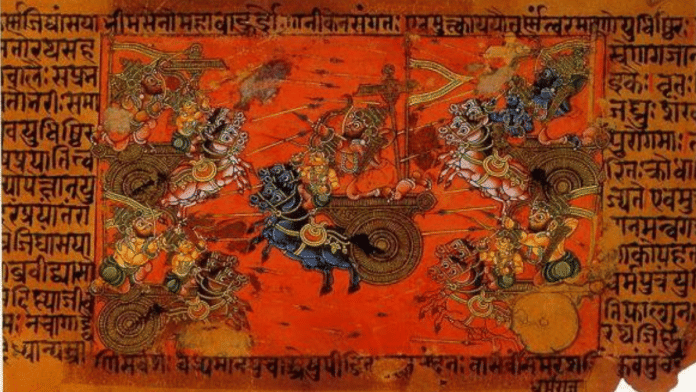
By the time the Arya came, India was already full of artworks that indicate mythic thinking.
- Since before the Ice Age, there were people in India creating cave paintings. At Bhimbhetka in Madhya Pradesh there are artworks showing hunters, foragers, fisherfolk, farmers, herders, warriors, men with horses, elephants and cattle, people dancing, going to war and even mythic animals. This indicates continuity through the Stone, Bronze and Iron Ages and the Agricultural Revolution. Cave paintings are difficult to date. There are layers on top of layers. Some images were created barely 2000 years ago, showing horse-riders and elephant-riders. Artworks similar to cave still appear on the walls and floors of Hindu houses, drawn by women seeking to usher in good fortune and mark happy occasions like marriage and childbirth. Do they have the same meaning now as they did then?
- Nearly 10,000 years ago, after the Ice Age, before cattle were domesticated, on the western coasts of Ratnagiri in Maharashtra, stone art has been found. Wild and aquatic animals were faithfully scratched on the ground below, to be seen by creatures in the sky. Abstract symbols were being made, indicating the rise of cognitive thinking and the need to classify and organise the world. There is even a giant image of a man separating a pair of territorial cats—the first indicator of humans realising that they do not have to mimic beasts. Relationships can be established without recourse to domination. We can exchange goods and services and treat each other with respect. Did this artwork, which reappears in Harappan seal.
- Around 8,000 years ago, at Baghor in Madhya Pradesh, in the Son river basin, near the Kaimur escarpment, people were worshipping a stone brought from far away that had concentric triangular layers. Placed pointing upwards, it indicates mountains, sky, and the aroused man. Placed pointing downwards, it indicates waterfalls, earth, and the menstruating woman. These ideas are articulated in Tantrik texts. Did they originate in the Stone Age?
- From 5,000 years ago, in the Deccan region, are found ash-mounds, where people at regular intervals piled cattle dung at a particular spot and set it on fire. Were they marking the seasons with festivals like Lohri and Holi, as Hindus still do today? Also in the Deccan, from this time, iron started being used, allowing people to cut stones more easily. People started raising dolmens and menhirs for the dead. Did these inspire the rise of stupas, hero-stones, sati-stones, chhatris, and guru-samadhis in later times?
Also read: Goddesses of Kumaon are no docile Sita, compliant Sati. They’re ‘ugra’ manifestations
There is much to speculate on the origins of Hindu mythology. Historians keen to show continuity dwell on it. Historians eager to display discontinuity ignore it.
Around 5,000 years ago, bangles made of shell, clay, and stone were being regularly
manufactured at pre-Harappan archaeological sites. They are found in disproportionately large numbers, compared to contemporary sites around the world, making them a significant find. Other cultures preferred the bracelet, over the bangle. They also appear persistently in subsequent periods of history, across India, and continue to play a key role in various domestic and subaltern Hindu rituals today. Bangles clearly mark the earliest layer of Hindu mythology.
Around 3,500 years ago, horses—along with spoked-wheel chariots—appeared for the first
time in world history, India included. It was a global military revolution. There was global demand for it, which propelled the migration of the Eurasian pastoral tribes westwards towards Europe and eastwards towards Iran and India. The spread of the horse was accompanied by the spread of the Steppe pastoral gene, the Indo-European language, and patriarchal customs and beliefs. Unfortunately, horses do not breed well in India owing to the monsoon climate, so horses had to be regularly imported from west of the Hindu Kush mountains, and later by sea. These horse-traders had a profound impact on Indian history.
Around 3000 years ago, the horse-traders called themselves the Arya. They rode chariots and their stories can be found in the Vedas, and with some creative liberty, in the epics Ramayana and Mahabharata. They probably came to India to trade iron that Indians had started to smelt, as indicated by archaeological sites especially in South India. They took the zebu (humped) bull to the West of the Hindu Kush. Their migratory routes created a corridor for lions of West Asia to enter India.
Around 2,000 years ago, the horse-traders were migrant Greeks who had settled in Central Asia (Yavana), as well as local tribes of Scythians (Saka) and Eurasian tribes like the Kushans. They replaced chariot-riding with horse-riding. And so came tales of Buddha leaving his palace on a horse. While the sun-god Surya was imagined as riding a horse-drawn chariot in the Veda, his son, Revanta, was shown riding a horse. These Yavana and Saka traders patronised Buddhism. Images of horse-riders on railings of Buddhist stupa show toe-stirrups and cushion seats not iron foot-stirrups and wooden saddles. These came much later.
This was when Rome controlled the Mediterranean world, and monsoon winds were discovered, enabling sea trade from Arabia (Shvet-dvipa) through India (Jambu-dvipa) to Southeast Asia (Suvarna-dvipa). Gold from Southeast Asia paid for horses from Arabia.
Around 1,000 years ago, Turkish horse-traders introduced wooden saddles-trees, iron stirrups, and the iron horse-shoe. This made it easier to ride in battle. They also introduced horse-breeding to India, and the rise of horse-riding hero gods such as Khandoba of Maharashtra, Momaji and Jakh Botera of Gujarat, Teja-ji of Rajasthan, Goga-pir of Punjab and Haryana, Golu-dev of Uttarakhand and Dharma-thakur of Bengal. Many local horse-breeding warrior communities would eventually be identified as the Rajput. When they invited Brahmins to their courts, they were equated with Kshatriya. The Turkish horse-traders brought with them Turuku Dharma, also known as Islam.
 This excerpt from ‘Itihasa’ by Devdutt Pattanaik has been published with permission from Penguin Random House India.