


Himalayan folktales carry a residue of innocence and wisdom. Their spontaneous and free-flowing forms, punctuated by superstition and whimsy, have endured the passage of time with charm and resilience. The influence of the Katha-sarit-sagara, the ‘Sea of Stories’, and the Arabian Nights, is imprinted in the narrative, as is that of the Jataka tales and Buddhist folklore traditions. The twice-told translations continue to carry the resonance of the human voice, hoarse, melodious, or sighing, in their nuance and inflections.
They are stories of survival, set in a terrain of beautiful landscapes and harsh physical challenges. My family ties are with Kumaon and Uttarakhand, and I have grown up in those mountains, listening in to stories that reflect these in so many ways. The simpleton son, the cunning old widow, the foolish and arrogant king, the proud maiden – these personages abide in folk and popular memory.
What Stuart H. Blackburn refers to as ‘geographical distribution, narrative consistency and cultural significance’ throw up recurrent patterns but the stories are somehow always unique in their crafting. The indicators and conventions of folklore traditions, and the particularities of local perception, are always at play with each other. Folktales from across the Tibetan plateau carry many similar inflections to those from Nepal or Arunachal Pradesh. In an interview, Stephen Alter, writer and Himalayan scholar, speaks of ‘… the way in which nature is interpreted differently from one range of mountains to the next. […] A bird’s call in Nepal will elicit a very different story from the same bird’s call in Kashmir. The allegorical aspects of a certain wild herb in Garhwal will take on different meanings in Bhutan. All these narratives are drawn from nature and reflect cultural differences as well as ecological diversity.’
Nineteenth-century Kumaon, under the rule of colonial British masters, was a hub of trade and travel. Despite the isolation of the high terrain, it had borders with Tibet and Nepal, and was on the silk route from China. Known as ‘Deva-bhumi’ or the ‘Land of Gods’, it witnessed the constant wanderings of pilgrims, fakirs and holy men, and saw a convergence of many peoples and religions. A joyous, pagan animism coexisted with the practice of severe tantric ritual, and Buddhism still thrived in nearby Nepal, across the Kali river.
The prevailing culture in Kumaon at the time had a patina of Sanskritization, of mantras and Brahmanical ritual, imported from the successive waves of settlers from the plains. Adi Shankaracharya, and his followers over the centuries, began a Hindu revivalist movement that remained the elite domain of the Hindu pilgrims and philosophers and priestly classes. For the rest, the intense energies and the magnetic presence of the mountains themselves led to an eclectic and localized pantheon of gods, an assertion of the genius loci of each place, as it were.
Apart from the omnipresent worship of Lord Shiva and his consort Parvati, in different forms and manifestations, each village had a bhumi-devata, a god of the soil. Temples also abounded dedicated to kula-devatas (clan gods), grama-devatas (village gods), nagadevatas (serpent gods), and veeras or local folk heroes who had been incorporated into divinity. Bholanath, Kailasanath, Gangnath and Haru were some of the local gods to be elevated in this fashion. An intense belief in demonology prevailed, as did a fervent fear of bhutas (ghosts) and ghouls and relish for tales about them. Superstition abounded, and esoteric Tibetan tantric practices, and those of the Siddha cults, were an integral part of religious and emotional life.
Also read: How Ladakh’s Saspol Caves capture a turning point in Buddhist art
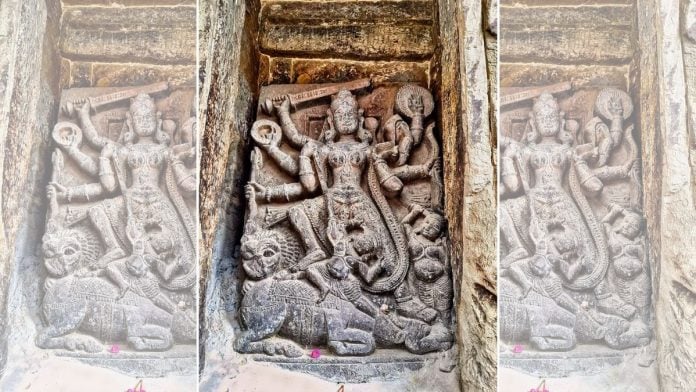
The goddesses of Kumaon were not the docile Sitas and compliant Satis of the Northern plains, but fiercely individualistic, often wrathful, ‘ugra’ manifestations. Gadha-devis were invoked at cremation grounds on moonless amavasya nights. The dayans or local witches, with their feet pointing backwards, supposedly derived from the ancient cult of Diana, with the Himalayan sojourns of the Greeks, the Yavanas, who came to these parts after Alexander. The tutelary goddess of Kumaon, Nanda Devi, perhaps similarly originated from the Greek goddess Nana, and were incorporated into local divinity with the Kushan kings and the Indo-Greek diaspora. Vanini Devi and Shyama Devi were guardian spirits of old Almora, transformed to divinity by the power and thrust of folklore. Sitala Devi represented the object of propitiation against the dreaded scourge of smallpox. Kali in all her manifestations – Mahakali, Bhadrakali, Shamshankali – was present through the length and breadth of Kurmanchal (as Kumaon was called under the medieval Katyuri rulers). In fact, every river, mountain peak, cave and waterfall was said to bear the spiritual imprint of a special god, sage or demon.
The folk songs, the muktaks, similarly reflected the fabric of local life. The oral literature of the hills, the ‘told tale’, or the danta-katha, largely survived within the repository of musical traditions. Pastoral agricultural songs, the hudkiya-bol, were sung during the sowing of paddy, a delicate task involving skill, dexterity and rhythm. The major life samskaras (rites of passage), such as childbirth, marriage, thread ceremonies, all began with shakunakhara, invocations to the various divinities to join the festivities. The ‘Nyoli’ or ‘Ritu Rain’ songs were representative of the seasonal cycles. The vibrant Jhora, Jhora Chappeli and Chhanchhari songs were accompanied by dances, in which the community also participated. The Jhoras were duets, often sung by men and women together. Chhanchhari, also known as ‘khel’ (game), had a lead singer surrounded by a circle that sang the chorus, and was danced to a slow and measured tread. In the month of Chaitra, people would congregate at homes and temples and in public spaces to celebrate Holi and the coming of spring. Heroic and romantic ballads such as ‘Rajula–Malushahi’, and ‘Ajua–Bafaul’ continue to be popular to this day. Jagars were, and are still, performed in shamanistic rituals of possession and exorcism, invoking local gods and demons.
 This excerpt from ‘The Living Himalaya: Rock, Sky Spirit’, edited by Namita Gokhale and Malashri Lal, has been published with permission from Hachette India.
Nana was a a Mesopotamian goddess. Please stop ascribing everything to the Greeks.
The white man seems to have successfully colonised your mind.