








By the late 1970s, Desh Bandhu Gupta had begun to passionately advocate for eradicating TB from the country. The first drug he decided to make was ethambutol. This would have been impossible without the new patent regime coming into effect. Companies like Ranbaxy, Pharmed, Themis and Cadila had already launched their versions, but except Themis, they all imported the ethambutol bulk and converted it into finished dosages in their factories.
Upon reviewing the new policy, DBG identified price advantages in importing the basic raw material (DL-2 aminobutanol) rather than the advanced intermediate to make ethambutol API. With this in mind, he rushed to the US to meet with Illinois-based Angus Chemical Company, the sole supplier of DL-2 aminobutanol worldwide. DBG proposed to the Angus brass a commitment to buying a large quantity of DL-2 aminobutanol, provided they gave him a preferential price. The hosts saw value and made the deal. While the agreement he stitched up with Angus was not exclusive, by the time his rivals woke up to similar possibilities, DBG had already raced ahead, pushing his first-mover edge to its fullest.
Back home in India, another vexing issue needed to be resolved. While import duties on the API and advanced intermediates were specified, no rate was given for DL-2 aminobutanol because nobody had imported it. DBG argued with the government that, since the objective of the duty structure was to add as much value as possible within the country, the duty on DL-2 aminobutanol should be lower than that on the advanced intermediates. The authorities saw merit in his argument. Soon, a lower duty on DL-2 aminobutanol was notified. A funny side story is the hours Lupin’s managers spent convincing customs that this material was not an alcoholic beverage – then a banned import – but a critical drug intermediate.
With these two wins, DBG sensed that the anti-TB medicine could pitch Lupin into the big league. But there was a hitch. The Aurangabad factory could handle the formulation volumes, but he needed a bigger factory to process the API. This search led him to Ankleshwar in Gujarat, a gruelling ten-hour drive from Aurangabad and seven hours from Kalina, where he set up what would become the world’s largest factory for ethambutol. This was an era when nobody in India was thinking in terms of ‘world’s largest’; China was the one to seize the opportunity to become the factory of the world over the next few decades by moving millions of people from farms to labour-intensive factories for shoes, clothes, toys and electronics while India’s labour laws and trade unions ensured that the percentage share of manufacturing in GDP remained in the low teens. Medicines would be one of India’s few manufacturing exports to scale.
DBG intended to start with producing formulations for TB in Aurangabad and sourcing bulk drugs to produce their branded ethambutol, Combutol. In 1978, the central government delivered a big blow to domestic companies by quadrupling the duty rate on imported API to encourage local production. Lupin had to raise the prices of its formulations to offset the increase in duty, but it needed permission from the ministry in Delhi. Once again, DBG rushed to the capital, this time in a group comprising the leaders of all major Indian pharmaceutical companies who needed to get their new prices cleared.
The much-awaited meeting with the minister did not take place, so an endless waiting game ensued. Finally, the man approached DBG, who had been waiting patiently for days, and asked why he was there. By now, DBG knew what to say. ‘Sir,’ he said, ‘Until you approve our prices, I cannot save the lives of millions of our countrymen from TB.’
The minister softened and invited him into his office. There, he told him that while he did not foresee these prices being authorized for many months, he would ensure they were on the agenda of the next drug price-control meeting. While the minister was speaking, DBG had a brainwave: manufacturing from basic raw materials would blunt the tariff burden for Lupin. But there was a hitch since the chemical processes could not be conducted in Aurangabad. This led to the setup of Lupin’s first dedicated bulk-drug facility in Ankleshwar to manufacture ethambutol rather than buy it.
On one Shivratri day, Lupin’s Kalina factory caught fire, destroying records, machinery and stock. The company, in any case, had outgrown the rented premises. In 1978, Lupin’s first plant opened in Aurangabad, and part of the existing team and leadership moved there from Mumbai. Lupin’s success meant there was money to design the plant – a semicircular building with one arched wing housing R&D and the other manufacturing – but frugality remained DBG’s tone from the top. An often-repeated Lupin story on DBG is the long-distance, eleven-minute telephone conversation he had with his brother in the US. At the end of the call, he instructed his assistant to inform the telephone operator that he should not be charged because the line was not clear.
Growth and government tariff unpredictability created a growing consensus among the brothers that Lupin needed someone who understood the complexities of the chemical world to turn it into an advantage. DBG decided to persuade Dr Atma, now an American citizen after completing his PhD from New York University and his postdoctoral research from Johns Hopkins in Baltimore, to return home. Atma was leading a comfortable life with his wife and two young sons, but DBG convinced him that his knowledge and experience were needed at Lupin, especially for solving the technology challenges at the Ankleshwar factory, which was struggling to maintain the bulk drug supply required by Aurangabad’s formulation factory, for the large anti-TB orders.
In 1981, Atma joined Lupin as head of R&D and was assigned to Ankleshwar to stabilize Lupin’s ethambutol production, while working on technology inputs and cost-effective manufacturing. Soon, the TB mission was up and running. By 1983, Lupin manufactured the ethambutol bulk drug at Ankleshwar and transported it to Aurangabad, approximately 400 km away, where it was converted into finished products and shipped to the market. Despite the complex logistics, Lupin’s ethambutol was significantly cheaper than its rivals’ products.
By 1984, ethambutol was DBG’s first taste of success in TB treatment. More was to come. Rifampicin bulk imported from Europe was added to the mix. At that time, pharmaceutical companies were required to obtain approval for the prices of their products from the National Pharmaceutical Pricing Authority (NPPA), an exercise that could take up to a year. However, companies designated ‘small scale’ were exempt from this requirement. So, DBG floated a small-scale unit, Laser, a wholly owned subsidiary of Lupin, to make and sell its version of rifampicin, thereby compressing the go-to-market time.
Kamal Sharma, a chemical engineer from IIT with an MBA, joined Lupin in 1978, having previously worked at an MNC manufacturing agricultural chemicals, to lead technology and production. He would eventually become the MD of Lupin, but at that time, he led the process research to stabilize the rifampicin capsules that were melting and liquefying inside the foil strips.
Rifampicin, a hygroscopic compound – meaning it readily absorbs moisture – was melting with the humidity that could enter the microscopic pores in the thin foil packaging, which the low-cost supply afforded. Expensive, thicker foil was not a viable option for the low-cost government tender, and raising the melting point would have required complex technical improvements to the formulation. The optimization took eight months, during which time an additional method for separating an unwanted compound also reduced the cost of rifampicin and improved its stability. The manufacturing culture of Lupin now featured an added element: constant process improvement to reduce costs and enhance quality, which remains at the heart of Lupin’s manufacturing strategy for both global and Indian markets.
When the team was set to launch its brand for rifampicin, it was to be labelled ‘Rimatzid’. The name was printed on the literature, embossed on the packaging and consignments were waiting to be shipped. DBG approached his marketing head and told him he didn’t like the name. ‘It’s not simple or elegant.’ The young manager suggested, ‘What about “R-Cin”?’ DBG liked it instantly; this would become the brand name that would make Lupin famous.
Lupin’s first marketing success occurred in 1983, when it launched R-Cin in 450 mg capsules. So far, the drug had only been available as a 150 mg capsule, which patients were required to take three times a day. As happens with most multidose medicines, this led to problems with compliance, as people forgot to take it all three times.
In 1983, in response to this proposition, DBG sent his marketing head, P.M. Sapre, to meet the Drug Controller General of India in New Delhi. Sapre had been hired six years earlier as Lupin’s first sales manager. At that point, most Lupin products weren’t selling well, product literature wasn’t up to par and the company had only sixty-seven medical reps. Things had changed a lot at Lupin since then, and Sapre convinced the bureaucrat about the product, but policy required the endorsement of TB specialists before approval. The specialists saw no reason to disapprove of Lupin’s proposition, and Lupin soon launched rifampicin 450 mg, under the brand R-Cin. A powerful marketing gimmick was a brochure with three pages representing individual tablets that, when folded became one capsule; these were distributed among doctors. Each capsule was priced slightly below what three 150 mg capsules would have cost. R-Cin swept the market, and its success rubbed off on other anti-TB medicines of Lupin.
In 1984, Lupin innovated on the WHO’s directly observed treatment, short-course (DOTS) by combining the four drugs used for TB treatment and replacing multiple pills over extended periods with simpler formulations. This innovation, marketed as AKT-3 and AKT-4 kits, not only made treatment easier for patients but also significantly improved compliance, thus reducing contagion and development of harder-to-treat, drug
resistant TB. This innovation also proved successful in Russia and other Eastern Bloc countries, which continued to import packs manufactured in Lupin’s Aurangabad plant for several years. Russia had been important to Lupin for years, and DBG often made long trips to the country. On one such trip, the children became anxious when they didn’t hear from him for ten days. He eventually returned bearing gifts that included Russian matryoshka nesting dolls and a foot-high chocolate Easter egg.
Over the next few years, DBG set up plants, developed indigenous fermentation technology to ensure the supply, purity and stability of compounds like rifampicin, which enabled lower packaging and transport costs, and also partnered with American companies like Angus and American Cyanamid for intermediates. This enabled him to supply formulations for government orders, build a private market by educating medical professionals and create unique innovations for formulations that revolutionized TB treatment compliance. Lupin, the world’s largest producer of TB medicines, is one of the main reasons TB mortality has decreased 80 per cent in recent decades.
DBG shifted focus to communicating its price and product superiority to customers. He hired Lintas, one of the top ad agencies in the country, led by the redoubtable Alyque Padamsee, to launch an awareness campaign for TB. The print and television media campaign was generic, with the company’s name mentioned only in small print.
DBG decided to up the ante even if it meant taking chances. An in-house-designed ad showed a rupee cut in half and an announcement declared that the price of Combutol (Lupin’s ethambutol brand) had been halved. DBG had personally vetted the copy, but such an ad was against the rules since drugmakers were barred from advertising prescription medicines. Despite that, the company went ahead, and the ad appeared on the front pages of The Times of India and Hindustan Times, the country’s leading newspapers.
As expected, the authorities were not pleased, and Lupin had to apologize and withdraw the campaign. DBG was responsible for the mistake. However, like most entrepreneurs, he knew that begging for forgiveness was often better than asking for permission.
The objective of letting people know about the price cut had been met. Other companies soon realized that Lupin could drop its prices because it had cut the cost of its basic raw material. Many companies importing APIs or advanced intermediates had begun buying their stock from Lupin. While the ethambutol formulation was under price control, its API was not. This gave Lupin reasonable elbow room to price its produce from Ankleshwar. As volumes began to rise, production costs fell, further improving Lupin’s profits. The challenge now was to keep up with demand.
Soon, overseas API makers based in Italy, Hungary and South Korea, which had a stranglehold over the ethambutol market in India, started to feel the heat as their Indian customers terminated their supply agreements and signed up with Lupin. Once Lupin started exporting the ethambutol API, many overseas units shut down. As a bonus, exports also brought financial incentives from a forex-starved government, which meant more money in Lupin’s coffers. By 1985, Lupin was the world’s No. 1 producer of ethambutol.
Not that it was all smooth sailing. Envious of his success, some competitors began a whispering campaign alleging that Lupin was mislabelling their imports of high-grade raw materials to pay lower import duties. Soon, it became a national controversy, with newspapers reporting on what they alleged was impropriety by the company. The matter reached Parliament, prompting the Ministry of Chemicals and Fertilizers to order an investigation. Officers from the Ministry of Health in New Delhi pored over the company’s books. On several occasions, senior Lupin executives had to travel to New Delhi with truckloads of files and receipts. Stock investigations were also carried out at the factories in Aurangabad and Ankleshwar.
No incriminating evidence was found against the company. The ministry-appointed investigators gave it a clean bill of health.
Both the initial manufacturing locations of Lupin at Kalina and Aurangabad and the later plants at Ankleshwar and Mandideep (set up for cephalosporin bulk drug and injectable formulations in 1987) and Tarapur (set up for rifampicin fermentation in 1992) had committed workers, led by factory managers who propagated DBG’s vision of treating employees like family. By offering better pay than anyone else in the region, Lupin kept its workforce out of trade unions, and the employees worked tirelessly, day and night, to meet the flood of government and private orders.
Also read: How a Bengali woman became doctor to the King of Nepal in the 19th century
Rifampicin API was difficult to make. During the first year of manufacturing, Tarapur achieved barely 50 percent of its intended production due to problems with the fermentation manufacturing process. It was haemorrhaging money; the plant had fixed costs that couldn’t be reduced. DBG and Kamal had frequent discussions, including during weekend walks, on how to turn it around. They did.
By 1984, the business had reached an impressive `20 crore in sales. Lupin entered other product segments, including herbal formulations, like the laxative brand Softovac, which became very successful, but the low margins, uncertainty and lumpiness of government orders, with the mainstay of anti-TB and other formulations, bothered DBG. Despite his hard work over the previous few years, a vast gulf separated Lupin from leaders like Ranbaxy and Cipla. In 1984, another dreamer of affordable, high-quality medicine joined the Indian landscape; Dr Anji Reddy established Dr. Reddy’s Laboratories Ltd and acquired a bulk drug manufacturing unit, Cheminor. With competition growing, the contours of strategy for the next phase of Lupin began to emerge in DBG’s mind: narrowing the gap with larger companies by building a strong prescription-based business and cementing ties with doctors.
DBG never gave up on TB. The TB base created the foundation for Lupin’s scale, hiring, investments and exports. By the 1990s, the prices of TB drugs were regulated by the Drugs (Price Control) Order (DPCO) and import duties on bulk drugs were progressively reduced. This meant there were no profits to be made from their sale. At one point, DBG considered stopping the manufacture of TB drugs; he ran the idea past Manju. She responded that Lupin shouldn’t care about making money on every product as long as the company made money overall, especially given that poor patients needed TB products.
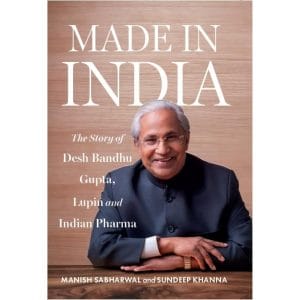 This excerpt has been taken from Manish Sabharwal and Sundeep Khanna’s ‘Made in India’, a Juggernaut publication.