



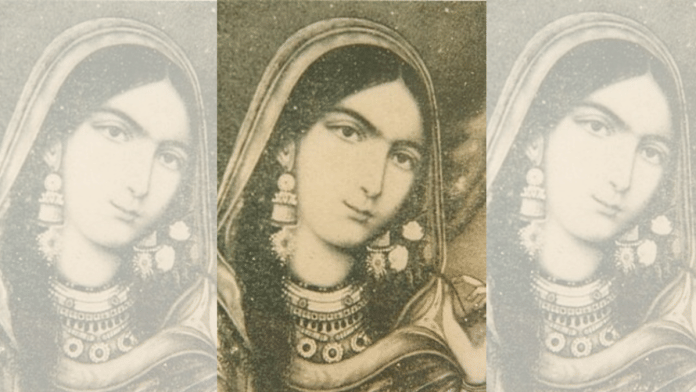

The events of the Uprising were of acute interest to people in Britain whose relatives and friends were in India in military or civilian roles. The urgent demand for news was met in two ways: by collating and publishing reports from India or by the then innovative method of sending out a correspondent. The Times despatched William Russell, an Irishman who had already covered the Crimean War. He was now attached to Colin Campbell’s force and therefore on the front line during the recapture of Lucknow in March 1858. He quickly picked up on what was going on, writing, ‘There are dissensions in the city. The presiding genius of the defence is Huzrut Mahul, Begum of Lucknow, whose son, a boy of fourteen years of age, is the puppet-king of Oudh. The Begum has a favourite, one Mummoo Khan. The opposition is led by a Moulvie, or Mohammedan priest, who is said to be a vigorous fanatic’. Russell subsequently reported on the lack of artillery among the rebels and noted the difference between the sepoy troops (those who had defected from the Company’s army) and
the matchlock-men of Oude, who have followed the chiefs to maintain the cause of their young king, Brijeis Kuddr, and so may fairly be regarded as engaged in a patriot war for their country and their sovereign. The sepoys during the siege of the Residency, never came on as boldly as the zemindarree levies and nujeebs. This Begum exhibits great energy and ability. She has excited all Oude to take up the interests of her son, and the chiefs have sworn to be faithful to him.
Russell had earlier repeated the slur about the paternity of Birjis Qadr but now questioned this assumption:
We affect to disbelieve his legitimacy, but the zemindars, who ought to be better judges of the facts, accept Brijeis Kuddr without hesitation. Will Government treat these men as rebels or as honourable enemies? The Begum declares undying war against us; and in the circumstances of the annexation of the kingdom, the concealment of the suppression of the treaty, the apparent ingratitude to the family for money lent, and aid given at most critical times, has many grounds for her indignant rhetoric.
Russell was not only an excellent journalist with his ear close to the ground; his nationality, as an Irishman, gave him a certain distance from the general British view of the time. His objective opinion that the Awadh soldiers should be treated as ‘honourable enemies’ is startlingly frank compared to what most Britons thought as Lucknow was recaptured. How much Russell’s liberal outlook may have influenced Campbell’s strategy towards the defeated enemy as it fled the city has not been examined, but there were certainly those who criticized the general for not vigorously pursuing the rebel soldiers. Campbell’s action – or lack of action – is said to have prolonged the Uprising by months because the escaped men were able to reform and continue the fight in eastern Awadh.
Having considered British accounts of the Uprising, what was the Indian view? As we have seen, it was almost non-existent – apart from the hukumnamas and proclamations – because anything in writing could be turned against both the authors and the recipients. At the beginning of the twentieth century a retired Indian Civil Service officer, William Crooke, began to collect folk songs about the mutiny, as it was then called. Building on a number of songs collected by the Indian scholar and ethnographer, Ram Gharib Chaube, Crooke published them in The Indian Antiquity journal of 1911. Only one mentions Hazrat Mahal, which could mean either that Chaube hadn’t found any other songs about her or that there were not many songs written about her. The latter suggestion is more likely, because a larger collection of songs published in 1993 included nothing specific about the begam, only a general sadness at the departure of her former husband from Lucknow. The one folk song we do have, recorded in the Agra District, is as follows:
Oh! To what extent did the Begam show bravery?
Her name remains in the world to the end.
Who will now show this kind of courage?
At the time the Begam fled, what fight was possible?
The translation that Crooke provided was not that accurate and he missed out on the pun in the first line, where ‘extent’ in Urdu is ‘qadr’ – an obvious reference to Birjis Qadr. Crooke also. seems to have misinterpreted popular feeling among the ‘lower orders’, as he calls them, who he claimed composed verses in honour of the British.
There is no doubt that Hazrat Mahal suffered an eclipse in the public consciousness almost as soon as she left Lucknow. She gets a cursory mention in V. D. Sarvakar’s book The Indian War of Independence of 1857, which was published in 1909 and promptly banned in British India. This was the first time that the Uprising had been described as a war of independence, rather than a mutiny. ‘This Begum of Oudh, though not quite another Laksmi Bai, was undoubtedly a great organiser, full of love of liberty and the spirit of daring,’ he writes, describing the large numbers of people who ‘hurried from all parts of Oudh to Lucknow to join the great War of Independence.’ The comparison with Lakshmi Bai, the rani of Jhansi, has persisted down to the present day, although the two women had nothing in common other than their opposition to the East India Company. The Hindu rani was killed in battle by the British in 1858 and was immediately mythologized as the potent symbol of defiance; a martyr in the fight for independence, something which Hazrat Mahal was unable to claim. Even the site of the begam’s burial was forgotten until 1957, the centenary of the Uprising when three grandsons of Birjis Qadr met Prime Minister Jawaharlal Nehru and asked that their great-grandmother be properly honoured.
Nehru requested the Indian embassy in Kathmandu to search for her grave and it was subsequently found and identified in the Hindustani Masjid in Baghbazaar, a busy commercial area of the city. It has been suggested that Hazrat Mahal herself founded the mosque but this seems very unlikely given her perpetual lack of funds. The question has been examined in detail by the historian Prawash Gautam, who dates the Hindustani Masjid to before the begam’s arrival in Nepal.11 He adds that virtually nothing could be learnt about the last twenty years of her life there and it is this obscurity – coupled with her former status as a royal wife and her brief leadership of the revolt in Awadh – that has made her such an intriguing figure to authors, and particularly to novelists. Her life has been imagined by writers from India, Canada and France which gives an idea of her wide appeal.
Dans la ville d’or et d’argent (In the City of Gold and Silver) by Kenizé Mourad was first published in 2010 in France. Mourad’s paternal ancestors came from Kotwara in Awadh. It is a long book, nearly 400 pages, and heavily reliant on Freedom Struggle in Uttar Pradesh. The author had clearly done a large amount of research which could have led to a straightforward biography of Hazrat Mahal but she chose to imagine her characters with the get-out clause: ‘This book is a work of fiction. Any references to historical events, real people or real locales are used fictitiously.’ So in the book Mammu Khan is a trusted eunuch, and the begam has a secret love affair with Jai Lal Singh.
A more nuanced novel was published in 2017, Amah and the Silk-winged Pigeons by Canadian author Jocelyn Cullity, one of whose female ancestors was among the Britons besieged in the Residency. Amah, a female soldier of African descent, is a member of the Rose Platoon and a friend and confidante of Hazrat Mahal in Lucknow. The disruption caused by annexation seems gradual at first and the new chief commissioner, Sir Henry Lawrence, with his fluent Hindustani, is drawn as a sympathetic character. The atmosphere of the city sliding into chaos during the summer is poignantly evoked and because events are seen through Amah’s eyes – which are neither Indian nor British – there is an objective, added, dimension.
Indian author Malathi Ramachandran’s book Begum Hazrat Mahal: Warrior Queen of Awadh was published in 2023. It is historical fiction with imagined characters, British and Indian, described as a saga based on actual events ‘within the walls of the Residency where love and passion rage alongside the battle and into the world of Begum Hazrat and her loyal band’.
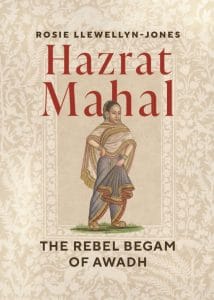 This excerpt from ‘Hazrat Mahal: The Rebel Begam of Awadh’ by Rosie Llewellyn-Jones has been published with permission from Pan Macmillan India.