





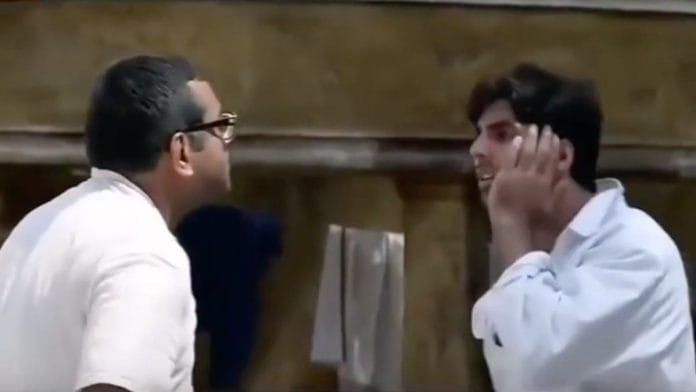

Trust me when I say that I have complete authority over this slap business. I have been at the receiving end of so many from my parents and teachers that, at some point, I had even started believing that it was a necessary step in raising children. I mean, how much can you beat up a poor child, granted that I wasn’t exactly the neighbour’s envy or even the owner’s pride? But all this beating was for nothing, it seems.
It wasn’t even the right kind of slap.
You see, I was always asked if I wanted ‘one tight slap’. It was a trick question, as I was to realise later. No matter how I answered the question, I received one anyway. Nonetheless, the entire process was made to look very democratic, even though it always resulted in the reddening of at least one cheek. And then to my deep chagrin, as education cleared the clouds of ignorance, I realised that a ‘tight slap’ doesn’t even exist!
I don’t know why Indians love to call it a ‘tight slap’. There is nothing actually tight about it. And yet, there was an entire movement built around it, where a tight slap was offered to every person who said politically incorrect things on social media. Native speakers of English and most of the Western world will have no clue what sort of a slap a tight one might be because they have ‘hard slaps’, not tight ones. They use ‘hard’ as an adverb that qualifies the verb ‘slap’. For example:
‘The officer slapped him hard.’
So, how did we Indians manage to convert the slap from a ‘hard’ one to a ‘tight’ one? Me thinks the answer lies in the act itself. When Indian parents and teachers ask the rhetorical question about whether the child wants a slap, the hand is always held firm, in a right angle, with fingers joined together tightly. Perhaps that is why it came to be called a ‘tight slap’. However, when native speakers call it a ‘hard slap’, they are referring to how hard you are going to be hit. Trust me, I know! It always felt hard, not tight.
Speaking of slaps, did you know that the phrase ‘a slap in the face’ has got nothing to do with an actual slap? It simply means ‘an unexpected rejection’. And surprisingly, ‘to slap someone on the back’ is neither a slap nor a rejection. It actually means ‘to congratulate someone’. I certainly wish I had got more of those when I was in school.
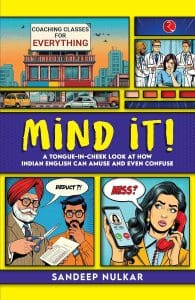
This excerpt from Sandeep Nulkar’s book ‘Mind it!: A Tongue-in-Cheek Look at How Indian English Can Amuse and Even Confuse’ has been published with permission from Rupa Publications India.