




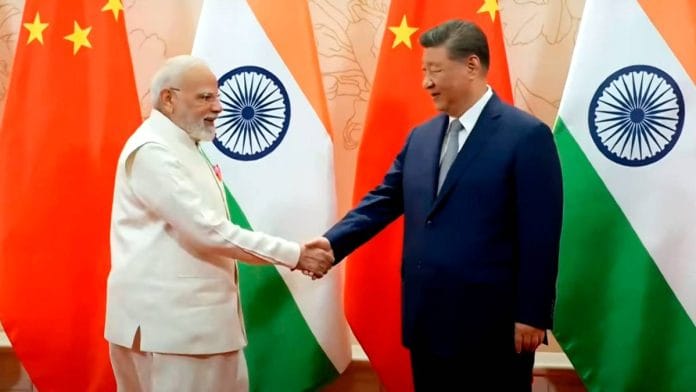

As Chinese President Xi Jinping prepares to land in New Delhi for the upcoming BRICS Summit 2026, New Delhi and Beijing appear to be engaged in intense bargaining over two questions: should the border determine the state of overall ties? And why has the economic relationship failed to take off, even two years since the October 2024 agreement?
The immediate backdrop is the tensions over the Taksing circle since July, alongside China’s growing interest in signalling a deeper economic recalibration of economic ties ahead of and during Xi’s visit.
There is a growing link being made between the prospect of Chinese investments flowing into India and a required shift in New Delhi’s position that the state of the border will determine the state of overall ties. China appears to be signalling that deeper economic cooperation will require assurances that border disputes will not, as they did after the June 2020 clash, put its companies’ investments and profits at risk.
This can be achieved when New Delhi agrees with Beijing that the state of the border will not affect overall ties. In some sense, this is China’s own version of strategic de-risking.
China’s current and modified posture of exercising a wide array of economic leverages vis-a-vis India allows Beijing to complement the carrot of promised manufacturing growth through greater cooperation with the stick of targeted export controls and other restrictions.
It is in this context that reports have emerged of plans for Xi to announce an investment package in New Delhi, along with discussions on SEZs, export-processing zones and a delegation of 400 officials.
The Taksing acid test
Despite the warning and temptation, New Delhi remains wary of de-linking the boundary issue from economic cooperation and overall ties. The reasonable concern is that such a step will only create more permissive conditions for grey zone operations and belligerence at the border.
Hence, the stand-off at Taksing had emerged (intentional or not) as an acid test of where relations stand at the present moment. Beijing may have expected that, out of regard for the upcoming BRICS summit and to secure a successful visit, New Delhi may find it convenient to ‘not sensationalise’ the incident at the border. Beijing’s preferred approach is for both sides to handle differences away from the public glare and more discreetly.
However, New Delhi took a somewhat different approach. The Ministry of External Affairs (MEA) spokesperson Randhir Jaiswal reiterated on 11 August, “We have also stated that the state of the border affairs will reflect on the state of our larger bilateral ties”. His Chinese counterpart, Guo Jiakun, used a more evasive stance, describing the situation as “generally stable” despite the tensions in the Taksing circle.
A few days earlier, the Ministry of Home Affairs (MHA) officially formalised standard names for 27 key locations and geographical features in Arunachal Pradesh. Notably, the list included Longju and Maja (relevant to the stand-off) as well as references to the past period of conflict from 1959-62. In a public-facing hat-tip, the MHA also added in a statement that the step is aimed at “facilitating accurate recognition and better awareness among the public at large”.
To be sure, India did demonstrate greater flexibility to ensure President Xi’s departure for New Delhi and to maintain stable ties more broadly. For instance, the Special Representatives (SR) talks skirted the issue of unresolved differences in the Western sector — something that was mentioned in last year’s joint statement. The public recrimination— albeit indirect — regarding the stand-off has now moved into the Corps-level military dialogue. Since the SR talks, two rounds of commander-level talks have already taken place in the Eastern sector.
Notably, in what can be seen as a concessionary gesture (and yet unofficial), former CDS General Anil Chauhan also said in a public event that “our relationship with China cannot be held hostage only to boundary issues”. In sum, however, India has maintained its bottom line regarding the state of the border’s effect on overall relations.
Also read: BRICS can widen India’s Arctic role. Though it can’t become another Arctic Council
It’s the economy, India
At this point, there is a need to take stock of the more persistent and deepening trend in India-China relations. This trend pertains to China’s downgraded assessment of India’s economic state of affairs and the almost impatient hope that India is starting to realise that China (capital, technology, exports, expertise) is indispensable to India’s manufacturing survival and growth story.
The predominant narrative since 2024 also notes and anticipates growing normalisation of economic ties between India and China. However, the optimistic sentiment is not necessarily reflected on the ground. India has been cautious (rightly or wrongly) in restoring normal economic ties, despite the trickle of news on flights, visas, and approvals of select investments and bids. The restraints and constraints on Chinese investments are still largely in place, leading the Chamber of Chinese Enterprises in India to describe the change as a “partial optimisation” rather than a “comprehensive liberalisation”.
Chinese officials, commentators and analysts have also increasingly coalesced toward a consistent message for India. The message is that India’s manufacturing push and China plus one strategy have failed, with India’s dependency on Chinese inputs not only continuing but also deepening. Hence, the advice is that India should calibrate by fundamentally reassessing the value of Chinese capital, expertise, and tech for growth, thereby unlocking great potential for manufacturing expansion.
If it could be paraphrased in non-diplomatese, it would read, “You need China economically. So, it’s prudent to give up futile resistance and instead strive towards benefitting from improved economic ties with China”.
This is a serious argument that will be maintained in the coming months and years—in rhetoric and actions.
With this, China increasingly hopes that India may, of its own accord, seek to de-link the border with overall ties so that it could gainfully advance its economic standing through a pragmatic ‘development-first’ approach.
Also read: India wants to lead BRICS without picking a side. Chinese think that won’t last
Is India confused about the economic relationship?
Within this same zeitgeist, India is increasingly portrayed as confused about what it wants from its economic relationship with China. However, that assumes Beijing itself has a clear and settled view of what it wants from India. That may not be the case.
Beijing is concerned and hyper-vigilant regarding the prospect of India taking advantage of China’s tech, capital, managerial expertise and labour to compete against in the longer run. India could then pose greater security and strategic challenges to China and from a position of greater relative strength.
This anxiety dovetails with Beijing’s trend to institute restrictions, licences and controls toward critical minerals, technologies and even off-shoring low-tech manufacturing. It greatly limits the attraction of the prospect that China is selling to India. The anxiety also underscores that in the present zeitgeist, economic cooperation and strategic calculations cannot be simply de-linked.
An illustrative example of this dilemma can be found in Chinese analyst (and member of China’s National Development and Reform Commission, or NDRC) Mao Keji’s response to a relatively innocuous and aspirational statement by External Affairs Minister (EAM) S Jaishankar. The foreign minister outlined India’s near-term intent of closer economic ties with China while retaining the long-term objective of kickstarting manufacturing-led growth and competing with all advanced economies, including China.
In response, Keji termed the statement “extremely revealing” and “very consequential”. He also wrote, “He explicitly and publicly confirmed that India’s long-term objective is to become a more self-reliant, industrialised and manufacturing-driven economy, one capable of outcompeting China”.
In one reading, the minister is engaging in the usual rationalising of a present policy (of greater engagement with China) to make it more palatable to both domestic and international audiences. A Chinese observer should have been, if anything, pleased by the direction of the immediate policy intent.
Instead, the minister’s statement was read in a way that prioritises long-term strategic anxieties over economic gains and that too on a basis that is not well-founded. How does China expect India to make industrial and manufacturing gains through virtuous interaction with China while not increasing its comprehensive power at the same time?
Both India and China, it appears, have reasons to be confused. The Chinese position urges India to de-prioritise present and active security concerns, while itself remaining deeply influenced by its own security concerns — albeit more long-term and passive. Clearly, better economic ties will require greater strategic mutual trust to be established first — even as it remains somewhat challenging.
India and China have strong reasons to seek positive ties and avoid conflict. The only question is how the two sides choose to reach such a state. As China’s confidence grows within the relationship based on growing economic and military asymmetry, there is growing risk of strategic overreach.
Sidharth Raimedhi is a Fellow at the Council for Strategic and Defense Research (CSDR), a New Delhi-based think tank. He tweets @SRaimedhi. Views are personal.
(Edited by Saptak Datta)