






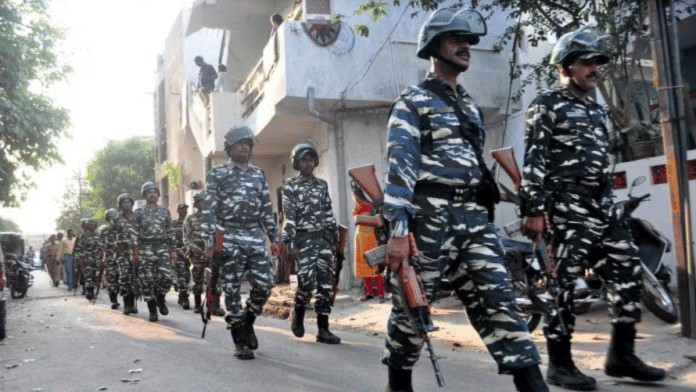


The Central Armed Police Forces (CAPF) General Administration Bill 2026 represents a pivotal step in fortifying India’s internal security framework while addressing long-standing grievances within the CAPFs. This legislation codifies essential service rules, ensures transparent promotions, fixed tenures, grievance mechanisms, and creates additional senior posts to alleviate career stagnation — all without dismantling the proven coordination mechanisms that have sustained effective operations against Naxalism, insurgency, and terrorism across the country.
Having spent over three decades in the trenches of India’s internal security — leading counter-insurgency operations in Odisha’s Maoist-affected districts, coordinating intelligence grids as IG (Intelligence), ADG, Operations and eventually, steering an entire state police machinery as Director General of Police — I have witnessed first-hand what happens when coordination fails, and the success when it is seamless. The ongoing debate around the CAPF’s new bill is not merely about pay scales or promotions. It is about whether we preserve the institutional steel frame that Sardar Vallabhbhai Patel forged in 1947 or allow career grievances to fracture the very architecture that has kept 1.4 billion citizens safe.
I stand firmly with the new bill. It delivers justice to the brave men and women of the CAPF while safeguarding the federal coordination mechanism that has repeatedly proved its worth in the fight against Naxalism, insurgency, and terrorism. Let me explain why, from the ground level where bullets fly and intelligence must travel faster than rumour.
The coordination imperative: Patel’s vision still holds
When Patel spoke in the Constituent Assembly about the All India Services, he was not being sentimental. He was solving an existential coordination problem. In a country as diverse as India, internal security cannot be a patchwork of insular forces answering only to their own hierarchies. Intelligence Bureau assessments must reach CRPF companies in Chhattisgarh or BSF battalions in Jammu within hours, not days. State police special branches must also share real-time inputs with CISF airport units. District Superintendents of Police (who are IPS) must exercise operational control when CAPFs are deployed to assist them.
My own career is a testament to this. When Naxalism was at its peak in Odisha, we could neutralise entire squads only because IPS officers rotated between state police, IB, CRPF, and intelligence roles. The same officer who once ran a district police station in Malkangiri could later serve in the IB’s Naxal desk and then command a CRPF sector. Those personal relationships — built over joint operations, shared hardships, and trust earned while working in seamless co-ordination — turned raw intelligence into surgical strikes. Remove IPS leadership from senior CAPF command, and you do not just lose one officer; you sever an entire trust network that no new organisational chart can ever hope to rebuild.
Also Read: Govt moves to formalise IPS dominance in top CAPF positions with new bill
Codification of rules: Ending the era of bureaucratic discretion
For decades, CAPF officers have lived with uncertainty. Service conditions, posting tenures, and promotion pathways depended on the whims of the Ministry of Home Affairs file-pushers. (ln CAPF, even after 20 years, one has not become a full-fledged Ccmmandant.) The 2026 bill ends this injustice once and for all. It codifies:
- Clear, statutory service rules that every jawan and officer can read and rely upon
- Fixed tenure norms for field and staff postings
- Transparent medical, family, and hardship allowances
- Grievance redressal mechanisms with statutory timelines
This is not cosmetic. When a CRPF company commander in Bastar knows his next promotion is governed by law rather than discretion, his focus shifts to the mission. He is no longer weighed down by his future uncertainty but motivated by its reliability. I have seen officers distracted by endless representations; this bill removes that distraction. Codification is welfare in its purest institutional form — it gives dignity through predictability.
Welfare that actually matters
The real genius of the 2026 bill lies in how it solves the career stagnation of CAPF Group-A officers without touching the federal security architecture. It creates hundreds of new senior posts at DIG, IG, and Additional DG levels. It also faithfully implements the Supreme Court’s Orderly Gradation and Seniority (OGAS) ruling. Furthermore, it removes pay disparities that had rankled for years.
These measures are not “appeasement”; they are justice long overdue for those who have laid down their lives in the same jungles and backwaters where I, too, once operated. Between 1998 and 2020, Odisha alone lost scores of CAPF personnel in joint operations with state police. Their families deserved better career prospects. The new bill delivers exactly that — without the dangerous shortcut demanded by some lobbies: Complete removal of any IPS leadership.
The Greyhounds–CoBRA lesson: Cross-pollination saves lives
Let me cite living proof. In 1989, IPS officer KS Vyas created the Greyhounds in Andhra Pradesh — an intelligence-driven, jungle-adapted force that became the gold standard of anti-Naxal warfare. The Naxals feared it so much that they assassinated Vyas in 1993. Yet, the doctrine he built lived on. Years later, another IPS officer who had served with the Greyhounds carried the same template into the CRPF and gave brith to the CoBRA (Commando Battalion for Resolute Action). Today, CoBRA is the CRPF’s most effective striking arm.
Crucially and thankfully, the CAPF does not operate in isolation. Under the law, they assist state police under the operational control of the district superintendent of police, who are trained in the IPS. In Odisha, every major Naxal encounter I oversaw succeeded precisely because the CRPF and state police worked under a well coordinated and unified command chain knitted together by IPS officers who had served in both worlds. Insularity would have meant delayed intelligence sharing and fragmented response — the exact failures we cannot afford.
The economic fallacy we must reject
The anti-IPS campaign frames the issue as “dignity versus discrimination.” It is nothing of the sort. It is a classic case of concentrated benefits (faster promotions for a few) versus diffuse but catastrophic costs (weakened national security for 1.4 billion people). Institutional economics teaches us that the most dangerous decisions are those whose costs remain invisible until the next crisis explodes.
The CAPF bill 2026 is a mature, balanced response: it fixes the distributional problem (career stagnation) while preserving the coordination mechanism that Patel had designed. Demolishing 75 years of institutional memory to solve a promotion chart is like burning the bridge because the toll booth needs painting.
Also Read: Cleared UPSC CAPF exam but no force allocation—459 candidates waiting endlessly
A veteran’s final word
I have buried too many young CAPF jawans and IPS colleagues in the red corridor. Their sacrifice demands two things from us — genuine welfare and unshakeable institutional strength. The Bill gives both.
Support the CAPF General Administration Bill 2026.
Codify the rules.
Deliver the welfare.
But above all — preserve the unifying leadership that turns five separate forces into one unbreakable shield for the Republic.
Sardar Patel, the architect of a modern and unified India, envisioned the All India Services — such as the IAS and IPS and later the Indian Forest Services (IFS) — as the indispensable “steel frame” of the nation. In his historic addresses, including to the Constituent Assembly and the first batch of the IAS probationers in 1947, Patel emphasised that these services were crucial for national integration. He argued that without a unified, disciplined, and impartial All India Service, the country would risk fragmentation, as provincial loyalties would undermine central coordination in a federal setup and national cohesion. Patel saw these services as tools to bind the country’s vast diversity under a common administrative and security architecture, ensuring uniform standards, loyalty to the nation, and seamless collaboration across states and central forces. He famously described them as essential to prevent administrative collapse and to foster true national service over parochial interests.
The CAPF General Administration Bill 2026 embodies and advances this very vision of Sardar Vallabhbhai Patel. By preserving IPS leadership in key senior roles within CAPFs — while simultaneously delivering justice through codified rules, expanded promotions via OGAS implementation, and new posts for CAPF cadre officers —the Bill upholds the unifying, coordinating role of the All India Services. It prevents insularity that could fracture intelligence sharing, operational command, and trust networks built across decades of joint operations. In doing so, it safeguards the federal structure Patel designed, where central forces assist states under unified leadership, turning diverse elements into a cohesive shield for the Republic.
This balanced approach, welfare with institutional strength, honours Patel’s foresight that India’s security and unity depend on mechanisms that transcend narrow interests. That is precisely why I strongly support this Bill: it codifies fairness for our brave CAPF personnel while reinforcing the All India Services’ role in national integration, ensuring that the steel frame Patel forged continues to protect 1.4 billion citizens in an era of evolving threats. Sardar Patel, the first Deputy Prime Minister and Home Minister of India, believed in a strong, dedicated civil service, envisioned an AIS — comprising the IAS, IPS and IFS — as the steel frame of the country’s administrative machinery. His vision was to create a merit-based, neutral bureaucracy that would ensure national unity, ensure efficiency in a Federal system where seamless coordination is a must as a stabilising force in a diverse but united India.
Sanjeev Marik is a former Odisha DGP, ex-IG Intelligence, and before that as DIG in three ranges infested with left-wing extremism. He tweets @SanjeevMarik. Views are personal.
(Edited by Insha Jalil Waziri)
Very unfortunate that IPS officers are so narrow minded.
Why not stop UPSC selection of CAPF officers & IPS must start careers as Asst commandants & move in force.
Nothing can be more far from truth than the views of the writer.
First and foremost this write up seems to be a deliberate attempt to question and belittle the judgment of the Apex court of land, the supreme court of India, which is a constitutional body.
Whether the writer mean to say that the learned bench of Honb’le Supreme court was not capable of understanding the entire issue before it and erred twice in pronouncing judgement in favour of CAPFs Cadre officers ? Is it ?
To make things clear all the flimsy grounds debated by writer have been repeatedly presented by govt and IPS association before Honb’le Supreme court and after careful examination of all facts and aspects as well as argument of both sides the Apex court of the nation the Honb’le Supreme Court bench repeatedly decided in the favour of CAPFs cadre officers, first on May 2025 by a bench comprising Honb’le Justice Abhay S Oka and Justice Ujjwal Bhuiyan and again on Oct 2025 by rejecting govt’s review petition by a bench Presided by non other than Honb’le present Chief Justice of India, Justice Suryakant.
Moreover the judgement no where says that completely remove IPS from CAPFs, neither the CAPF officers says that. It only directs gradual time bound progressive reduction of IPS up to the rank of IG, so that cadre officers having more than 3 decades of dedicated service could get promotion. What’s wrong in that.
Let the rank upto IG with CAPF cadre officers and IPS come on above ranks as usual. Isn’t it a fair deal, a balanced approach. I sincerely wish the writer to correct me if m wrong.
Moreover, the writer either purposely hide the fact that the bill has no clear provisions or clarity that how the govt is planning to remove stagnation in CAPFs, where officers appointed through UPSC are awaiting their first promotion for more than 15 years of selfless service and even after sacrificing their life and limbs, they are deprived by their own government from lawful promotion and financial benefits.
Their families and children are deprived of basic facilities of schooling and medical care as they are relentlessly serving in hinterland of Maoists deep inside jungles of Chhattisgarh and Jammu & Kashmir. Who will take care of them, their own soldiers and their families.
The writer just narrated a fabricated story of rosy future without any firm base or documented proof.
The sole purpose of the bill is to overturn a judicial pronouncement of Honb’le Supreme court which is gross violation of the division of powers as enshrined in our constitution and a deliberate attempt to crush rights of more than 13000 CAPFs officers who relentlessly sacrificed their everything in fields, just to safeguard a handful of IPS officers benefit.
The govt who is changing names of roads and building to erase colonial baggage failed to come out of the colonial mindset of elite ruling class (IPS) born to rule vs Son of soil (CAPFs cadre officers) who sacrifice their youth to grow this force.
If govt is so sincere as the writer says and if the bill is so beneficial for CAPFs officers and so crucial for national security then what’s the hurry of bringing it without wider consultation . Why the govt is hesitant to refer the bill to the JPC/Standing committe for all party discussion wider consultation with all stake holders to come up with a balanced and transparent bill after clearly mentioning all provisions for clear understanding of the entire nation.
Last but not least, a humble request to writer , Sir u may have ur loyalty and inclination towards a particular service, IPS, for being a former member of the service , you may personally consider CAPFs officers inferior to your royal blood , but sir at least for once be honest to your conscience and think what’s the brutal truth.
The nation know that the entire police system collapsed under the able command of unmighty IPS, even the naxalism, terrorism in states are/were due to failure of ur leadership. The state police system led by you since independence is so incapable and biased that even public judiciary, politicians and Election commision has no faith on your and every time they need someone reliable they look and ask for CAPFs.
Sire, when You failed everywhere then CAPFs cleared the mess created by you incabale pen pushing babu mentality gentlemen(exception do exists), at cost of their own sacrifices and still you have the audacity to question the capability of CAPFs officers. Shame…Jai Hind 🇮🇳
Sir, if you talk about cream and superiority and talent assessed merely from cracking exam, then I guess, even IPS should be made to lead upto IGP level as policy taking and decision making IAS would be the right choice as DGs and ADGs.
You don’t know the full form of OGAS ; it is *Organised Group A Service* and not orderly Gradation and Seniority.
The article is totally garbage and away from facts. You are just trying to shield the interest of your IPS brethren. Whereas the bill (under the pressure of IPS) is intended to nullify the Supreme court judgement which stated that CAPF cadre officers are Organised Group A Service and all consequential benefits should be given to them including abolition of IPS deputation till IG level in a gradual manner.
Rebuttal of article of Sanjeev Marik
CAPF Bill 2026 is being projected as a reform that strengthens Internal Security while addressing grievances of CAPFs.
The argument in favour of the Bill rests on the idea of preserving IPS leadership within CAPFs for maintaining coordination and national security. This claim which has been repeatedly asserted does not withstand scrutiny.
Coordination is not monopoly of IPS. If coordination between forces needs a single IPS cadre, that’s not strength, instead it is systemic weakness of Govt. It is a misleading narrative by Sanjeev Marik.
Mr Marik! The professional forces coordinate through institution/systems, not badges/cadres.Your suggestion that coordination would collapse without IPS dominance is to underestimate both the maturity of CAPF and strength of Govt where two institutions cannot coordinate without IPS.
Your invocation of Sardar Patel to justify this arrangement further weakens the argument. His vision of the AIS was rooted in national integration, not in the permanent subordination of one cadre by another.
In fact, most of the forces were not born when steel frame was forged by Sardar Patel. The relevance of steel frame with CAPFs itself is not understandable. The invocation of the steel frame in the context of CAPFs is conceptually misplaced as it was intended to describe a unifying civil administrative structure and not to justify hierarchical control over forces with distinct operational mandates of securing border, CI etc.
Mr. Marik! the Paramilitary forces like Assam Rifles, Rashtriya Rifles, Coast Guard continue to coordinate successfully with states without IPS elements in these forces. You have advanced a shrewd narrative that masks the preservation of IPS dominance in CAPFs and conveniently sidestepped a discussion that if IPS led coordination is so indispensable why does it often falter when law and order fails in states. In practice, IPS officers, on deputation in CAPFs,rely on CAPF cadre officers and personnel to initiate, execute and sustain coordination, while IPS leadership often occupies only credit appropriating role. This exposes and bares the gap between the narrative of Mr. Marak regarding indispensability of IPS and the reality of execution on ground.
CAPFs are battle hardened forces with decades of operational experience across diverse theatres, majorly where the IPS led Police failed, ranging from militancy to insurgency to law and order to border. By not recognizing the sacrifices of CAPFs, the Bill refuses to address the core grievance of CAPF officers of establishing the recognition of status of OGAS.
Mr Sanjeev!The officers who spend their entire careers within a force are better positioned to understand operational challenges against short term deputationist(s) who severely lack operational understanding.
Bill has deeper consequences than mere career dissatisfaction. It will erode the morale and professional commitment of the CAPFs.
You claim that the defence of IPS leadership relies on trust networks built through shared service and inter cadre movement. I want to make it clear that the national security cannot depend on informal relations or personal familiarity. It must be based on institutional mechanisms that function regardless of cadres/badges.
Your claim that federalism depends on IPS deputation in CAPFs is fundamentally flawed by the reason that other forces(Assam Rifles, Coast Guard, Rashtriya Rifles) or other organizations without IPS would be incapable of upholding federalism. Mr Marik, federalism is preserved through constitutional structures and institutional cooperation, not through the dominance or coordination of a particular cadre over other.
The claim that IPS leadership in CAPFs strengthens national security is impossible to understand or sustain when majority of these officers (IPS) lack domain expertise, whereas CAPF cadre officers possess fielddriven operational experience. Thus your assumption (and also of Govt) of superior contribution by IPS officers is logically untenable.
The introduction of this Bill is an exercise in optics and eye wash that projects concern for welfare and structural reform while leaving the underlying inequities, discrimination(between IPS and CAPF Cadre) unaddressed.
The implementation of the Hon’ble Supreme Court’s judgment would have adequately addressed the issues of welfare and concerns of institutional reform of CAPFs. The decision to bypass it by way of legislation raises questions about the intent and sincerity of the Govt.
By not implementing the orders of Honourable Court, the CAPF Bill 2026 will leave a deeper rift between IPS and CAPF. And until the order of Hon’ble court is implemented, the promise of genuine institutional strength will remain unfulfilled.
Indian police system is one of the most corrupt and extractive institution. IPS officers who lead at district level are leaders of this corrupt system.The only purpose why IPS officer are holding CAPF is because they get to hold large budget and administration.
Bureaucracy is most difficult thing to destroy once it establishes it self.
How many IPS officer have laid their lives in combat operation? If this number is less than propotion to Indian Army officer then IPS dont deserve to lead.
This bill would be a threat to INDIA’S INTERNAL SECURITY. Stagnation in promotion would only reduce the effectiveness of officers.
Young officers now know they can’t climb the ladder, no use of hardworking since they have to retire at the rank of commandant. They know that their boss would be someone who haven’t seen combat
The author is trying to blur the lines between political and burecratic control being two different things. IPS officers hailed as torch bearer of national security while rest are always trying to be subversive. IPS officers like K P S gill, Mr Vijay Kumar and Ashok patel Fmr IG BSF were legendary police officers. however The police and burecrats failed to realize that CAPF mandates a military style leadership with civil fusion at certain junctures. A soldier fights for his paltan his CO who leads from the front. The data for KIA of CAPF officers is disproportionately high than any other police force. This stagnation is a national security crisis cracks are being seen as fraticides, mental health issues, suicides, increased VRS. The most funny part is that IPS officers who fail to manage state police machinery claim to provide strategic leadership to CAPF. Their short tenure in CAPF has and resultant myopic policies which have degraded the force. Thanks to cadre officers we still have some momentum left.
This former IPS officer has written 3 articles over this bill to justify the failed leadership of IPS over CAPF.
CAPF GENERAL ADMINISTRATION BILL 2026, once passed will only demoralise more than 12000 cadre officers. All their hopes will be shattered,risking INDIA’S INTERNAL SECURITY. Leadership in combat isn’t defined by a one-time exam (UPSC CSE), but by years of field experience