






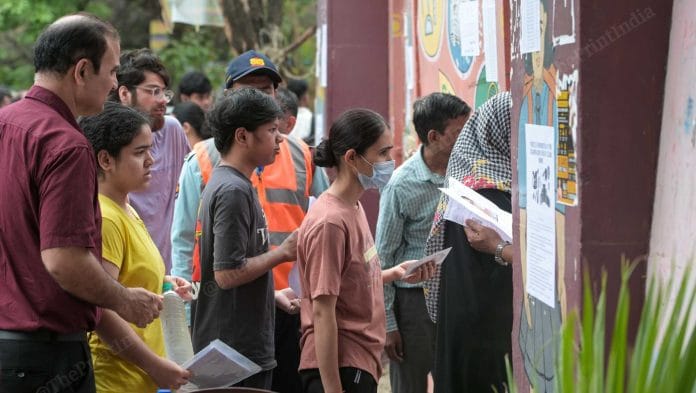

By most non-political assessments, the 21 June National Eligibility-cum-Entrance Test (NEET), which is the entry point for a course in medicine, went off more or less without incident. Sure, some candidates were denied entry as they arrived late, one candidate was shown to have registered from Abu Dhabi when he wanted to write the exam in India, some others complained (after taking the exam) how hard some subjects were, but the exam went off without a major snafu.
This “success” should worry us more than the failure of the previous one in May, when question-papers were leaked and the whole exercise had to be cancelled, leading to major tensions for the student community. Too many of our successes depend on a multi-stakeholder national effort, with even the armed forces being conscripted to pitch in this time, when such things ought to happen in the natural course through inherent institutional strengths.
Why should an entrance exam take Prime Ministerial supervision to work flawlessly? Why does NEET need a social media site to be banned temporarily, high-level intelligence monitoring, and deep coordination between the ministries of railways, defence, home, health and information technology, to work without a hitch? If a thing can succeed only when we are making a war-effort, how many important things can we really achieve as a nation?
Garbage will be littered everywhere till a major city is hit by the plague. Even then other cities will not take the cue and start moving their garbage till catastrophe strikes them. Defence procurement will not speed up unless the top political executive steps in and bashes heads together. Municipalities will not act on the stray dogs menace till the Supreme Court orders it, and even then things won’t move till some official somewhere is threatened with contempt and hauled up before courts. Banks will not clean up their balance-sheets and report bad loans till a law empowers the Reserve Bank to force them to do so.
India aims to be a developed country by 2047, but development is not just about reaching some GDP or per capita income goal. It is also about how we get there, and in what state.
A country that does not build institutions and processes and self-corrective mechanisms by regularly reviewing things already assumed to be working cannot easily call itself developed when it can work only when it is at the brink of a precipice. No country can work in mission mode all the time, and it is the daily processes of improving things that will get us to Viksit Bharat.
R Jagannathan is an editor and the former editorial director at Swarajya magazine. He tweets @TheJaggi. Views are personal.
This article has been republished from the author’s personal blog. Read the original article here.
Because citizens are by and large not worried about any issues which does not affect them and the change in society. They are self-centric only interested in their benefits by hook or crook.
Same script everywhere. A recruitment drive needs the PM physically handing over letters before anyone believes the jobs are real. Vande Bharat trains need him flagging them off, line after line, as if Railways can’t be trusted to commission its own rolling stock. None of this should require someone at the very top to personally intervene every single time, but apparently it does.
And there’s a reason it keeps happening. Indian bureaucracy doesn’t trust its own discretion… it treats it as a corruption risk to be engineered out. So every decision of any consequence gets routed upward, and “getting work done” becomes synonymous with someone senior issuing the order. That’s not a side effect, it’s the operating culture. Officers at every level will tell you they’re just “post officers” passing on commands from above. The PM showing up to flag a train or hand out a letter isn’t a quirk… it’s that same command-and-control reflex, just visible at the top instead of buried in a file somewhere.
That’s the tell. Strength looks like things running on their own. What we have is the opposite… a system that stalls the moment the spotlight moves elsewhere, because nobody below the top is trusted or empowered to keep it running. Calling that a “Vishwaguru” model isn’t aspiration, it’s a mismatch between the story being sold and the machinery actually doing the work.
For once, I completely agree with this author.